Leonardo Fioravanti
Leonardo Fioravanti is an Italian automotive designer renowned for his work at Pininfarina, where he contributed to the styling of landmark Ferrari road cars.
Explore record ↗
2009
THE VEHICLE AT A GLANCE
THE PEOPLE BEHIND THE CAR
Leonardo Fioravanti is an Italian automotive designer renowned for his work at Pininfarina, where he contributed to the styling of landmark Ferrari road cars.
Explore record ↗Fioravanti is an Italian automotive design and engineering studio that expanded from architectural work into transport and industrial design in the early 1990s.
Explore record ↗01 / THE STORY
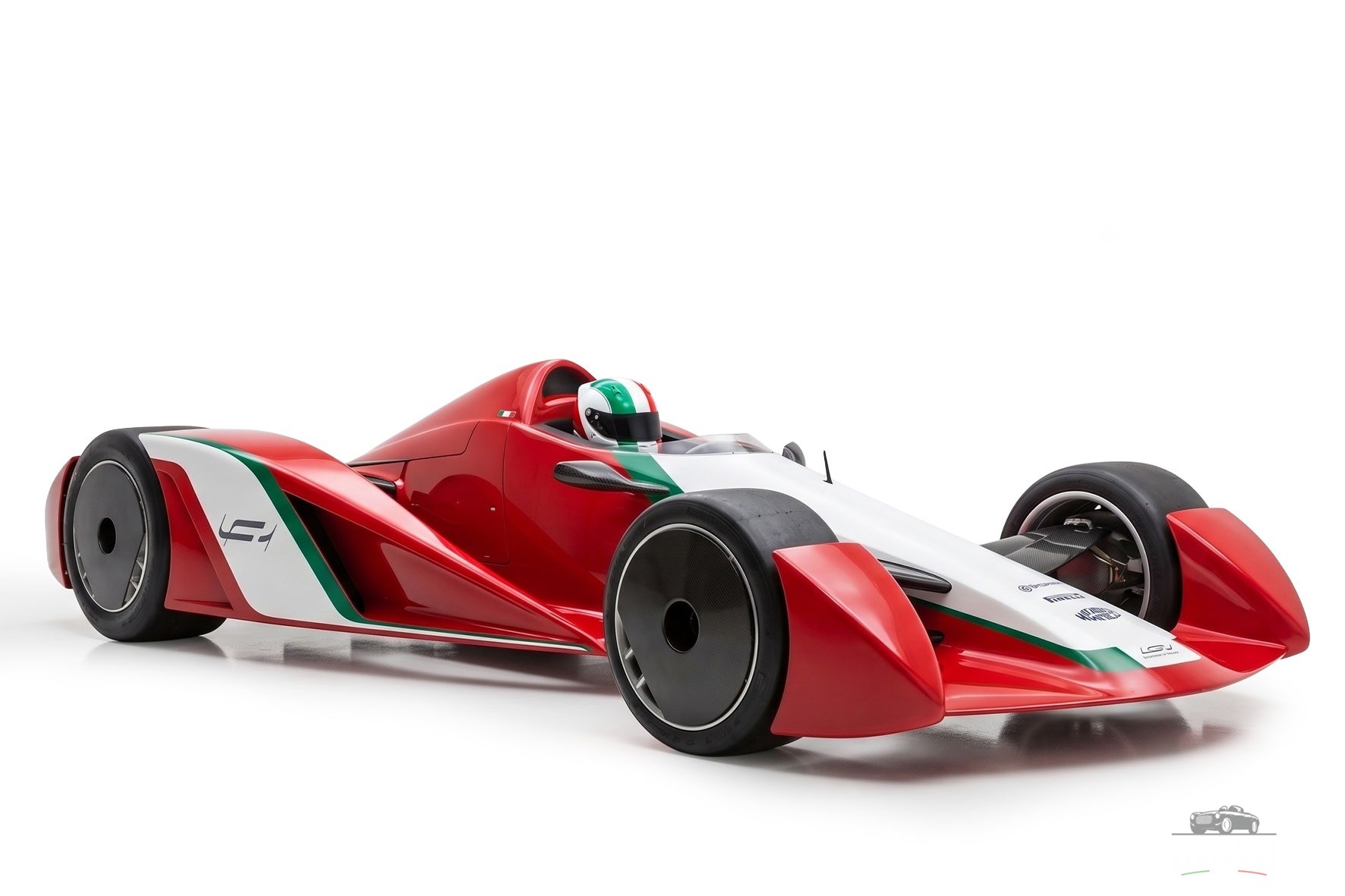
The Fioravanti LF1 is a study and development prototype intended to bring together the technologies of three Italian industrial groups that are leaders in their fields and operate in the field of major competitions, in order to offer them in an exhibition car made in the form of a concept car by the Italian design house Fioravanti, which also applies its aerodynamic and structural knowledge. The three companies involved in the research and development of the solutions are Pirelli, Magneti Marelli and Brembo. It was unveiled at the 2009 Geneva Motor Show and was an atypical study for the well-known Turin-based atelier, in that it is a study aimed at the world of Formula 1. It is a model that marries technical features typical of the single-seaters used in that championship, such as the 1.8 Turbo engine and the KERS system for recovering kinetic energy, to others that are completely at odds with the specifications of the top car series, such as the 18-inch wheels. Among the latter solutions, however, the lack of a rear wing should definitely be mentioned, which is the real reason behind the LF1’s creation. In fact, the aim of patron Leonardo Fioravanti is to eliminate the so-called wake effect during competitions, namely that effect whereby the wing of a single-seater usually tends to generate such aerodynamic turbulence behind it that it disturbs the following car, even if it is still at a certain distance. This phenomenon, among other things, makes even overtaking maneuvers difficult. The Fioravanti LF1 is also characterized by an equally breaking body compared to that of the normal Formula 1 single-seaters: in fact, it has much more aerodynamic characteristics, a fact that allows it to better cleave the air during the race and to move faster, but above all to generate a marked ground effect so as to compensate for that which would normally be had with a wing and which in this case is not possible to have, given the lack of the large aerodynamic appendage. Moreover, the ground effect is also guaranteed by the fact that the car is equipped with a floor that is itself atypical, meaning that it is not flat as in the usual race cars, but has a “wave-like” pattern that guarantees, according to Fioravanti, exceptional grip on the ground. The Fioravanti LF1 is then equipped with a front spoiler that can be adjusted by the driver, as are the rear flaps, while the suspension features fairing arms, which is another aspect aimed at optimizing aerodynamics. The wheels are also partially fairing, again for aerodynamic needs.
02 / TECHNICAL IDENTITY
03 / DESIGN, BODY & SUPPLIERS
Coachbuilder / Design studio
Fioravanti is an Italian automotive design and engineering studio that expanded from architectural work into transport and industrial design in the early 1990s.
Explore record ↗Designer
Leonardo Fioravanti is an Italian automotive designer renowned for his work at Pininfarina, where he contributed to the styling of landmark Ferrari road cars.
Explore record ↗04 / CHRONOLOGY
07 / GALLERY

THE CONVERSATION
Comments 0