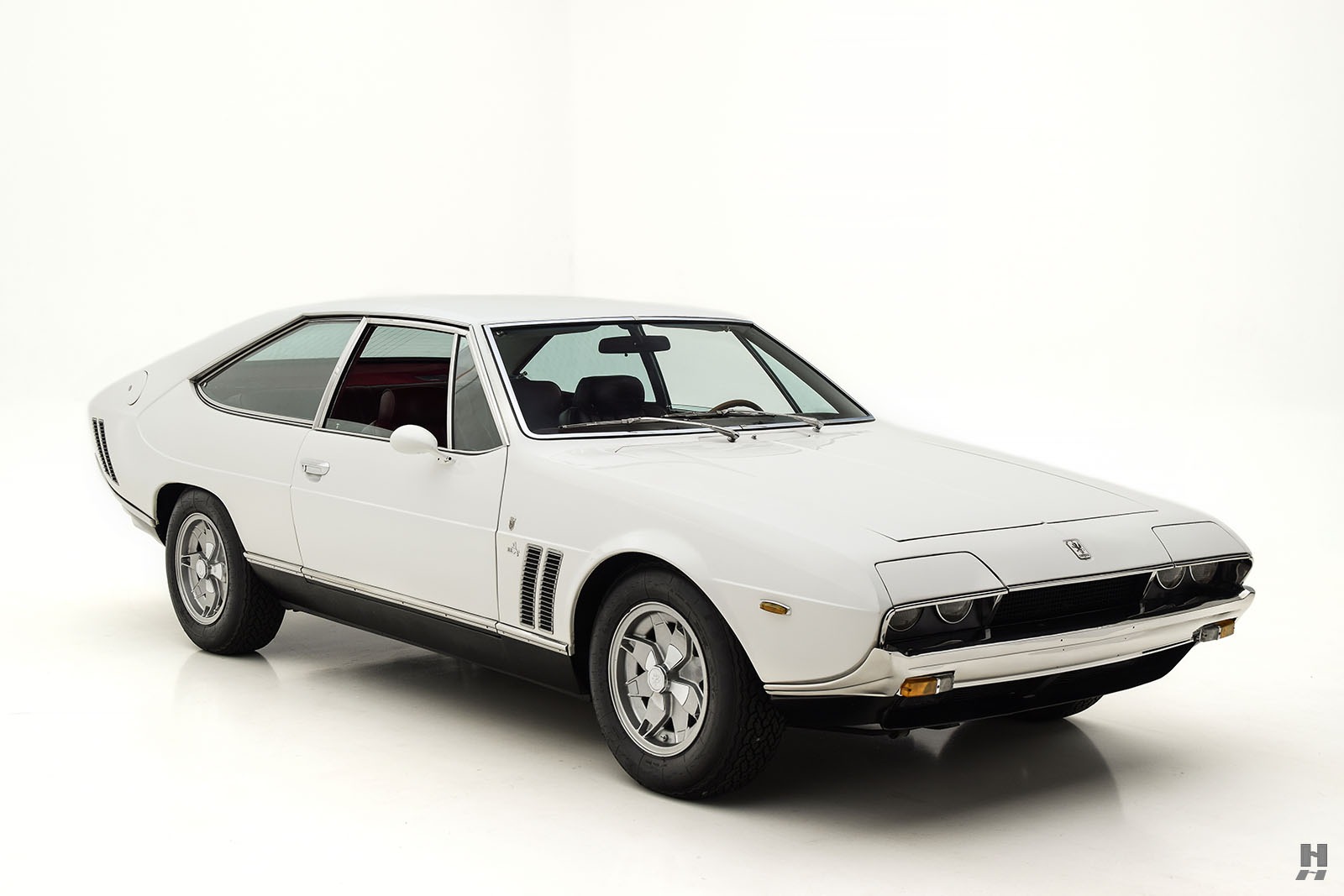
The Iso Rivolta Lele emerged in 1969 as the successor to the Iso Rivolta GT 300/340, extending the Italian manufacturer’s approach to the grand touring car: Italian body design combined with powerful American V8 mechanical components. Styled by Marcello Gandini at Bertone, the new 2+2 coupé brought a more angular and contemporary appearance to the range. Its public introduction at the New York Auto Show in April 1969 marked the beginning of a production programme that continued until Iso ceased automobile manufacture in 1974. The Lele occupied a position between the more overtly sporting Grifo and the larger Fidia, while retaining the emphasis on comfortable high-speed touring that had defined Iso’s earlier cars.
Under the bodywork, the Lele evolved from the established Iso Rivolta GT architecture. The layout combined a longitudinal front-mounted V8 with rear-wheel drive, independent front suspension and a De Dion rear axle. Early cars used Chevrolet small-block engines, with different displacements and power ratings depending on the version and year. In 1972 Iso began adopting the Ford 351 Cleveland V8, creating the later IR6 series; the change required corresponding engineering adaptations. Manual and automatic transmissions were offered, but their availability varied across the Chevrolet and Ford-powered versions. Consequently, engine capacity, power output, gearbox and even some published dimensions should be attached to the relevant variant or documented chassis rather than treated as specifications shared by every Lele.
The later Lele Sport and Marlboro-related cars reflected Iso’s attempt to make the model more overtly sporting. The association with Philip Morris and the Iso-Marlboro Formula One programme led to specially prepared cars with changes to equipment, weight and engine specification, distinct from the ordinary grand tourers. The official marque history describes two special promotional cars and a small series of Lele Sport derivatives. The Lele was never built in large numbers: Iso’s own history describes fewer than 300 examples, although published totals vary, and the precise production breakdown requires comparison with a factory chassis ledger.
Surviving cars demonstrate the importance of preserving individual identities within the broader model history. For example, RM Sotheby’s recorded the sale of 1974 chassis 500236/D in 2024, while Aguttes offered 1973 chassis 50.0145 as a restoration project in 2025. The two auction records document different cars, configurations and conditions, not a single representative market value for the entire family. The Lele is best understood alongside its Iso Rivolta GT predecessor and the contemporary Iso Rivolta Fidia, which together illustrate the marque’s unusual position between Italian coachbuilding and transatlantic engineering.



THE CONVERSATION
Comments 0