Franco Scaglione
Franco Scaglione was an Italian automotive designer celebrated for his aerodynamic bodywork, notably the Alfa Romeo BAT prototypes at Bertone and the Alfa Romeo 33 Stradale.
Explore record ↗
1963Coachwork by Sargiotto
THE VEHICLE AT A GLANCE
THE PEOPLE BEHIND THE CAR
Franco Scaglione was an Italian automotive designer celebrated for his aerodynamic bodywork, notably the Alfa Romeo BAT prototypes at Bertone and the Alfa Romeo 33 Stradale.
Explore record ↗Giorgio Sargiotto established a specialist coachbuilding business after his Monterosa period, creating small-series bodies and conversions on Fiat, Lancia and other Italian chassis.
Explore record ↗01 / THE STORY
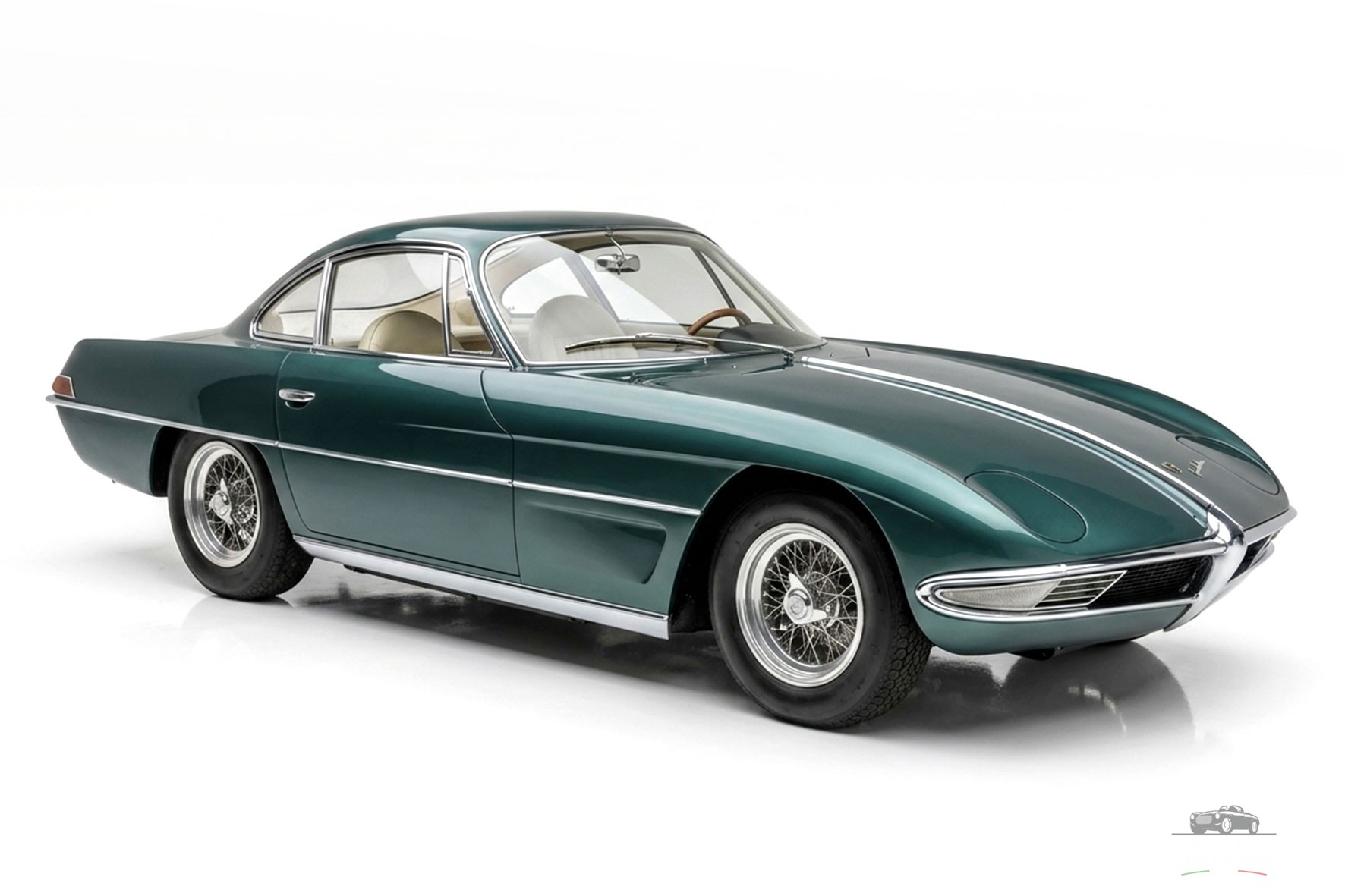
The Lamborghini 350 GTV ‘s name signified the 3.5 L displacement of the engine, the “GT” for grand tourer and the “V” for the Italian word “Veloce” (meaning “fast”). The 350 GTV body was designed by Franco Scaglione and built by Carrozzeria Sargiotto in Turin. Ferruccio Lamborghini’s opinion had a significant amount of influence on the design. He reportedly requested styling echoing the Aston Martin DB4’s tapering rear bodywork and the sleek front of the Jaguar E-type. The 350 GTV had many styling details that were unusual at the time of its introduction, including hidden headlamps and six exhaust tailpipes (three on each side of the car’s rear). The body was constructed of aluminum and steel. As workers at Sargiotto were primarily skilled in building molds for plastic products, the 350 GTV’s body had numerous fit and finish issues. Initially, Bizzarrini designed a racing-style tubular spaceframe chassis for the 350 GTV. Giorgio Neri and Luciano Bonacini built the tube frame chassis in Modena. This design was later reworked by Dallara into a more conventional, heavier design constructed of mostly square and rectangular section tubing that would be used in the production Lamborghini 350 GTV. Ferruccio Lamborghini commissioned Giotto Bizzarrini to develop the 350 GTV engine. This was the first iteration of the Lamborghini V12 series of engines, which would power future Lamborghini models up through the end of Murciélago production in 2010. Bizzarrini developed a 3.5 litre racing-specification V12 engine, with an output of 255 kW (347 PS; 342 bhp) at 8,000 rpm, and torque of 326 N?m (240 lbf?ft), using the DIN measurement standard. This design was derived from Bizzarrini’s plan for a 1.5 litre Formula One racing engine. Top speed was claimed by the factory to be 280 kilometres per hour (170 mph), although this was an estimate as the car was never driven or tested by the factory. This engine had a compression ratio of 9.5:1 and relatively aggressive valve timing compared to later versions of the Lamborghini V12. The higher redline, compression ratio and timing made the 350 GTV’s engine more suitable for competition use rather than as a comfortable road car. The Lamborghini 350 GTV engine was also equipped with six downdraft Weber carburetors and a dry sump lubrication system. The transmission was a 5 speed manual made by ZF. Power was directed to the rear wheels via a Salisbury self-locking differential. The independent suspension used triangular wishbones on the front and trapezoidal wishbones on the rear, with telescopic shock absorbers and coil springs at all four corners. Servo-controlled disc brakes were equipped on all four wheels. The Borrani center locking wire wheels were fitted with Pirelli Cinturato HS tires. The 350 GTV was never a complete, driveable car during its time as a Lamborghini prototype. During assembly, the workforce discovered that the body panels would not fit around the engine. Since he had no further plans for the Lamborghini 350 GTV beyond being a show car, Mr. Lamborghini had the engine bay ballasted with bricks and kept the bonnet shut throughout the Turin Auto Show. The incomplete show car also lacked brake calipers, foot pedals and windshield wipers.
02 / TECHNICAL IDENTITY
Become a Pro member to see the full details in this section.
Membership is not available yet.
View membership options03 / DESIGN, BODY & SUPPLIERS
Coachbuilder / Design studio
Giorgio Sargiotto established a specialist coachbuilding business after his Monterosa period, creating small-series bodies and conversions on Fiat, Lancia and other Italian chassis.
Explore record ↗Attributed designer
Franco Scaglione was an Italian automotive designer celebrated for his aerodynamic bodywork, notably the Alfa Romeo BAT prototypes at Bertone and the Alfa Romeo 33 Stradale.
Explore record ↗04 / CHRONOLOGY
05 / PEOPLE, COLLECTIONS & MUSEUMS
07 / CHASSIS REGISTER
08 / GALLERY
THE CONVERSATION
Comments 0