Federico Formenti
Federico Formenti was an Italian automotive stylist at Touring and Alfa Romeo, noted for his contributions to post-war coachbuilt grand tourers.
Explore record ↗
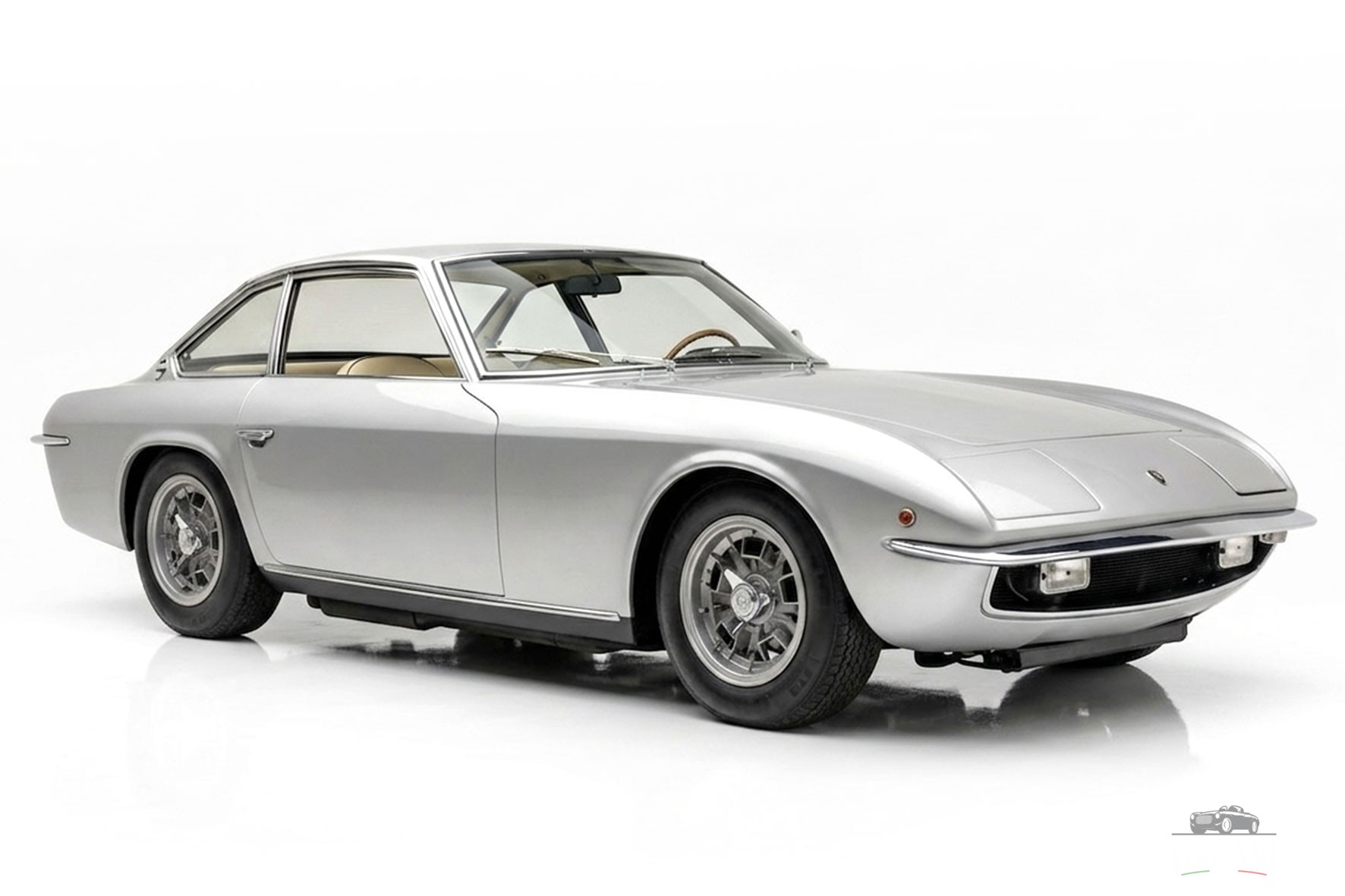
1968Coachwork by Marazzi
THE VEHICLE AT A GLANCE
THE PEOPLE BEHIND THE CAR
Federico Formenti was an Italian automotive stylist at Touring and Alfa Romeo, noted for his contributions to post-war coachbuilt grand tourers.
Explore record ↗Founded by Carlo Marazzi and former Touring employees, Carrozzeria Marazzi assembled Lamborghini grand tourers and produced bodies for specialist Italian sports cars.
Explore record ↗01 / THE STORY
The Lamborghini Islero debuted at the 1968 Geneva Auto Show. The Islero was named after a Miura bull that killed matador Manuel Rodriguez “Manolete” on August 28, 1947 (Lamborghini also produced a car named the Miura, from 1966 to 1973). Since Carrozzeria Touring, the company that designed Lamborghini’s body, was bankrupt, Carrozzeria Marazzi was the next logical choice as it was funded by Carlo Marazzi, an old employee of Touring, with sons Mario and Serafino. Islero was essentially a rebodied Lamborghini 400GT, but the track was altered to allow for wider tires and while the Islero’s body suffered from a lack of proper fit between the panels, its good outward visibility, roomier interior, and much improved soundproofing made it an improvement over previous models. It had a 325 bhp (242 kW; 330 PS) 4.0 L (3929 cc) V12 engine, a five-speed transmission, fully independent suspension, and disc brakes. Its top speed was rated at 154 mph (248 km/h) and acceleration from 0 to 60 mph (97 km/h) took 6.4 seconds. 125 Lamborghini Isleros were built. When leaving the factory the Lamborghini Islero originally fitted Pirelli Cinturato 205VR15 tyres (CN72). An updated Islero, dubbed the Islero S, was released in 1969. The engine in this model was tuned to 350 bhp (261 kW; 355 PS), but the torque remained the same. There were quite a few styling changes, including brightwork blind slots on the front fenders, an enlarged hood scoop (which supplied air to the interior of the car, not the engine), slightly flared fenders, tinted windows, round side-marker lights (instead of teardrops on the original), and a fixed section in the door windows. Various other changes included larger brake discs, revised rear suspension and revamped dashboard and interior. The top speed of the S improved to 161 mph (259 km/h) and acceleration from 0 to 60 mph (97 km/h) in 6.2 seconds. 100 examples of the Islero S were built, bringing the production total of the Islero nameplate to 225 cars. Ferruccio Lamborghini himself drove an Islero during that era as did his brother Edmondo. The Lamborghini Islero is also famous for its appearance in the Roger Moore thriller The Man Who Haunted Himself and in Italian “Vedo nudo“.
02 / TECHNICAL IDENTITY
03 / DESIGN, BODY & SUPPLIERS
Coachbuilder / Design studio
Founded by Carlo Marazzi and former Touring employees, Carrozzeria Marazzi assembled Lamborghini grand tourers and produced bodies for specialist Italian sports cars.
Explore record ↗Designer
Federico Formenti was an Italian automotive stylist at Touring and Alfa Romeo, noted for his contributions to post-war coachbuilt grand tourers.
Explore record ↗04 / CHRONOLOGY
05 / PEOPLE, COLLECTIONS & MUSEUMS
08 / GALLERY

THE CONVERSATION
Comments 0