From the Turin debut to the production Urraco
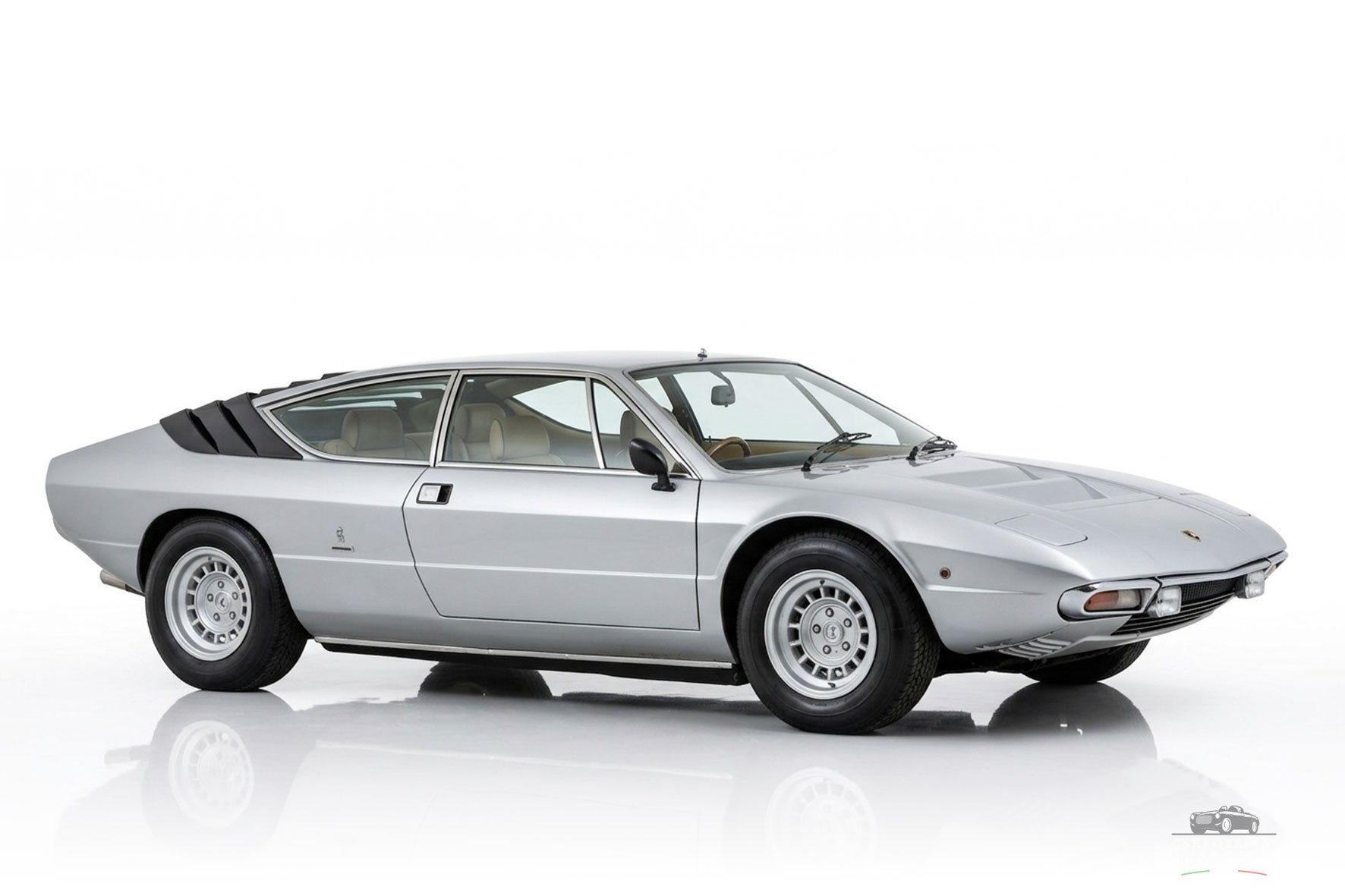
Unveiled at the Turin Motor Show in October 1970, the Lamborghini Urraco marked an important departure for the manufacturer at Sant’Agata Bolognese. Ferruccio Lamborghini wanted a more compact and comparatively accessible sports car without abandoning the company’s mid-engined philosophy. The result was a two-door 2+2 coupé conceived around a new transverse V8. Marcello Gandini was responsible for the design at Bertone, while Paolo Stanzani directed its technical development. The wedge-shaped profile, abbreviated nose, sharply inclined rear roof and louvred rear quarters created a different visual language from the Miura, while the arrangement of the engine behind the passenger compartment made space for two occasional rear seats.
The path from show car to production was not straightforward. Stanzani later recalled successive prototypes and revisions discussed with Gandini; these development cars should be distinguished from the eventual production family and are documented separately in the Urraco prototype record. The first series version, the P250, used a 2,463 cc V8 mounted transversely behind the cockpit, with a single overhead camshaft per cylinder bank and a five-speed manual transaxle. Lamborghini’s own historical account gives its original output as 220 CV at 7,800 rpm. The production car retained the 2+2 layout and introduced an unusually modern interior with an angled instrument arrangement and a deeply dished steering wheel. Although the Urraco was shown in 1970, regular production and deliveries followed only after further development in the early 1970s.
Variants and the evolution of Lamborghini’s V8
The Urraco name encompasses several distinct specifications rather than one fixed engine or power figure. The P250 was joined by the P250 S and the emissions-adapted P111 for the United States, the latter forming part of the P250 population rather than an additional production series. In 1974 Lamborghini introduced the P200, with a 1,994 cc V8 intended primarily for the Italian market, and the P300, whose 2,996 cc engine adopted revised cylinder heads with twin overhead camshafts per bank. Contemporary and later references differ on some performance figures and production dates, so the technical specifications of an individual Urraco must always be tied to its particular version and chassis.
A specialist production account published by Jean-François Marchet in 1983, citing figures supplied by Lamborghini through Ubaldo Sgarzi, records 791 Urracos: 520 P250, 66 P200 and 205 P300. Other published totals differ, notably in their treatment of prototypes and P300 production, and should not be silently combined. The Urraco programme also provided the technical foundation for Bertone’s 1974 Bravo study, developed from a modified Urraco chassis. Its clearest production derivative was the Lamborghini Silhouette, a two-seat targa introduced in 1976 using the Urraco P300 architecture; the line subsequently evolved into the Jalpa. In the contemporary Italian mid-engined market, the Ferrari Dino 308 GT4 provides a useful comparison as another Bertone-designed V8 2+2, but it was an independent Ferrari programme, not an Urraco derivative.
Individual cars and historical documentation
Surviving Urracos must be investigated as individual cars rather than treated as interchangeable examples of the model. Auction documentation records, among others, P300 chassis 20024, completed in October 1974 and later registered in Switzerland, and two P250 S examples catalogued as chassis 15212 and 15568. The latter carries a discrepancy between the chassis number in the auction description and the registration document, which requires separate verification. Original Bertone press material, Lamborghini brochures and factory-related production figures provide a valuable documentary framework, but none of these records establishes the chassis identity or ownership history of the Urraco family entry itself.



THE CONVERSATION
Comments 0