
I.DE.A Institute
Italian automotive design, engineering and prototype-development institute founded near Turin in 1978, active on experimental and series-vehicle programmes until 2019.
Explore record ↗
2000Coachwork by I.DE.A Institute
THE VEHICLE AT A GLANCE
THE PEOPLE BEHIND THE CAR
Italian automotive design, engineering and prototype-development institute founded near Turin in 1978, active on experimental and series-vehicle programmes until 2019.
Explore record ↗Pietro Camardella is an Italian automotive designer known for his work at Pininfarina, including his contribution to the Ferrari F40.
Explore record ↗01 / THE STORY
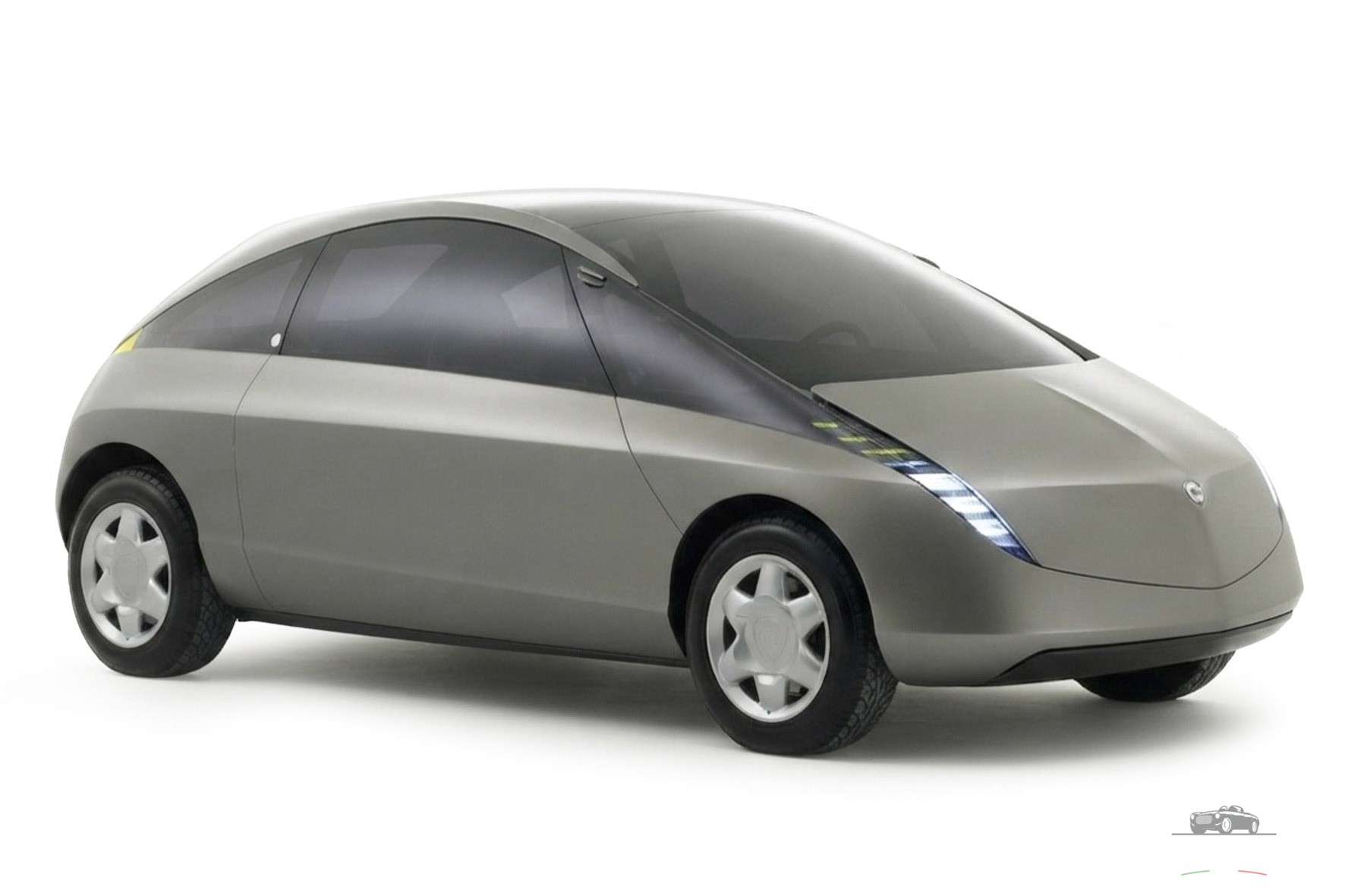
The Lancia Nea was a compact concept car developed in 2000 by the Centro Ricerche Fiat (CRF) in collaboration with the Lancia Style Center and designed under the direction of Ermanno Cressoni. Pietro Camardella served as chief designer, responsible for both exterior and interior key sketches, supported by designers Di Lillo and Tencone on the exterior, and Concillio on the interior. The development process included the creation of three 1:4 scale modelseach representing a different design approachthat were ultimately unified into a single finalized form built by I.DE.A Institute. Measuring 4.10 meters in length, the Nea was conceived as a forward-looking exploration of urban mobility within the compact car segment. The model drew conceptual influence from the earlier Lancia Dialogos, retaining the brand’s emphasis on passenger comfort, fluid onboard interaction, and ergonomic interior design. The Nea further developed these principles through a reconfiguration of interior space, adaptable seating, and a user-focused climate control strategy, all aimed at enhancing onboard harmony. Technologically, the Nea reflected contemporary trends in automotive connectivity and human-machine interaction. The concept integrated digital systems to facilitate communication between vehicle and user, as well as between the car and external networks. These systems were not limited to navigation or telematics but extended to ambient interface controls and vehicle feedback, emphasizing the role of the automobile as a digital node in daily life. The design was intended not merely to reference tradition but to reinterpret it within a modernized, tech-forward context. Its visual language retained Lancia’s formal elegance while signaling a shift toward intelligent surface treatments and integrated systems. The Nea’s stance, volumes, and glazing demonstrated a nuanced study of proportion and visibility within a constrained urban footprint. Though not intended for production, the Lancia Nea served as a research platform and design manifesto. It exemplified the evolving role of the automobile at the turn of the 21st centuryno longer solely a transport tool but an environment for interaction, comfort, and connectivity. The project affirmed Lancia’s interest in synthesizing legacy craftsmanship with speculative design and digital integration.
02 / TECHNICAL IDENTITY
03 / DESIGN, BODY & SUPPLIERS
Attributed coachbuilder / design studio
Italian automotive design, engineering and prototype-development institute founded near Turin in 1978, active on experimental and series-vehicle programmes until 2019.
Explore record ↗Attributed designer
Pietro Camardella is an Italian automotive designer known for his work at Pininfarina, including his contribution to the Ferrari F40.
Explore record ↗04 / CHRONOLOGY
07 / GALLERY
THE CONVERSATION
Comments 0