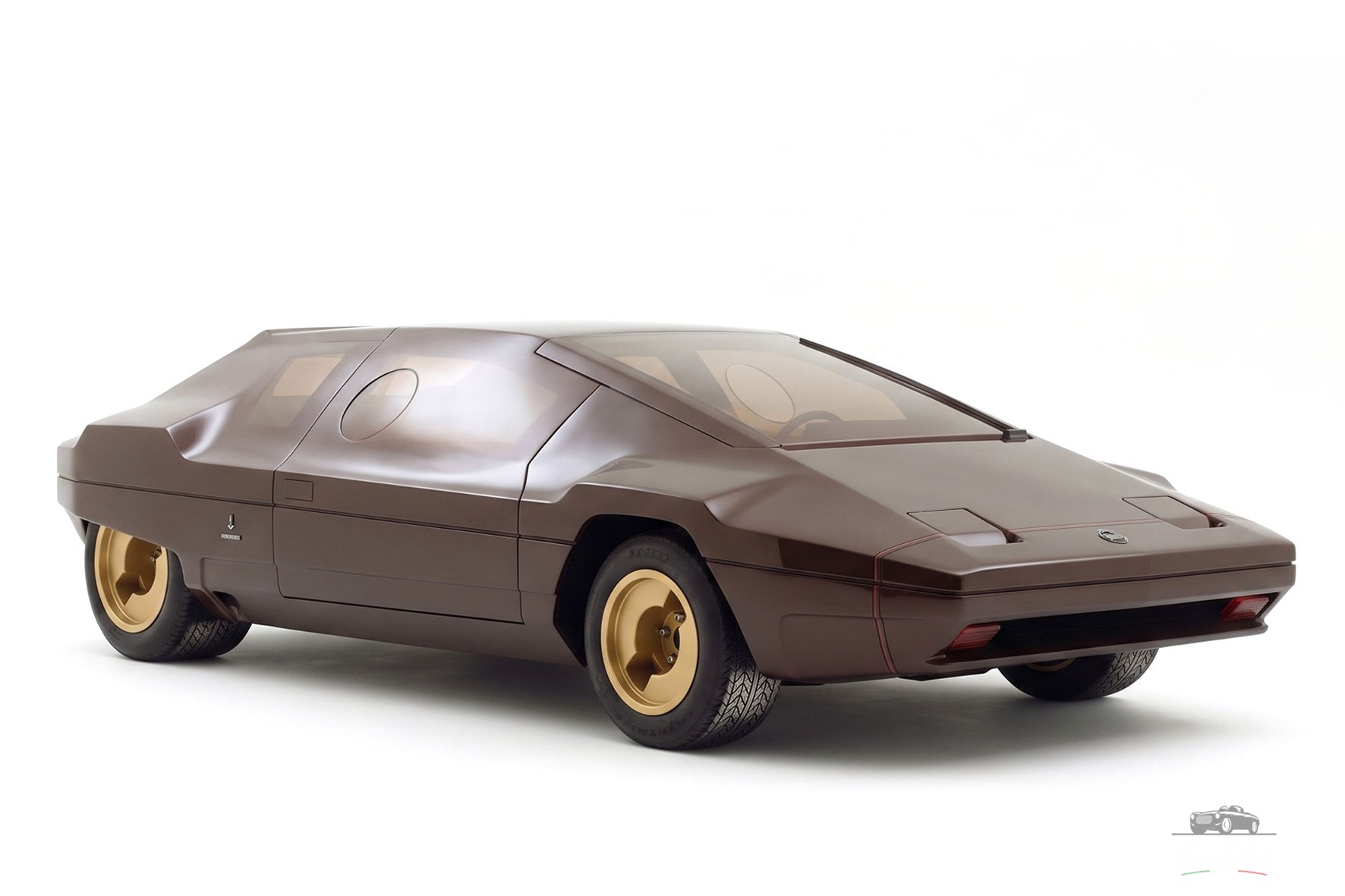
Unveiled by Bertone at the Turin Motor Show in April 1978, the Lancia Sibilo was a fully functioning experimental coupé designed by Marcello Gandini. It was constructed around the mechanical architecture of the Lancia Stratos HF, whose competition successes had already established the original model as one of the defining Italian sports cars of the decade. Rather than propose another rally machine, Gandini used the Sibilo to investigate a more continuous and sculptural interpretation of the wedge-shaped automobile. The surviving prototype is identified in the 2011 RM Auctions catalogue as chassis S 12201.
The Stratos chassis was lengthened by approximately 100 mm, producing a wheelbase of 2,280 mm, while the mid-mounted Dino V6 and five-speed manual transmission were retained. RM’s catalogue gives the engine displacement as 2,418 cc and quotes 190 bhp, with three Weber 40 IDF carburettors. Its original English specifications mistakenly called the engine a V8, an error expressly corrected in the auction house’s addendum. The Sibilo’s body was formed from hand-beaten steel, with the cabin and glazing visually integrated into a single surface rather than separated by conventional pillars and brightwork.
Much of the car’s experimental character lay in the treatment of details. Its flush-mounted polycarbonate side windows did not lower in the usual manner; instead, small circular sections moved inward and slid forwards to provide ventilation. The bumpers were absorbed into the body volume and defined by narrow contrasting lines, while the angular wheel openings reinforced the unusual silhouette. Inside, an elongated, one-piece steering wheel incorporated controls and warning lights, and the principal instruments occupied horizontal recesses near the base of the windscreen. In these solutions Gandini extended ideas previously explored in the Lamborghini Bravo and Alfa Romeo Navajo, although the three prototypes used different mechanical foundations.
The Sibilo remained part of Bertone’s collection for many years and was offered at RM Auctions’ Villa d’Este sale on 21 May 2011, where the published result was €95,200 against a pre-sale estimate of €60,000–100,000. It subsequently became associated with the collection of Corrado Lopresto and has appeared at historic motoring events. Some secondary histories place the transfer to Lopresto in 2010, a date that does not agree with the documented 2011 Bertone auction; the precise ownership chronology therefore remains under review. The car survives as a particularly concentrated example of Gandini’s late-1970s experiments with the integration of glazing, bodywork and interior architecture.



THE CONVERSATION
Comments 0