
Viotti & Tolfo
Established in Turin in 1921 by Vittorino Viotti and Torquato Tolfo, Viotti & Tolfo became associated with innovative torpedo bodies and refined coachwork during the interwar years.
Explore record ↗
1925Coachwork by Viotti & Tolfo
THE VEHICLE AT A GLANCE
THE PEOPLE BEHIND THE CAR
Established in Turin in 1921 by Vittorino Viotti and Torquato Tolfo, Viotti & Tolfo became associated with innovative torpedo bodies and refined coachwork during the interwar years.
Explore record ↗01 / THE STORY
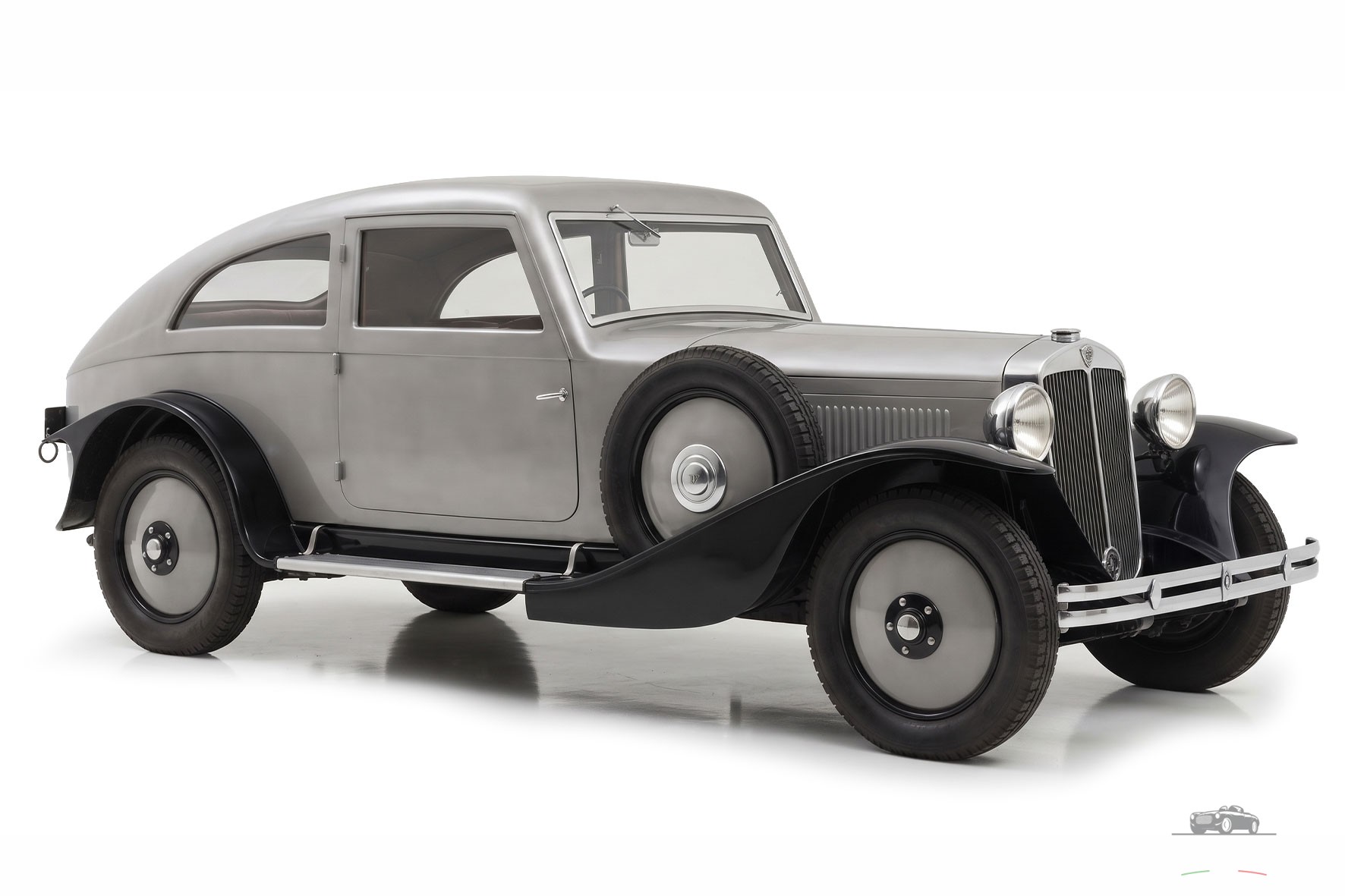
The Lanza Fiat 509 “La Bizzarra” was completed in 1925 and represents the final automobile created by Michele Lanza, an early Italian automotive entrepreneur and engineer. Born in Turin, Lanza accumulated substantial wealth through the candle and soap industry; his company Mira Lanza remained one of Italy’s best-known household brands well into the second half of the twentieth century. This financial independence enabled him to pursue automotive experimentation without commercial constraints.
Lanza was among the founders of Fiat and was involved in several minor automotive ventures, in addition to operating a marque under his own name. His activity differed markedly from that of most contemporaries: production and sales were not objectives. Lanza focused exclusively on engineering research and technical exploration, producing almost entirely one-off vehicles that were rarely sold.
“La Bizzarra,” meaning “the Extravagant,” embodied this approach. The car was built on a Fiat 509 chassis and fitted with a 1.5-litre engine designed and constructed by Lanza himself. The bodywork was executed by the young Vittorino Viotti, at an early stage of his career. Its design departed sharply from prevailing automotive forms of the mid-1920s, which were characterized by upright profiles, exposed components, and decorative coachwork. Instead, La Bizzarra featured smooth, continuous surfaces and a streamlined silhouette, reflecting an intuitive understanding of airflow and mechanical efficiency.
Although aerodynamics was not yet a formalized discipline in automotive engineering, the body’s proportions and reduced visual mass anticipated principles that would only gain wider acceptance in the 1930s. Lanza used the car personally for several years, treating it as both a functional vehicle and an experimental platform.
In 1929, the original body was removed and replaced with a conventional Coupé Royal body. The reasons for this transformation are undocumented. Despite this alteration, La Bizzarra remains significant as the last expression of Lanza’s automotive philosophy: a non-commercial, research-driven approach that linked the experimental practices of early motoring with later, more systematic design methodologies.
02 / TECHNICAL IDENTITY
03 / DESIGN, BODY & SUPPLIERS
Coachbuilder / Design studio
Established in Turin in 1921 by Vittorino Viotti and Torquato Tolfo, Viotti & Tolfo became associated with innovative torpedo bodies and refined coachwork during the interwar years.
Explore record ↗Designer
05 / PEOPLE, COLLECTIONS & MUSEUMS
08 / GALLERY
THE CONVERSATION
Comments 0