Franco Scaglione
Franco Scaglione was an Italian automotive designer celebrated for his aerodynamic bodywork, notably the Alfa Romeo BAT prototypes at Bertone and the Alfa Romeo 33 Stradale.
Explore record ↗
1969
THE VEHICLE AT A GLANCE
THE PEOPLE BEHIND THE CAR
Franco Scaglione was an Italian automotive designer celebrated for his aerodynamic bodywork, notably the Alfa Romeo BAT prototypes at Bertone and the Alfa Romeo 33 Stradale.
Explore record ↗Turin coachbuilder founded in 1968; built Fiat-based show cars, LMX Sirex bodies and prototypes designed by independent stylists.
Explore record ↗01 / THE STORY
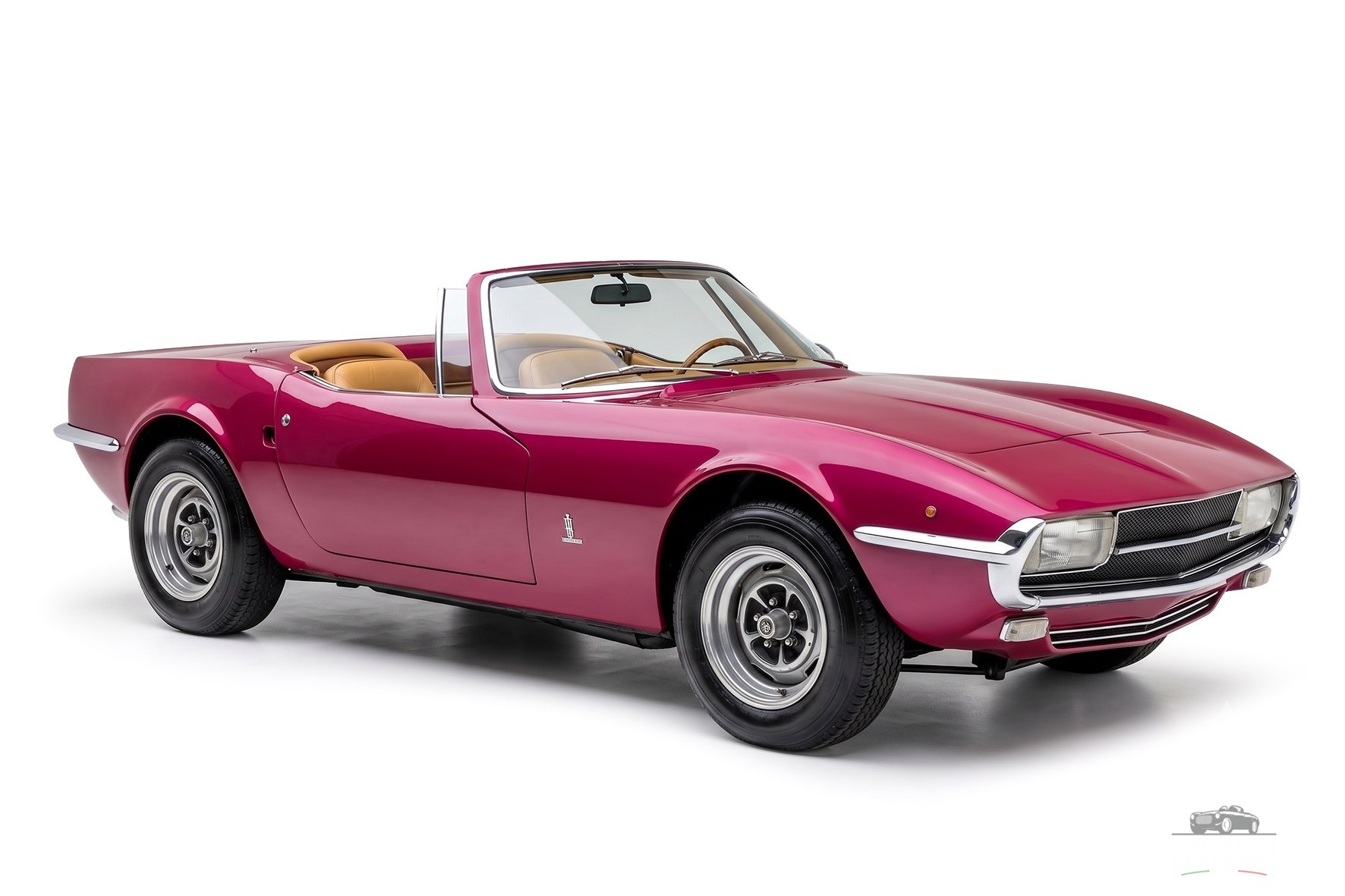
The LMX Sirex Spider was a limited-production Italian sports car developed by LMX Automobile S.R.L. (Linea Moderna Executive), a Milan-based enterprise founded by Michel Liprandi and Giovanni Mandelli. Introduced in 1968, the Spider was conceived as an open variant of the earlier LMX Sirex coupé, reflecting a period in which Italian boutique manufacturers sought to produce lightweight, stylistically distinctive vehicles for private clients and small-scale motorsport applications. The bodywork of the Sirex Spider was designed by Franco Scaglione, a figure associated with several notable Italian automotive projects. The exterior employed a low, angular silhouette with pronounced wheel arches and minimal overhangs, in line with contemporary design trends emphasizing aerodynamic efficiency and visual aggressiveness. The body shell was fabricated in fiberglass and mounted to a steel central backbone chassis, a construction method intended to reduce weight while maintaining structural rigidity. Dimensions included an overall length of approximately 3.96 meters, a width of 1.76 meters, and a height of 1.13 meters, with a wheelbase measuring 2.30 meters. The vehicle accommodated two occupants in a minimalistic cockpit outfitted with functional instrumentation and sparse trim, consistent with its sporting orientation. The powertrain was sourced from Ford of Germany, specifically the 2.3-liter V6 engine utilized in the Ford Taunus series. In standard configuration, the engine produced between 108 and 126 horsepower, transmitted to the rear wheels via a four-speed manual gearbox. Select versions were equipped with turbocharging systems developed by Michael May, increasing output to approximately 210 horsepower. These variants offered a top speed near 200 kilometers per hour, facilitated by the vehicle’s low weight and compact form. Assembly was initially conducted by Carrozzeria Eurostyle in Turin. Following LMX’s financial collapse in the early 1970s, production ceased after a limited run. Several incomplete chassis were subsequently finished by SAMAS in Ricca d’Alba and marketed as the Sirex LMS, with minor modifications to mechanical and interior specifications. The LMX Sirex Spider remains a peripheral but notable example of late-1960s Italian sports car design, distinguished by its composite construction, independent origins, and design lineage. Surviving examples are rare and preserved primarily by collectors of niche European performance vehicles.
02 / TECHNICAL IDENTITY
03 / DESIGN, BODY & SUPPLIERS
Coachbuilder / Design studio
Turin coachbuilder founded in 1968; built Fiat-based show cars, LMX Sirex bodies and prototypes designed by independent stylists.
Explore record ↗Attributed designer
Franco Scaglione was an Italian automotive designer celebrated for his aerodynamic bodywork, notably the Alfa Romeo BAT prototypes at Bertone and the Alfa Romeo 33 Stradale.
Explore record ↗07 / GALLERY

THE CONVERSATION
Comments 0