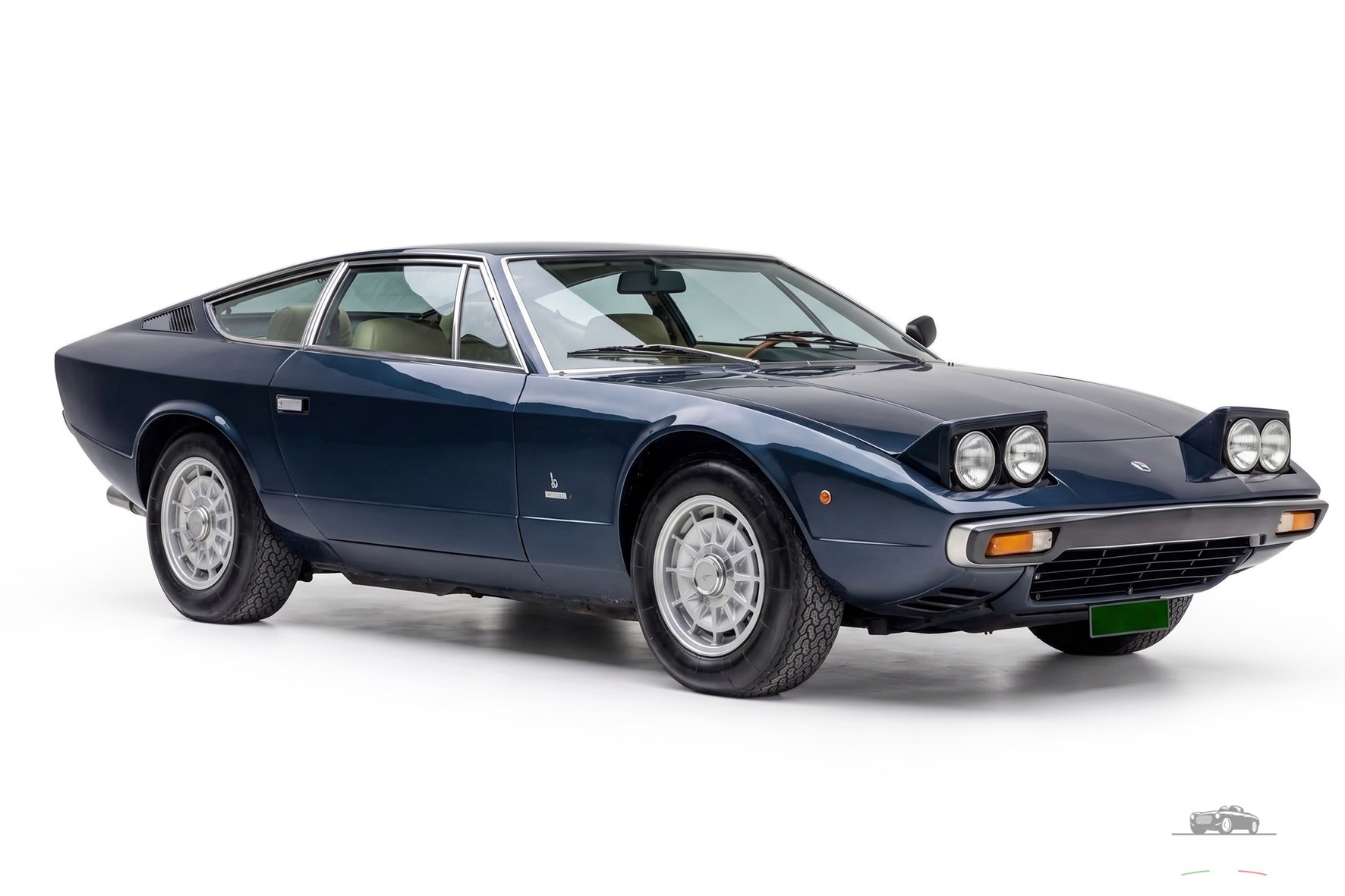
The Maserati Khamsin (Tipo AM120) was the last major front-engined grand tourer developed under Giulio Alfieri’s leadership of Maserati engineering. First shown on the Bertone stand at the 1972 Turin Motor Show, it combined a traditional longitudinal V8 and rear-wheel drive with an angular 2+2 body drawn by Marcello Gandini for Bertone. Series production ran from 1974 to 1982. The name, taken from a hot North African desert wind, followed Maserati’s established practice of naming its road cars after winds.
Design and construction
Where the earlier Maserati Ghibli Coupé expressed the long-bonnet idiom of the 1960s, the Khamsin adopted a lower, sharply tapered nose, a distinctive asymmetrical bonnet vent and a broad glazed rear panel carrying the lamps and Trident emblem. Its steel, self-supporting body incorporated a rear subframe and independent rear suspension, a departure from the Ghibli’s rear-axle arrangement. Although the Khamsin retained elements of the Ghibli’s V8 mechanical tradition, it was not merely a rebodied Ghibli chassis. The rear seats were occasional rather than spacious, but the front-engined layout offered a more conventional grand-touring package than Maserati’s mid-engined Bora and Merak.
Mechanical character and production
The standard European specification centred on Maserati’s naturally aspirated 4,930 cc, 90-degree V8 with twin overhead camshafts on each bank, rated at 320 hp at 5,500 rpm in the factory’s historical specification. A five-speed ZF manual gearbox was fitted, while a three-speed Borg-Warner automatic was offered. Citroën’s influence was apparent in the high-pressure hydraulic assistance for the brakes, steering, clutch and other functions, including the retractable headlamps. Contemporary technical reporting gave a 2,550 mm wheelbase, and Maserati’s published maximum speed was 270 km/h. Performance ratings and equipment could vary by market and production period; these model-level specifications should not be taken as proof of an individual car’s original configuration.
The Khamsin entered production amid the oil crisis and the upheaval surrounding Citroën’s ownership of Maserati. Maserati’s current historical specification lists 430 cars, although its accompanying narrative also cites 435; the discrepancy remains unresolved. Auction records preserve the histories of individual examples, but their chassis, engine numbers, colours, owners and sale prices belong to those particular cars rather than to the whole AM120 family. The Khamsin therefore remains a distinctive meeting point between Maserati’s front-engined GT tradition, Bertone’s early-1970s design language and Citroën-era hydraulic engineering.



THE CONVERSATION
Comments 0