Vignale
Founded by Alfredo Vignale in Turin in 1948, Carrozzeria Vignale produced bespoke sports and grand touring bodies for Ferrari, Fiat, Maserati and other manufacturers.
Explore record ↗
1966Coachwork by Vignale
THE VEHICLE AT A GLANCE
THE PEOPLE BEHIND THE CAR
Founded by Alfredo Vignale in Turin in 1948, Carrozzeria Vignale produced bespoke sports and grand touring bodies for Ferrari, Fiat, Maserati and other manufacturers.
Explore record ↗Virginio Vairo was an Italian automotive stylist associated with Carrozzeria Vignale, contributing to special-bodied Fiat models including the Fiat 850 Vignale range.
Explore record ↗01 / THE STORY
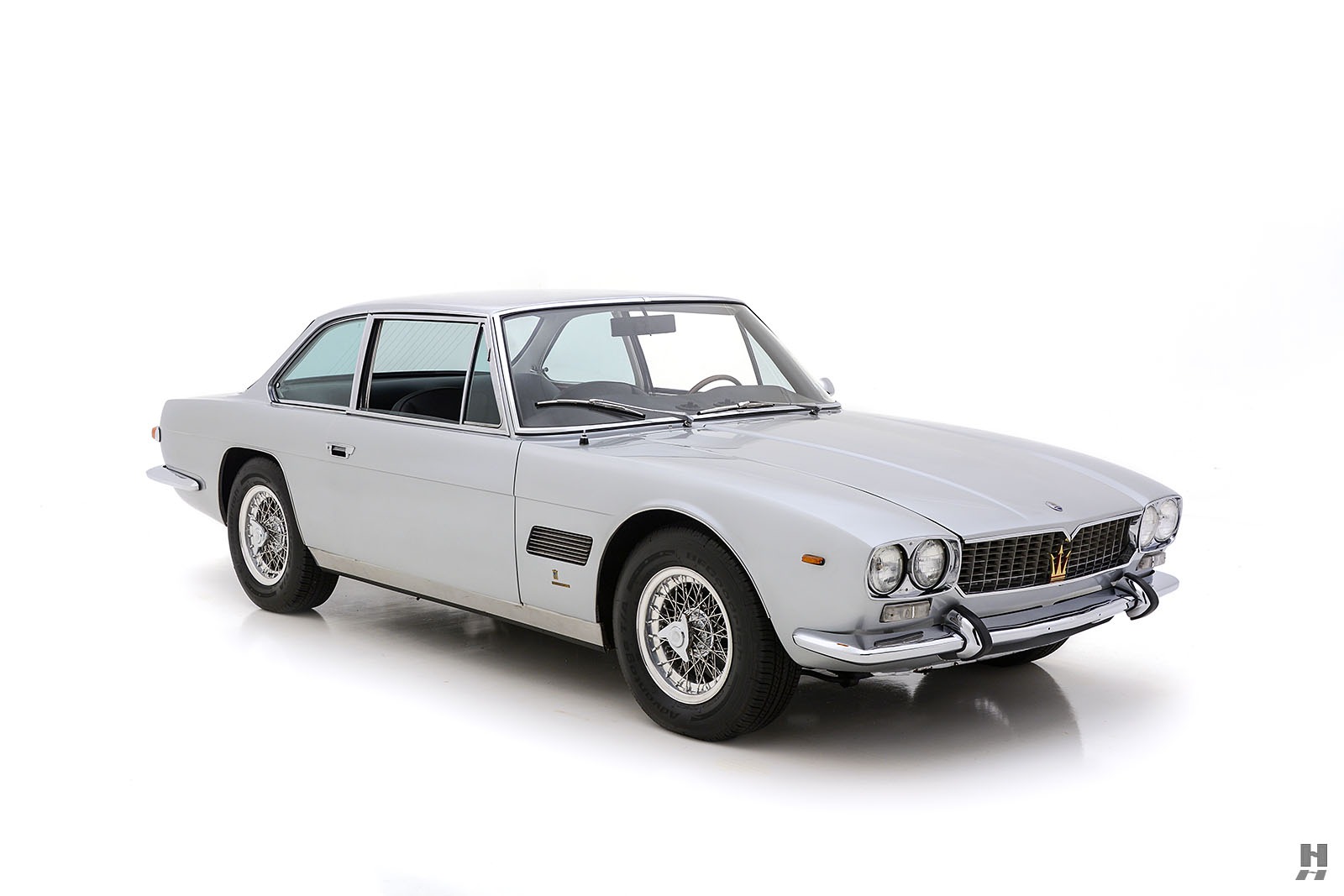
The Maserati Mexico debuted in August 1966 at the 20° Concorso internazionale di eleganza per auto in Rimini, while its international premiére was at the October Paris Motor Show. It was built on the chassis of the first generation of the Quattroporte with a wheelbase shortened by 11 cm (4.3 in). The Maserati Mexico ‘s design derived from a 2+2 prototype bodywork shown on the Vignale stand at the October 1965 Salone di Torino and built upon a 4.9-litre 5000 GT chassis, rebodied after it had been damaged. As the car after the show was sold to Mexican president Adolfo López Mateos, the model became known as the Mexico. By coincidence, John Surtees won the Mexican Grand Prix on a Cooper-Maserati T81 the following year. Vignale’s prototype was so well received that Maserati immediately made plans to put a version into production. The production version appeared in 1966 at the Paris Motor Show. The first version was equipped with a 4.7-liter, 290-hp V8 engine that could propel the Mexico up to 250 mph. In 1969, contrary to Maserati traditions, this coupe was also available with a smaller 4.2-liter V8 (the one that already powered the Quattroporte). Few changes on the Mexico in its career (except the smaller engine). Its luxurious equipment included leather seats for four adults, electric windows, wooden dashboard and air conditioning as standard. Automatic transmission, power steering, and radio were available as options. The Mexico was the first series Maserati to be equipped with power-assisted disc brakes, and self-ventilating on all four wheels. Photo courtesy of Hyman Ltd.
02 / TECHNICAL IDENTITY
03 / DESIGN, BODY & SUPPLIERS
Coachbuilder / Design studio
Founded by Alfredo Vignale in Turin in 1948, Carrozzeria Vignale produced bespoke sports and grand touring bodies for Ferrari, Fiat, Maserati and other manufacturers.
Explore record ↗Attributed designer
Virginio Vairo was an Italian automotive stylist associated with Carrozzeria Vignale, contributing to special-bodied Fiat models including the Fiat 850 Vignale range.
Explore record ↗04 / CHRONOLOGY
05 / PEOPLE, COLLECTIONS & MUSEUMS
07 / CHASSIS REGISTER
08 / GALLERY
THE CONVERSATION
Comments 0