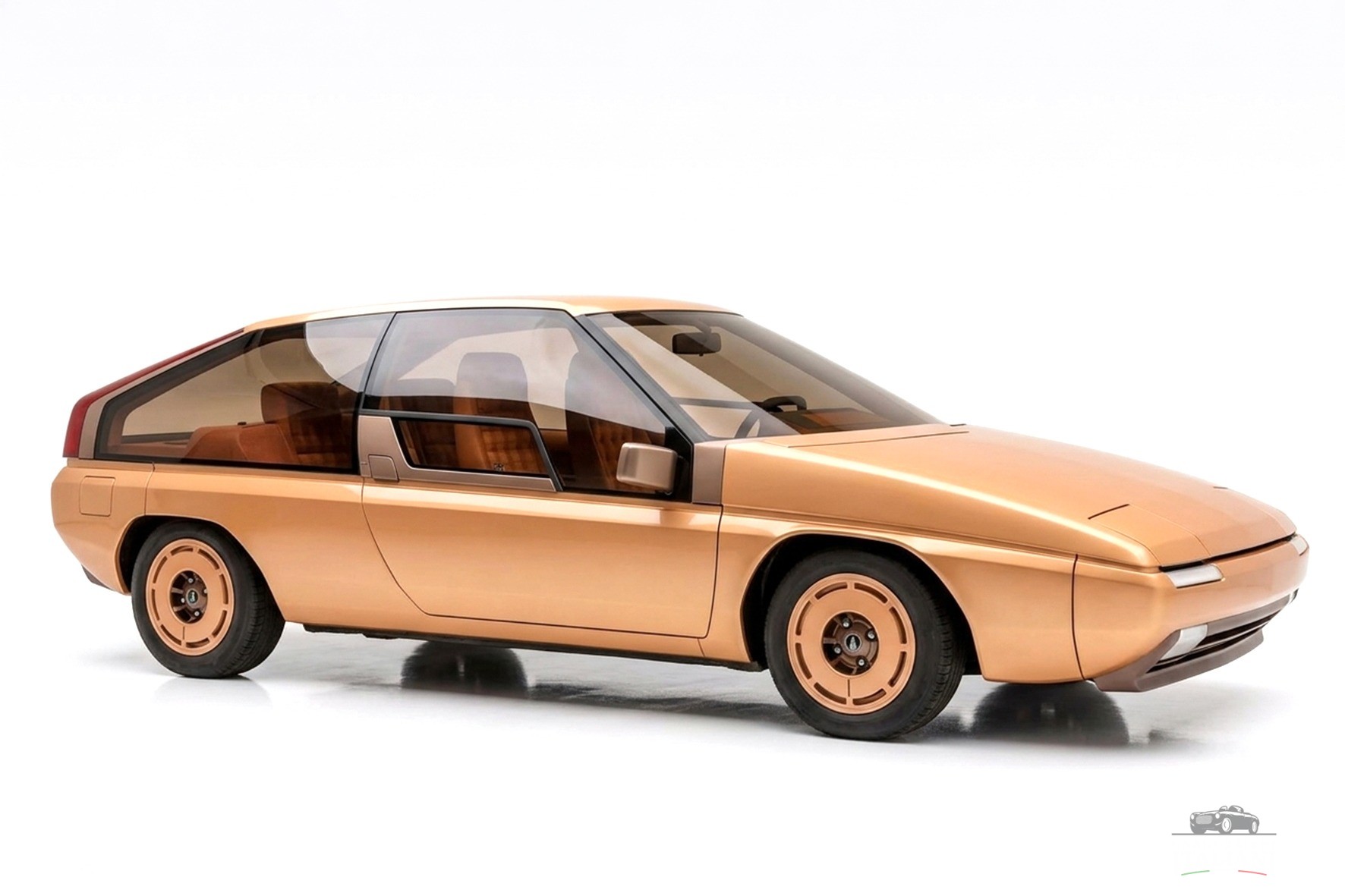
The Mazda MX-81 Aria was presented at the 1981 Tokyo Motor Show as an experimental collaboration between Mazda and the Turin-based Carrozzeria Bertone. Designed by Marc Deschamps, the compact four-seat concept used the mechanical foundations of the Mazda 323 but exchanged the production car’s familiar appearance for an entirely new body. It was the first Mazda to carry the MX designation, later associated with the manufacturer’s more unconventional production and experimental vehicles. Rather than anticipating a production replacement for the 323, the MX-81 explored how an established mechanical package could support an unusually adventurous design.
Design and experimental interior
The Aria’s gold-painted wedge-shaped body was defined by its exceptionally generous glass area, retractable headlights and tall rear lamps integrated into the pillars. Its sharply controlled surfaces continued the geometric design language explored in earlier Bertone studies, notably the Volvo Tundra, although the Mazda and Volvo used different mechanical foundations. The rear hatch and the low beltline created a strikingly open cabin. Inside, Bertone replaced the conventional steering wheel with a recessed rectangular control surrounded by a moving belt, incorporating switches and a small television-style instrument display. The front seats could swing sideways to ease entry. These features were experiments in vehicle ergonomics rather than equipment destined for a production Mazda.
Survival and restoration
Unlike many motor-show prototypes, the MX-81 survived after its exhibition career and remained in Mazda’s custody in Hiroshima. Rediscovered in the company’s storage facilities decades later, it underwent mechanical recommissioning in Japan before being sent to Italy, where SuperStile in Turin restored its exterior and interior under a project coordinated by Flavio Gallizio. Mazda marked the completion of the work in 2021 by recreating the car’s original publicity photographs in front of Milan Cathedral. The restored MX-81 therefore preserves both a particular moment in Bertone’s design experimentation and a less familiar chapter of the long relationship between Mazda and Italian automotive design.


THE CONVERSATION
Comments 0