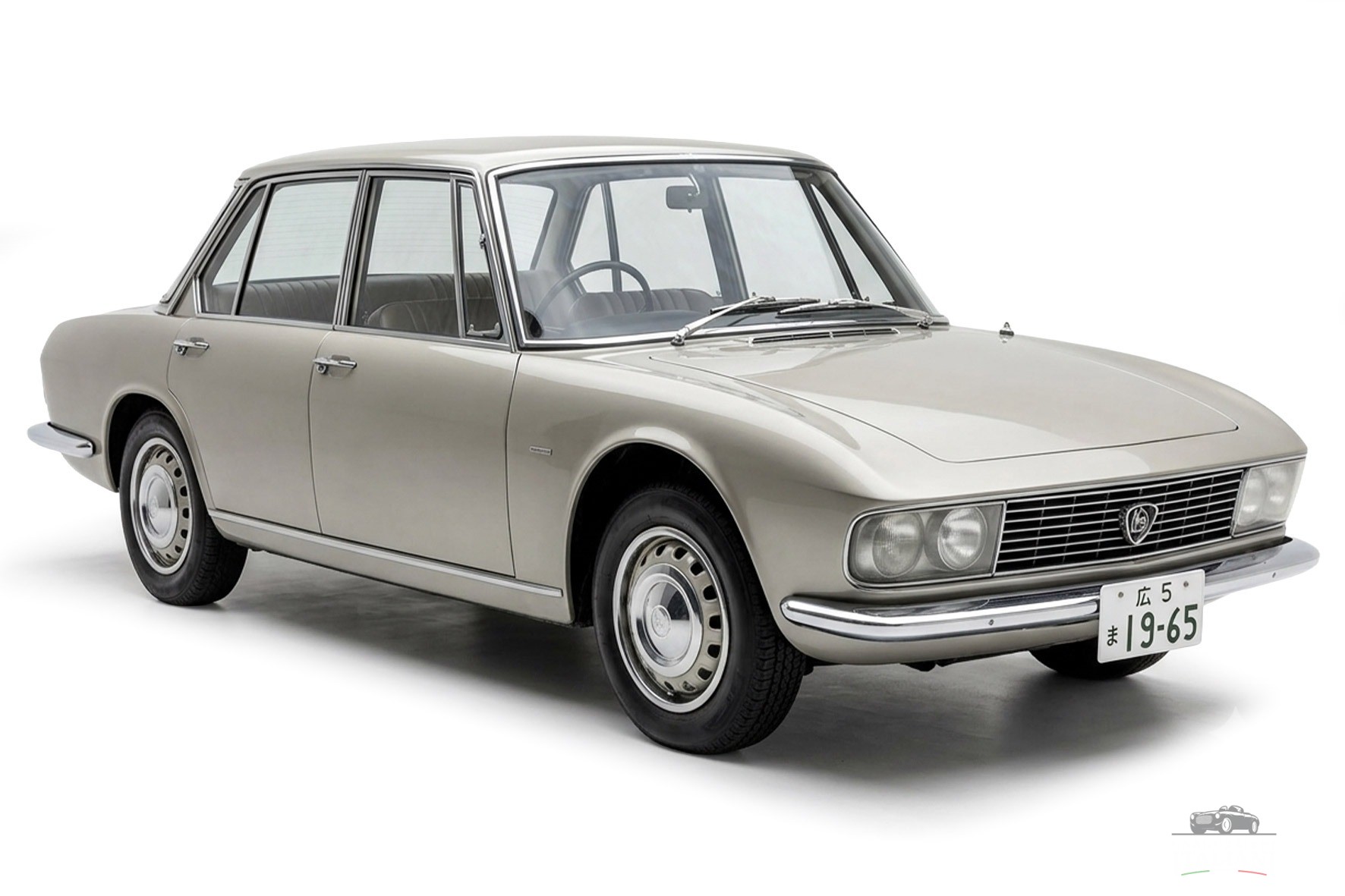
The Mazda S8P was a prototype built by Bertone in 1964 for Mazda’s internal evaluation. It was developed during the collaboration between Toyo Kogyo, later Mazda, and the Italian design house, with design work linked to Giorgetto Giugiaro. The S8P belonged to the early development history of the Mazda Luce. The Luce name, meaning “light” in Italian, was created for Mazda’s future flagship model. The production Luce would later become an elegant rear-wheel-drive sedan, but the S8P showed a more advanced and experimental direction. The prototype followed the general theme of the later Luce sedan, but with more dramatic proportions. The body was longer, lower and sleeker, with a descending rear section and a large wrap-around rear window. The front used twin round headlamps, partly hidden behind a metallic mesh cover. The car also carried a distinctive Mazda emblem, with the period “M” script placed inside a double-rotor graphic. The S8P was planned around Mazda’s early rotary engine development. It was intended to use the L8A, a 399 x 2 cc twin-rotor engine also associated with the 1963 Cosmo Sport concept. Unlike the later production Luce, the S8P was conceived with front-wheel drive, an advanced layout for the period. The car, however, was not a running prototype. Its engine was a dummy unit made of wood. The S8P helped explain the direction later taken by the Mazda Luce Rotary Coupé, previewed as the RX-87 concept in 1967. Both cars used a low, sleek body, concealed lighting treatment, rotary power and front-wheel drive. The prototype was rediscovered in a Mazda warehouse in the 2000s in poor condition. It was later restored by a team of volunteers and displayed at the Hiroshima City Transportation Museum in 2011.



THE CONVERSATION
Comments 0