
Giorgetto Giugiaro
Giorgetto Giugiaro is an Italian automotive and industrial designer whose career includes Italdesign and GFG Style, with a lasting influence on production-car and concept-car design.
Explore record ↗
1986
THE VEHICLE AT A GLANCE
THE PEOPLE BEHIND THE CAR
Giorgetto Giugiaro is an Italian automotive and industrial designer whose career includes Italdesign and GFG Style, with a lasting influence on production-car and concept-car design.
Explore record ↗Established in 1968 by Giorgetto Giugiaro and Aldo Mantovani, Italdesign is an Italian design and engineering company known for production-car styling, concepts and prototypes for global manufacturers.
Explore record ↗01 / THE STORY
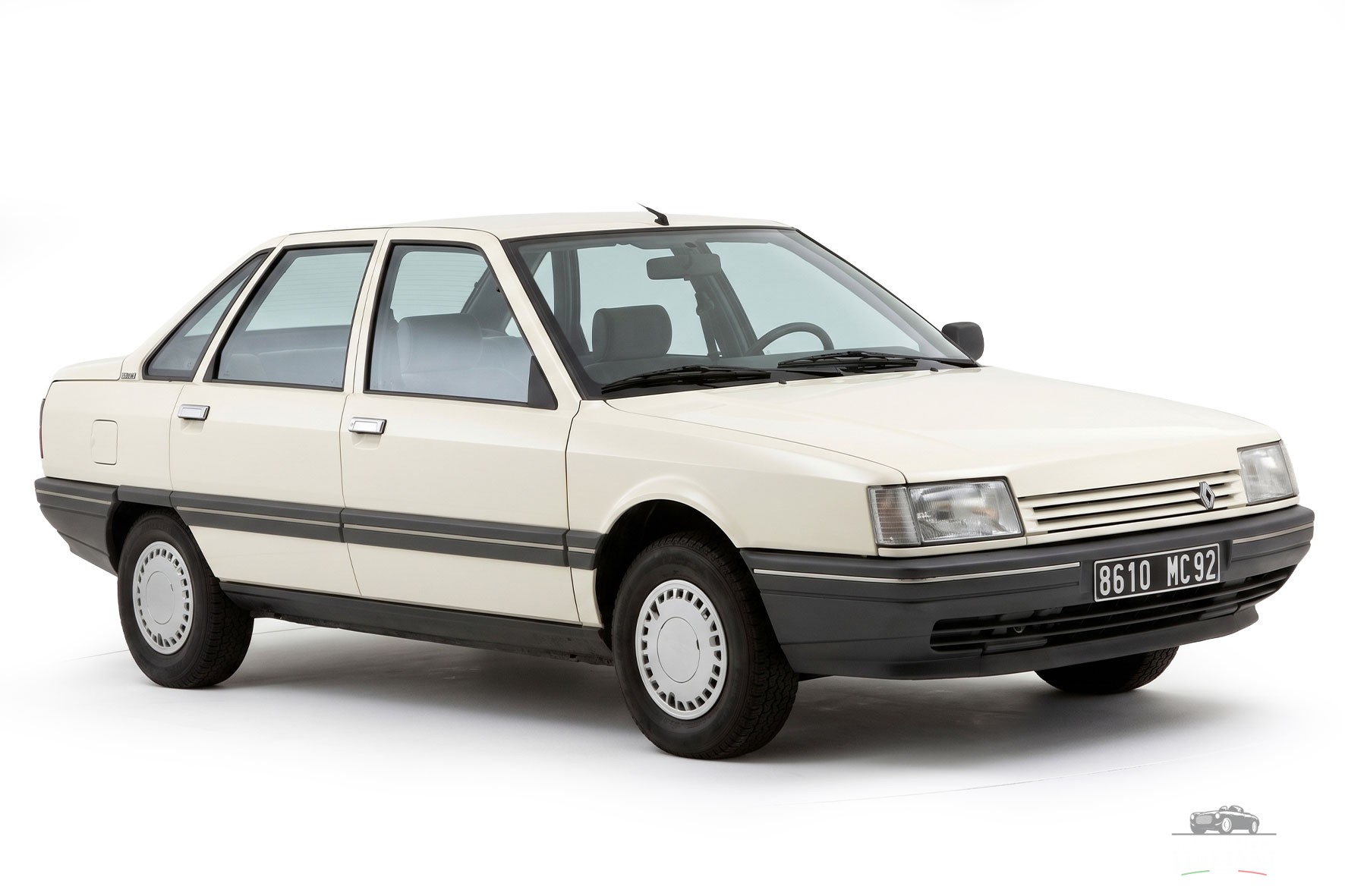
The first Renault 21 model, requested by the President Bernard Hanon, was a kind of Lancia Medusa compact version, but the management of this French brand considers it too advanced and decide to produce a more traditional three box just like Audi 80. But the story is far way more complex: Between the end of the 1970s and the beginning of the following decade, the X48 project was launched, intended to produce the model that would replace the Renault 18. In those years the Billancourt-based company was heading toward one of the most serious financial crises in its history. When the X48 project was getting into full swing, Renault plunged to the brink of the abyss because of some big investments that were not quite right, such as the one related to the annexation of AMC in 1979, or the poor success of some models, such as the Renault 14 or the Renault 30. Finding itself with few resources when it came to thinking about the mechanics, and in particular the powertrains, Renault had to make do with what it already had in-house: as far as engines were concerned, two variants of the already well-known 1.7 Source were chosen for the base of the range, one with 76 hp and the other with 90 hp. For the higher engines we went for the 2-liter Douvrin powerplants and so did the diesel units. Unfortunately, a not insignificant obstacle was faced, consisting of the fact that the Douvrin engines could only be installed longitudinally, while the 1.7 Source could only be installed transversely. For these reasons, since they could not invest in new engines or new gearboxes, given the paucity of economic resources, specific structures had to be made to support the powertrains, with the result that from a chassis point of view the cars would have been characterized by significant differences depending on whether they mounted a 1.7 Fonte or a Douvrin engine, diesel or gasoline. Even the track and wheelbase measurements would have varied. As far as the industrial design aspect was concerned, they obviously wanted a car that was modern, but also elegant and capable of providing more roominess than the 18. Renault designers worked extensively on that aspect and succeeded in obtaining a body with a Cx of 0.29, a remarkable value for that time. The Renault 21 was unveiled in March 1986 at the Geneva Motor Show under the new numerical designation of 21, a designation that had actually been known in the trade press for some months. At its debut it was to counter some competing models such as the Peugeot 505 and the Ford Sierra, but above all it was more suitable to face the North American market, in which Renault planned its production and marketing as part of the alliance with AMC. The exterior styling of the Renault 21 was initially entrusted to the Italian coachbuilder Italdesign Giugiaro, whose very angular proposals did not meet with unanimous approval in-house. They were revised and slightly softened by Renault’s styling department under the impetus of Robert Opron, who was already responsible for the R25. The whole remains in the rectilinear style of the 1980s but the treatment of the front face (in particular the closed grille on the lower engines) suggests aerodynamism. It is also the designers of the house who conceive the interior layout, deliberately inspired by that of the R25 created by another famous stylist, Marcello Gandini.
02 / TECHNICAL IDENTITY
03 / DESIGN, BODY & SUPPLIERS
Coachbuilder / Design studio
Established in 1968 by Giorgetto Giugiaro and Aldo Mantovani, Italdesign is an Italian design and engineering company known for production-car styling, concepts and prototypes for global manufacturers.
Explore record ↗Attributed designer
Giorgetto Giugiaro is an Italian automotive and industrial designer whose career includes Italdesign and GFG Style, with a lasting influence on production-car and concept-car design.
Explore record ↗04 / CHRONOLOGY
07 / GALLERY

THE CONVERSATION
Comments 0