Stabilimenti Farina
Stabilimenti Farina was a leading Turin coachbuilder established by Giovanni Carlo Farina, training generations of craftsmen while creating bespoke bodies for major Italian marques.
Explore record ↗
1923Coachwork by Stabilimenti Farina
THE VEHICLE AT A GLANCE
THE PEOPLE BEHIND THE CAR
Stabilimenti Farina was a leading Turin coachbuilder established by Giovanni Carlo Farina, training generations of craftsmen while creating bespoke bodies for major Italian marques.
Explore record ↗01 / THE STORY
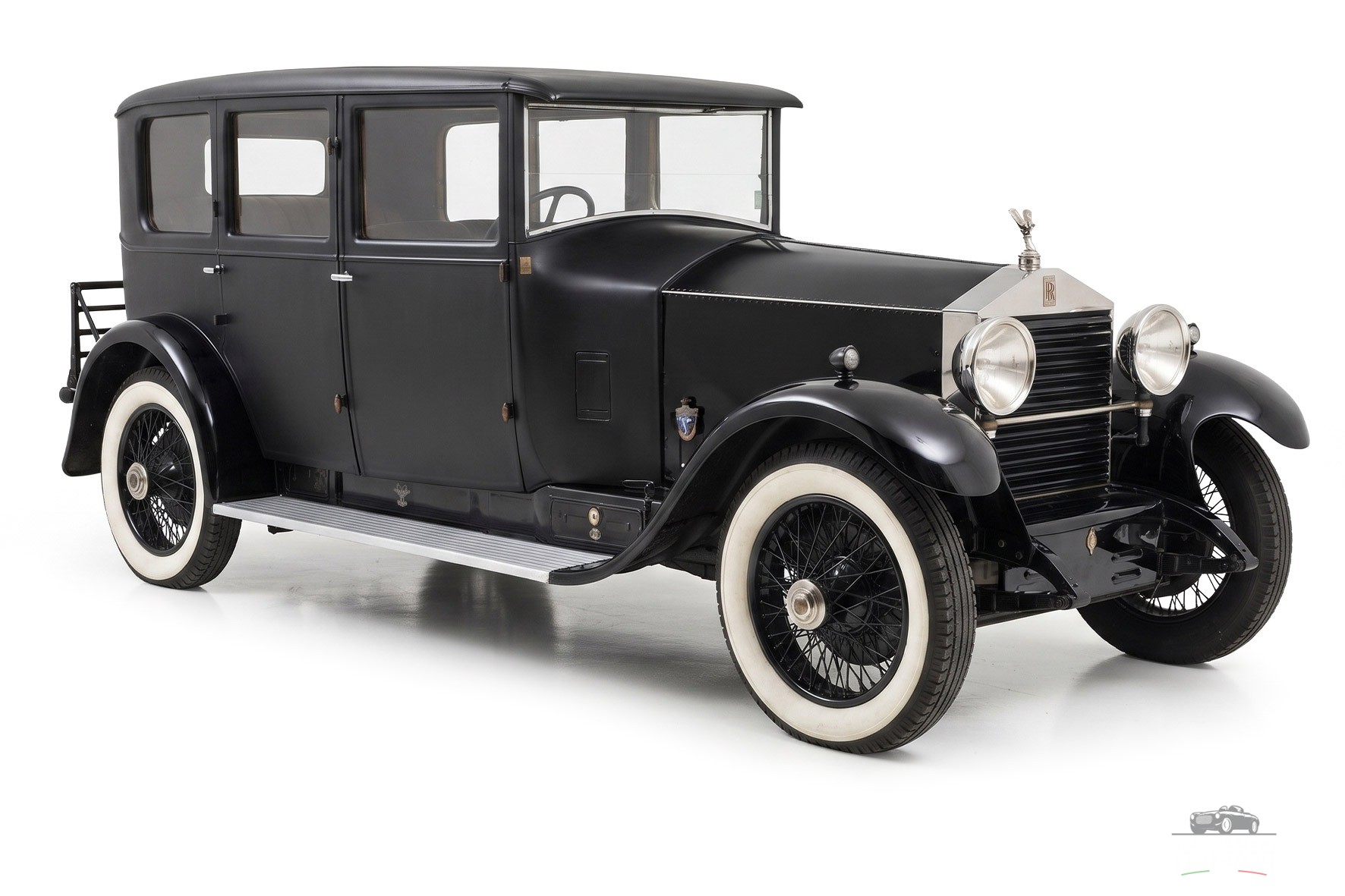
The 1923 Rolls-Royce Twenty Limousine by Stabilimenti Farina was built using Weymann-type flexible body construction, a method licensed widely during the 1920s for its weight reduction and noise-damping advantages. The Rolls-Royce Twenty chassis, introduced in 1922, was designed as a smaller and more manageable model than the Silver Ghost, combining a rigid ladder frame with semi-elliptic leaf springs and, in later production, four-wheel brakes. Farina’s bodywork followed the principles of the Weymann system: an ash frame joined with flexible joints, covered not by metal panels but by layers of fabric stretched over padding. This approach reduced squeaks and body vibration, improved ride comfort, and lowered overall mass. The Limousine configuration adopted the formal, upright geometry typical of chauffeur-driven cars of the period, with a high roofline, a separate driver’s compartment, and wide rear doors. The rear of the body incorporated an externally mounted spare wheel carried on the vertical tail panel. The chassis was powered by Rolls-Royce’s 3.1-litre side-valve inline-six with a detachable cylinder head, coupled to a three-speed manual transmission. The engine’s design prioritized quiet operation and consistent torque delivery at low speeds, aligning with the refinement expected of the marque. Steering, suspension, and braking components were engineered for durability and for accommodating diverse body types produced by independent coachbuilders. Stabilimenti Farina’s execution preserved the clean, unadorned surfaces characteristic of Weymann bodies while adding subtle Italian stylistic cues. The fenders, running boards, and radiator treatment followed standard Rolls-Royce practice, whereas the overall stance reflected the lighter structure made possible by the fabric-covered frame. Interior equipment depended on commissioning requirements and often included upholstered rear seating, glass division, and fittings appropriate to formal use. Surviving examples of the Rolls-Royce Twenty with Farina’s Weymann coachwork are documented in marque registries and private collections, providing research material on early interwar lightweight construction and the cross-European diffusion of the Weymann system among high-end coachbuilders.
02 / TECHNICAL IDENTITY
Become a Pro member to see the full details in this section.
Membership is not available yet.
View membership options03 / DESIGN, BODY & SUPPLIERS
Coachbuilder / Design studio
Stabilimenti Farina was a leading Turin coachbuilder established by Giovanni Carlo Farina, training generations of craftsmen while creating bespoke bodies for major Italian marques.
Explore record ↗06 / CHASSIS REGISTER
07 / GALLERY
08 / PERIOD ARCHIVE
Become a Pro member to see the full details in this section.
Membership is not available yet.
View membership options
THE CONVERSATION
Comments 0