Giovanni Michelotti
Giovanni Michelotti was a prolific Italian automotive designer whose independent Turin studio produced coachwork and production-car designs for Vignale, Triumph, BMW and numerous other manufacturers.
Explore record ↗
1952Coachwork by Stabilimenti Farina
THE VEHICLE AT A GLANCE
THE PEOPLE BEHIND THE CAR
Giovanni Michelotti was a prolific Italian automotive designer whose independent Turin studio produced coachwork and production-car designs for Vignale, Triumph, BMW and numerous other manufacturers.
Explore record ↗Stabilimenti Farina was a leading Turin coachbuilder established by Giovanni Carlo Farina, training generations of craftsmen while creating bespoke bodies for major Italian marques.
Explore record ↗01 / THE STORY
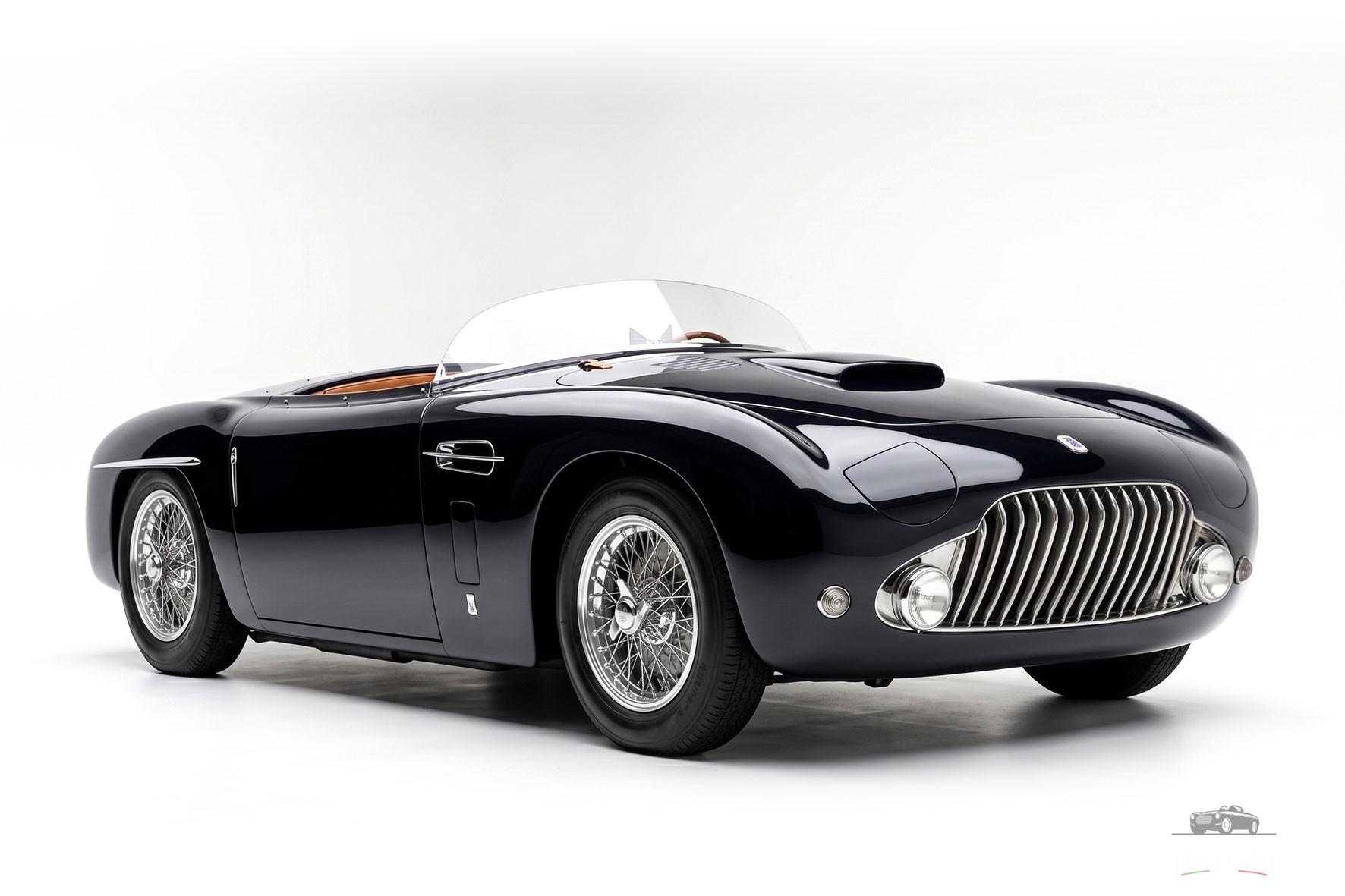
The Siata 208 CS Spider by Stabilimenti Farina was a limited-production Italian sports car constructed in the early 1950s, utilizing mechanical components derived from the Fiat 8V. Developed by Società Italiana Auto Trasformazioni Accessori (Siata), a Turin-based manufacturer known for its modified Fiat-based competition cars, the 208 CS embodied a transitional phase in postwar Italian sports car production, combining independent engineering with coachbuilt craftsmanship. The vehicle was powered by the Fiat Tipo 104 V8 engine, a compact two-liter unit developed in-house by Fiat. With a displacement of 1,996 cubic centimeters, the overhead-valve, 70-degree V8 produced approximately 110 horsepower in its early specification, transmitted through a five-speed manual gearbox. The engine was front-mounted, and power was delivered to the rear axle, which was suspended by semi-elliptic leaf springs, while the front employed independent suspension with coil springs and hydraulic dampers. The chassis was constructed using tubular steel, engineered for both rigidity and reduced weight. The Spider variant, bodied by Stabilimenti Farina, was distinguished by aluminum panelwork shaped with an emphasis on aerodynamic efficiency and stylistic modernity. The body featured restrained ornamentation, a low-slung profile, and elements such as a wraparound windshield and integrated lighting, reflecting early 1950s Italian design language. Stabilimenti Farina, which had developed a reputation for refined gran turismo styling, ceased operations shortly thereafter, rendering examples of their final works especially rare. The 208 CS appeared in both closed and open forms, though production figures for each variant remain limited. The Spider configuration, with its lightweight construction and open cockpit, was well suited to competitive events. One example achieved eleventh place overall in the 1952 Mille Miglia, reinforcing the model’s credibility as a dual-purpose sports car. The Siata 208 CS Spider by Stabilimenti Farina occupies a minor yet distinctive position in the evolution of Italian sports cars. It reflects the postwar resurgence of independent constructors and coachbuilders who operated in the interstices between mass-market production and artisanal design. Its significance derives not from volume or innovation alone, but from the synthesis of refined mechanical engineering and coachbuilt individuality in a rapidly industrializing automotive culture.
02 / TECHNICAL IDENTITY
Become a Pro member to see the full details in this section.
Membership is not available yet.
View membership options03 / DESIGN, BODY & SUPPLIERS
Coachbuilder / Design studio
Stabilimenti Farina was a leading Turin coachbuilder established by Giovanni Carlo Farina, training generations of craftsmen while creating bespoke bodies for major Italian marques.
Explore record ↗Designer
Giovanni Michelotti was a prolific Italian automotive designer whose independent Turin studio produced coachwork and production-car designs for Vignale, Triumph, BMW and numerous other manufacturers.
Explore record ↗06 / CHASSIS REGISTER
07 / GALLERY

THE CONVERSATION
Comments 0