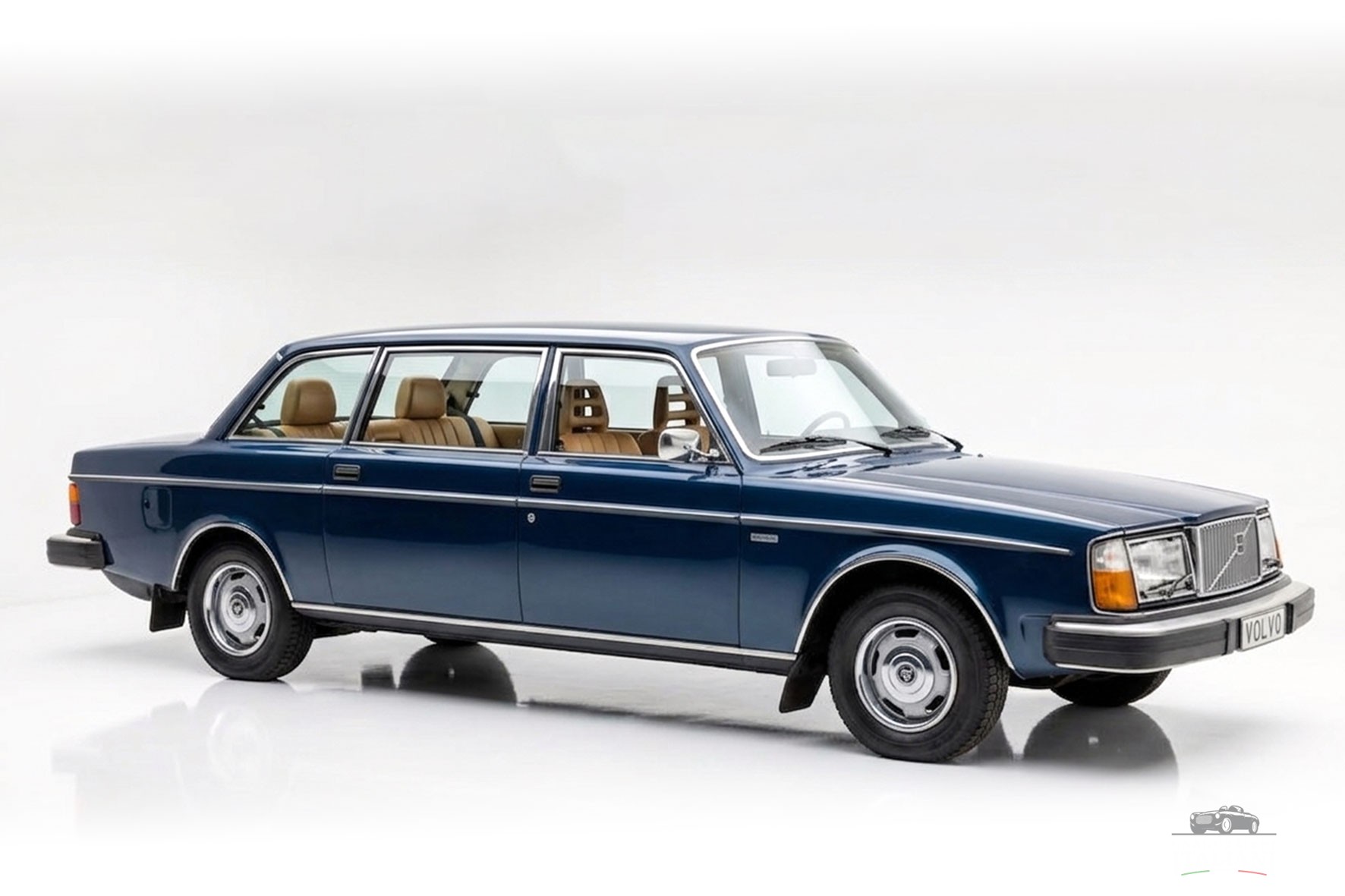
The Volvo 264 TE (Top Executive) was an extended-wheelbase limousine developed from Volvo’s six-cylinder 264 saloon and built in small numbers with the participation of Bertone in Italy. It belonged to a distinctive programme in which Volvo’s engineering and safety architecture were adapted for official transport, diplomatic duties and private executive use. Volvo’s own historical account identifies the Italian-built TE as a 5.60-metre representative limousine, rather than a standard 264 with additional trim.
Development and construction
The specialist Swedish magazine Klassiker places the presentation of the 264 TE in April 1975, while later sources give differing production date ranges. Bertone received Volvo body shells for extension, finishing and assembly at its Turin-area facilities. The modified four-door body had longer rear doors and additional side glazing, with an overall length of approximately 5,600 mm. Specialist records report a wheelbase of 3,430 mm, a figure retained with its source rather than inferred from the standard 264’s dimensions. Volvo’s 2014 retrospective describes both the 264 TE and the separately developed 245 Transfer as 70 cm longer than their respective standard models.
Early examples were associated with the PRV V6 of 2,664 cm³ used by the Volvo 264, while later cars followed developments of the 260-series powertrain. These figures should not be treated as one unchanging specification for every TE built. The 1979 Volvo sales brochure specifies a three-speed automatic transmission as standard in the version it describes. Its factory literature also documents air conditioning, electrically operated windows and radio aerial, a four-speaker radio with rear-passenger volume control, individual reading lamps and provision for a telephone in the rear armrest.
Passenger accommodation and official service
Two folding intermediate seats allowed the 264 TE to carry six passengers in addition to the driver. The seats, plush upholstery and extended rear compartment distinguished it from the regular saloon. Period brochures offered combinations of dark blue, black, metallic silver and white exterior finishes with grey or blue plush interiors, although those colours cannot be assigned to any particular surviving car without individual evidence. A 1979 brochure photograph shows the registration BNL 443; the image alone does not establish the chassis identity or subsequent ownership of that vehicle.
The 264 TE was used in government service, including by the German Democratic Republic. The DDR Museum in Berlin preserves a 1982 example recorded as having belonged to the GDR Council of Ministers’ fleet. Contemporary specialist reporting also illustrates King Carl XVI Gustaf inspecting a new 264 TE at Bertone and describes a later car given by the Swedish royal household to the Norwegian royal household. Neither account establishes the king as the registered owner of an identified Bertone-built chassis.
Production and the later programme
The often-quoted figure of 335 cars appears in museum and specialist sources. However, Klassiker distinguishes approximately 335 vehicles assembled by Bertone from subsequent production undertaken by Yngve Nilssons Karosserifabrik in Sweden. The combined total and precise end date have not been established from a complete factory ledger; a museum entry uses 1976–1984, whereas the specialist history describes the last regular examples around 1983. Accordingly, 335 should be understood as a reported figure whose production scope needs qualification, not an independently audited total for every derivative.
The Bertone-built limousine programme also provides historical context for the later Volvo 262C coupé, which shared the Swedish manufacturer’s Italian manufacturing partnership but was a distinct two-door model. The Volvo 780 Bertone continued that relationship in a later generation, without being a direct variant of the 264 TE.


THE CONVERSATION
Comments 0