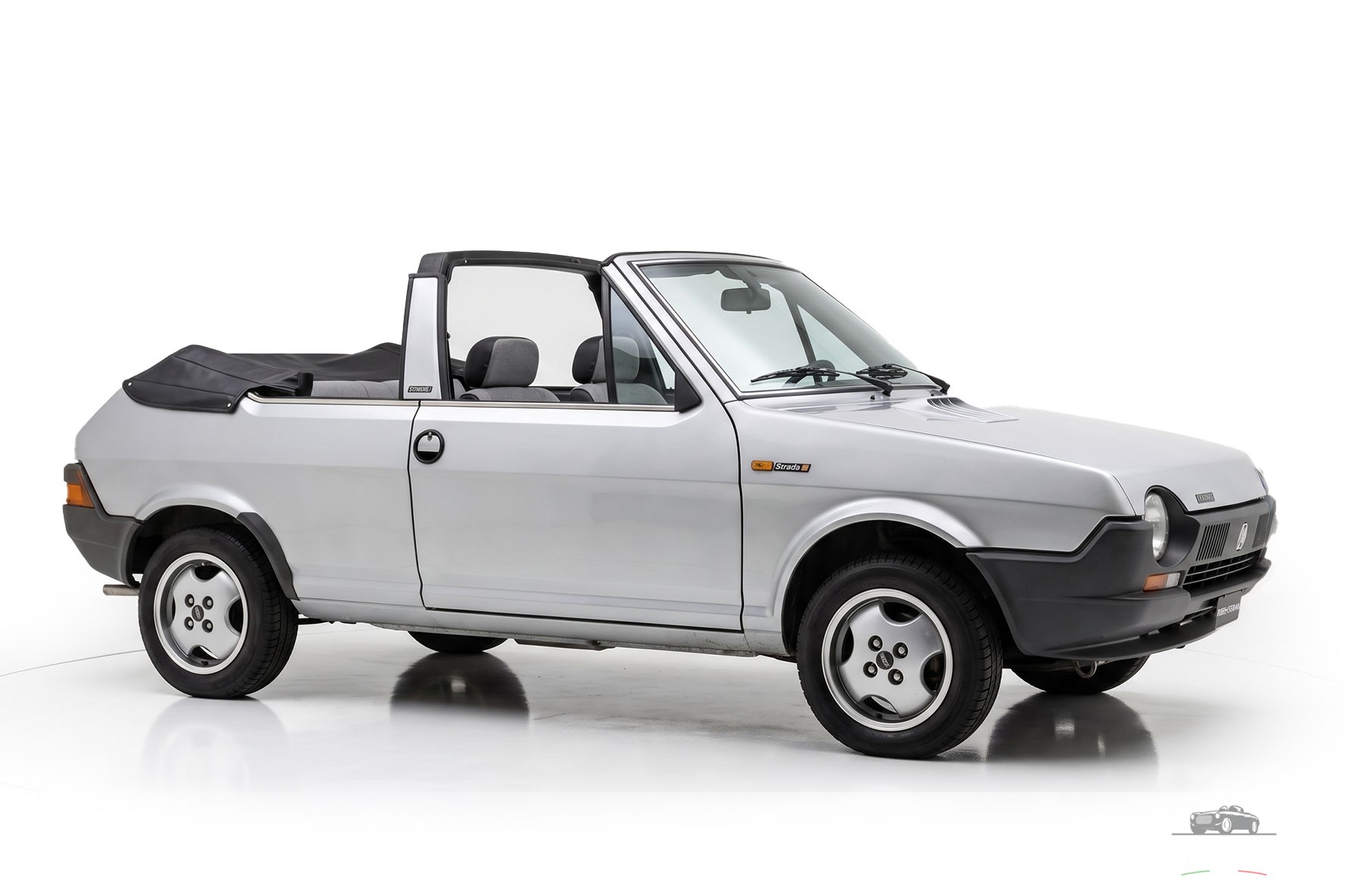
The Bertone-built Fiat Ritmo Cabrio transformed Fiat’s front-wheel-drive compact hatchback into a practical open four-seater. The original Ritmo had been introduced in 1978, and the coachbuilder’s conversion retained its transverse-engine mechanical layout while substantially reworking the body structure. A prominent fixed roll-over bar divided the open cabin and supported the folding fabric hood. The Cabrio was more than a hatchback with its roof removed: reinforcement of the shell and the treatment of the rear body and luggage compartment were central to the conversion.
The chronology of the prototype is not entirely settled in the available accounts. The original Carrozzieri Italiani record places its presentation at the Frankfurt Motor Show in 1979 and also associates it with Geneva in 1980; later specialist histories variously describe a Turin presentation in 1979 or a Frankfurt appearance in 1981. Without a contemporary show catalogue that identifies the precise prototype, those appearances should remain attributed rather than treated as a single confirmed debut. Series manufacture followed in the early 1980s at Bertone’s Grugliasco facilities, where the standard Fiat three-door body provided the starting point for the reinforced convertible.
The early Cabrio was offered with Fiat four-cylinder engines, including a 1,498 cc version. A surviving Bertone advertisement gives 82 HP for one 1.5-litre specification and lists equipment such as electric windows and central locking, while period-model catalogues also document an 85 CV 1.5-litre Cabrio S. These figures describe different published configurations and should not be merged into a single universal engine rating. The convertible evolved alongside the closed Ritmo, and Bertone subsequently developed the Supercabrio with a more powerful twin-cam engine. The Cabrio Leader represented a later special edition within the same programme.
The Ritmo Cabrio occupies a distinctive position in the history of Italian production coachbuilding: Bertone was responsible not merely for styling but also for the extensive structural conversion and assembly of a series-production open car. Contemporary and retrospective sources disagree on the exact production total and final year. The original database recorded 15,544 cars through 1986, while other histories give approximately 15,000 across the model’s different versions into the late 1980s; these figures should be treated as reported totals until reconciled against factory records. The separate Rayton Fissore Ritmo Cabriolet illustrates another coachbuilder’s approach to the same Fiat platform, not a Bertone derivative.


THE CONVERSATION
Comments 0