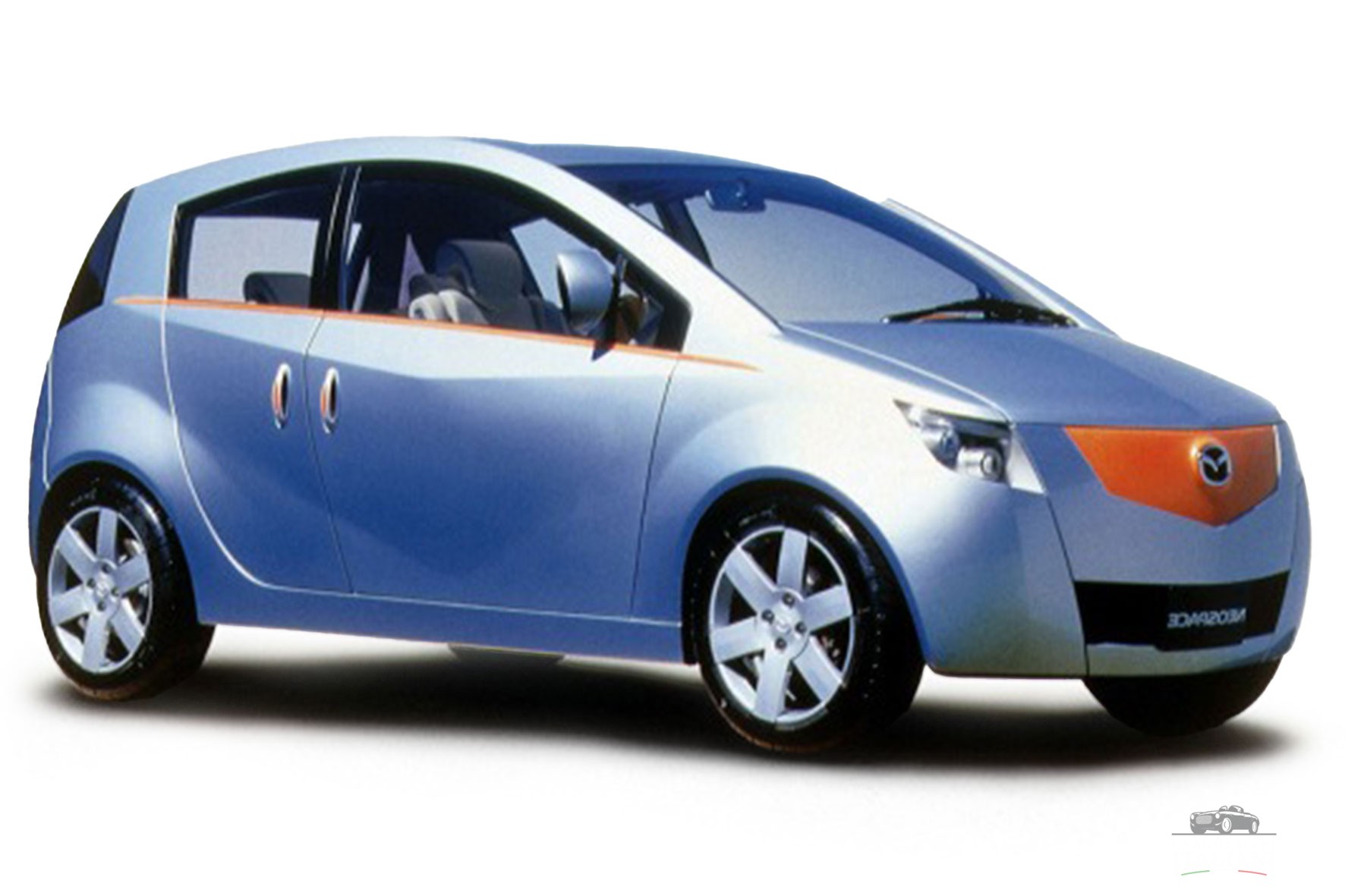
Introduced at the 1999 Frankfurt Motor Show, the Mazda Neospace explored how a compact car could provide the passenger space and versatility of a small MPV without conventional minivan proportions. Mazda presented it as a “Functional Compact Car” alongside the Nextourer concept and the new MPV. The Neospace was subsequently included in Mazda’s display at the Tokyo Motor Show in October 1999. It remained an experimental design programme rather than a production model.
European design and Italian construction
The concept was developed within Mazda Research & Design Europe, while the show car’s construction is attributed in specialist documentation to Stile Bertone in Turin. The distinction matters: Bertone’s role in building the physical prototype does not by itself establish that the Italian studio originated its design. The original listing credits Kevin Rice and Erica Tsubaki, but the precise individual division of responsibility remains to be corroborated by contemporary design records. Mazda and Bertone had previously collaborated on the separate MX-81 Aria concept of 1981; no direct mechanical or stylistic derivation between the two projects has been demonstrated.
Packaging and mechanical proposal
Measuring 3,900 mm long, 1,695 mm wide and 1,550 mm high, on a 2,550 mm wheelbase, the Neospace was designed to seat four adults. Its pillarless Freestyle Door System paired conventional front doors with rear-hinged smaller rear doors. The rear seats could be folded into the floor, while a retractable rear bumper incorporated a loading ramp. A centrally mounted instrument display, floating front-seat supports and a low cargo floor were intended to make the most of the interior volume.
Period Mazda-attributed technical material described a 1.5-litre DOHC direct-injection petrol four-cylinder with a metal-belt continuously variable transmission, MacPherson-strut front suspension, a torsion-beam rear axle and Michelin PAX run-flat tyres. These are published concept specifications, not independent proof of the exact mechanical installation or operating condition of the surviving show car. The separate 2.0-litre manual-transmission specification in Mazda’s Japanese Frankfurt release concerns the production MPV, not the Neospace.
Place in Mazda’s design history
In a 2002 interview, Mazda design chief Yasushi Nakamuta described the European Neospace proposal as one of the early ideas considered during development of the second-generation Demio. He also explained that the design eventually selected for production came from Mazda’s Hiroshima studio. The Neospace is therefore relevant to the Demio’s design history without being identified as its direct production prototype or donor vehicle. A German-language Neospace/Nextourer brochure dated September 1999 survives in the automobilia market; no authenticated chassis number, registration plate or vehicle-specific sale price has been established in the sources examined.


THE CONVERSATION
Comments 0