
Pininfarina
Founded by Battista Pinin Farina in Turin in 1930, Pininfarina became one of the most influential Italian styling and coachbuilding houses, particularly through its work for Ferrari and other international manufacturers.
Explore record ↗
1964Coachwork by Pininfarina
THE VEHICLE AT A GLANCE
THE PEOPLE BEHIND THE CAR
Founded by Battista Pinin Farina in Turin in 1930, Pininfarina became one of the most influential Italian styling and coachbuilding houses, particularly through its work for Ferrari and other international manufacturers.
Explore record ↗01 / THE STORY
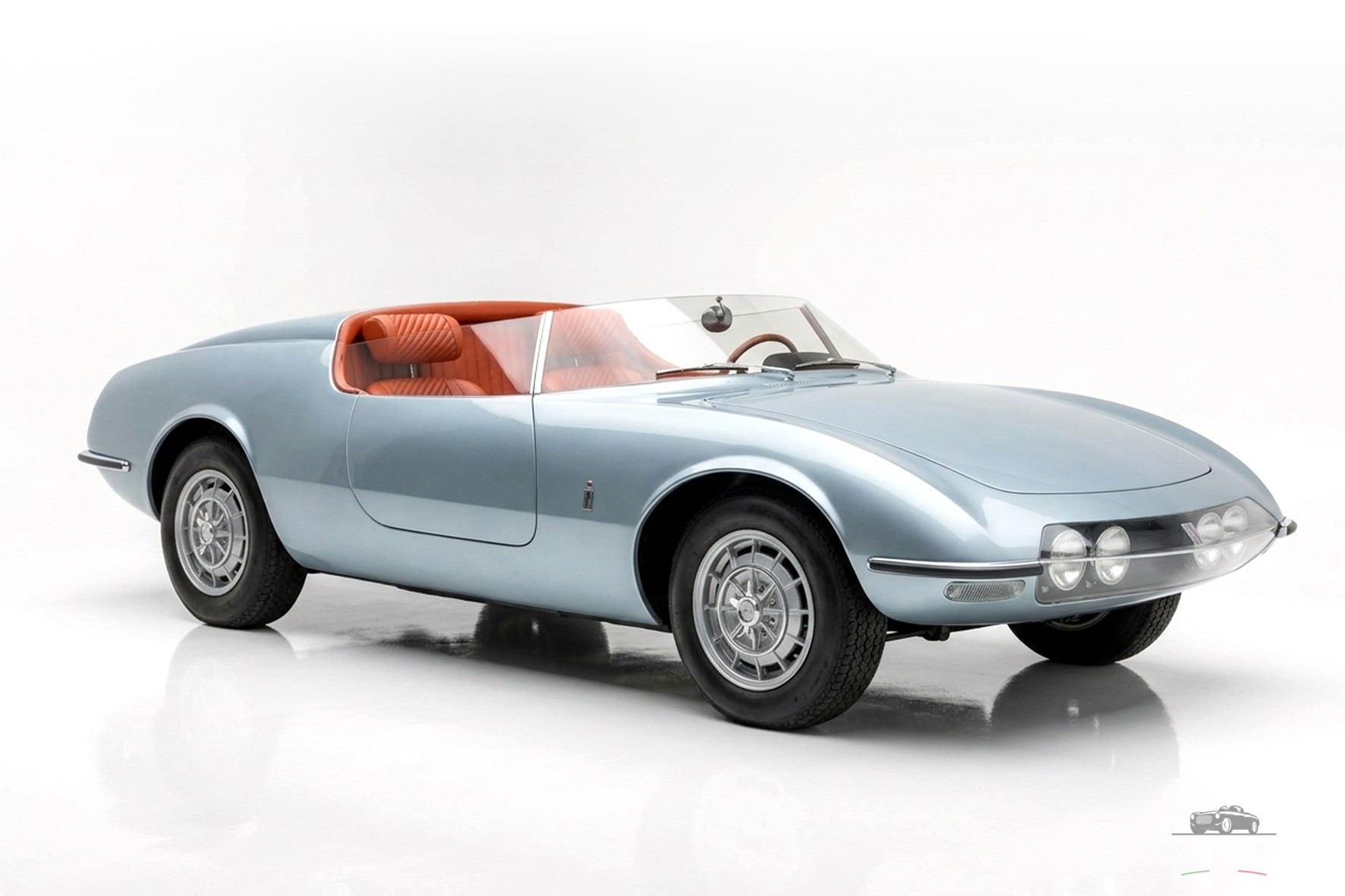
The 1964 Abarth 1000 Spider Speciale was an experimental open sports car created by Pininfarina with Abarth mechanical components and presented at the 1964 Turin Motor Show. Its underlying architecture derived from the rear-engined Fiat 850, but its body was a distinct coachbuilt study rather than a production variant of the small Fiat. The Spider is documented as a single concept car, with no confirmed series-production programme.
The design placed a low, sharply descending nose ahead of a compact two-seat cockpit and a raised rear section accommodating the engine. A slim, transparent wind-deflecting band extended around the passenger compartment, including the sides of the car. Unlike a conventional windscreen and roof, this nearly continuous glass strip provided broad lateral visibility while leaving the occupants exposed to the weather. The open cabin was therefore a deliberate element of the styling experiment, not the weather-protected interior of a touring Spider.
The front lighting was integrated behind a broad transparent cover, giving the nose an uninterrupted horizontal appearance. Contemporary and later descriptions of the design emphasise the fragility of this arrangement in ordinary road use. Pininfarina was testing how glazing could form part of the exterior surface and visual identity of a very small sports car, rather than merely surrounding the passenger compartment. The effect was particularly noticeable against the relatively restrained rear-engine mechanical layout.
The concept retained the Fiat 850 family’s rear-engine, rear-wheel-drive arrangement, using a 982 cc Abarth-developed inline-four with a four-speed manual gearbox. Later technical accounts list a length of 3,780 mm, a width of 1,500 mm, a height of 1,080 mm and a weight of 635 kg. Published power figures differ, and published wheelbase specifications are not consistent; neither has been accepted as a confirmed individual-vehicle specification. No chassis number or independently documented performance test has been established for this exhibition car. Technical figures belonging to the later production Fiat-Abarth OT1000 Spider must not be transferred to the Pininfarina prototype without supporting evidence.
The open Spider preceded the related Abarth 1000 Coupé Speciale, shown by Pininfarina in 1965. Although both concepts were based on the Fiat 850 and shared a low, experimental body treatment, the coupé adopted a fully enclosed cockpit and an unusual forward-tilting canopy. The two designs should be catalogued as separate prototypes, not as alternative photographs or body states of one documented chassis.
Period photographs document the Spider’s public presentation, while its later ownership, precise chassis identity and present survival remain undetermined. Pininfarina’s wider work in Italian coachbuilding is covered in Pininfarina Through the Ages.
02 / TECHNICAL IDENTITY
03 / DESIGN, BODY & SUPPLIERS
Coachbuilder / Design studio
Founded by Battista Pinin Farina in Turin in 1930, Pininfarina became one of the most influential Italian styling and coachbuilding houses, particularly through its work for Ferrari and other international manufacturers.
Explore record ↗04 / CHRONOLOGY
07 / GALLERY
CONTINUE READING
Discover the fascinating journey of Pininfarina, a name synonymous with luxury automotive design and innovation. From its inception in 1930 to its status as a leader in the industry, this article explores…
Read story
THE CONVERSATION
Comments 0