

Pininfarina
Founded by Battista Pinin Farina in Turin in 1930, Pininfarina became one of the most influential Italian styling and coachbuilding houses, particularly through its work for Ferrari and other international manufacturers.
Explore record ↗
1965Coachwork by Pininfarina
THE VEHICLE AT A GLANCE
THE PEOPLE BEHIND THE CAR
Founded by Battista Pinin Farina in Turin in 1930, Pininfarina became one of the most influential Italian styling and coachbuilding houses, particularly through its work for Ferrari and other international manufacturers.
Explore record ↗01 / THE STORY
The 1965 Abarth 1000 Coupé Speciale was a two-seat experimental sports car developed through a collaboration between Pininfarina and Abarth. It combined Pininfarina’s study of a very low, enclosed coupé body with mechanical components derived from the Fiat 850 and modified by Abarth. The project followed the open Abarth 1000 Spider, presented at Turin in 1964, but used a quite different solution for access to its passenger compartment.
The Coupé Speciale was conceived around a long, sloping nose and a comparatively full rear section containing the mechanical assemblies. Its front wings were slim, with the headlamps set behind a continuous transparent cover. Contemporary descriptions identify Carello as the supplier of the lighting equipment. Small steel-and-rubber guards protected the outer edges of the front wings without interrupting the low frontal profile.
The body sides had a restrained crease, while the broad rear window and inclined windscreen formed part of a single, visually continuous upper structure. Rather than relying on conventional side access, the passenger canopy was hinged to tilt forward. Its rear section also served as a protective hoop. The two small quarter-lights, extensive glazing and low seating position made the relationship between visibility, access and aerodynamic form central to the design. Pininfarina was exploring a feature of Italian experimental coachbuilding in which large transparent surfaces played both functional and stylistic roles; the broader development is examined in Italy’s Plexiglas Revolution in Postwar Car Design.
The mechanical basis was a Fiat 850 fitted with an Abarth four-cylinder engine of 982 cc, rated at 54 DIN horsepower in contemporary Pininfarina descriptive material. A 9/37 final-drive ratio and Girling disc brakes were also specified. Secondary technical catalogues list a four-speed manual gearbox, rear-wheel drive and a 2,000 mm wheelbase for this concept; these dimensions are model-level specifications rather than measurements tied to an identified chassis. The car was also described with lightweight Elektron-alloy wheels, selected to reduce unsprung mass compared with conventional wheels.
The interior followed the unusual exterior architecture. The occupants sat low, in rearward-inclined seats upholstered in elastic leather over protective foam padding. Instruments were grouped in a small, streamlined housing rather than a conventional full-width dashboard, and the steering wheel could be moved aside to ease entry. These provisions addressed the compromises created by the exceptionally low roof and forward-opening canopy.
The Coupé Speciale is recorded as a single styling prototype, not a production version of the Fiat 850. Its precise chassis identity, later ownership history and surviving configuration remain undetermined. It belongs to the mid-1960s sequence of experimental Pininfarina bodies produced in collaboration with manufacturers seeking to demonstrate new design solutions. For the coachbuilder’s wider history and experimental design work, see Pininfarina Through the Ages.
02 / TECHNICAL IDENTITY
03 / DESIGN, BODY & SUPPLIERS
Coachbuilder / Design studio
Founded by Battista Pinin Farina in Turin in 1930, Pininfarina became one of the most influential Italian styling and coachbuilding houses, particularly through its work for Ferrari and other international manufacturers.
Explore record ↗04 / CHRONOLOGY
07 / GALLERY
CONTINUE READING
Discover the fascinating journey of Pininfarina, a name synonymous with luxury automotive design and innovation. From its inception in 1930 to its status as a leader in the industry, this article explores…
Read story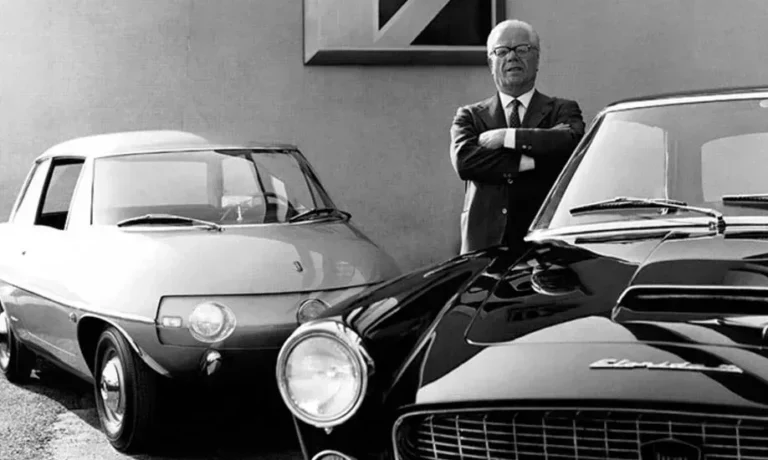
THE CONVERSATION
Comments 0