Aldo Brovarone
Aldo Brovarone was an Italian automotive stylist associated with Pininfarina, contributing to the Turin firm's post-war tradition of refined sports cars and experimental design.
Explore record ↗
1956Coachwork by Pininfarina
THE VEHICLE AT A GLANCE
THE PEOPLE BEHIND THE CAR
Aldo Brovarone was an Italian automotive stylist associated with Pininfarina, contributing to the Turin firm's post-war tradition of refined sports cars and experimental design.
Explore record ↗Founded by Battista Pinin Farina in Turin in 1930, Pininfarina became one of the most influential Italian styling and coachbuilding houses, particularly through its work for Ferrari and other international manufacturers.
Explore record ↗01 / THE STORY
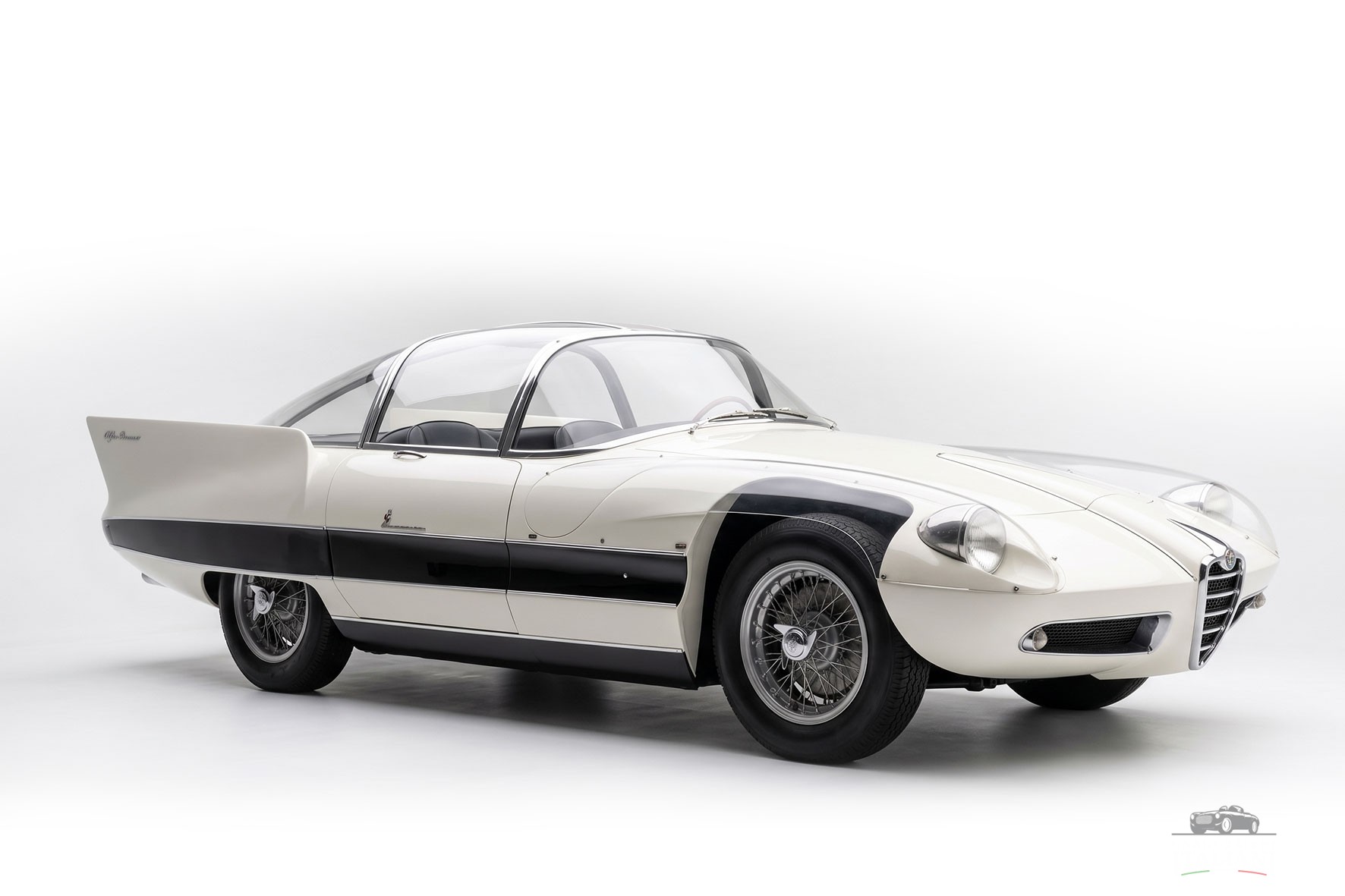
The Alfa Romeo 6C 3000 CM Super Flow I is a unique and fascinating chapter in Alfa Romeo’s legacy, blending racing heritage with cutting-edge design experimentation. Originally, the car was built as a racing model with a body by Carrozzeria Colli, designed specifically for competition. This vehicle was driven by the legendary five-time Formula One World Champion Juan Manuel Fangio, who took it to an impressive second place in the 1953 Mille Miglia, one of the most grueling endurance races of the time. Following its racing career, the car transitioned into something much more experimental. The chassis, numbered 1361.00128, was handed over to Pininfarina, where it became a rolling laboratory for aerodynamic research and design innovation. From 1956 to 1960, this particular chassis underwent four different body transformations, but the first, known as Super Flow I, is particularly iconic. The Super Flow I featured a radically futuristic design that pushed the boundaries of what was considered possible in automotive styling at the time. Key features included a sloping plexiglass roof, which was not only aerodynamic but also highly unconventional. In addition, the car sported fins at the rear, lending it a look reminiscent of aircraft design, which was popular during the era’s fascination with jet-age styling. Perhaps the most daring element of the Super Flow I was its transparent plexiglass front fenders, which provided a view of the front suspension and wheels. This was a bold aesthetic choice, reflecting Pininfarina’s desire to showcase the car’s mechanical elements, but it seems this innovation wasn’t particularly practical or effective. As a result, later versions of the Super Flow returned to more conventional opaque front fenders. Despite these evolutions, the Super Flow I remains the most memorable version, illustrating Pininfarina’s forward-thinking approach to automotive design. Its experimental nature, combined with Alfa Romeo’s 6C 3000 CM racing chassis, makes it a rare and significant piece of automotive history, symbolizing the blend of performance and innovation that both Alfa Romeo and Pininfarina were known for.
02 / TECHNICAL IDENTITY
Become a Pro member to see the full details in this section.
Membership is not available yet.
View membership options03 / DESIGN, BODY & SUPPLIERS
Coachbuilder / Design studio
Founded by Battista Pinin Farina in Turin in 1930, Pininfarina became one of the most influential Italian styling and coachbuilding houses, particularly through its work for Ferrari and other international manufacturers.
Explore record ↗Designer
Aldo Brovarone was an Italian automotive stylist associated with Pininfarina, contributing to the Turin firm's post-war tradition of refined sports cars and experimental design.
Explore record ↗04 / CHRONOLOGY
06 / CHASSIS REGISTER
07 / GALLERY

THE CONVERSATION
Comments 0