
Pininfarina
Founded by Battista Pinin Farina in Turin in 1930, Pininfarina became one of the most influential Italian styling and coachbuilding houses, particularly through its work for Ferrari and other international manufacturers.
Explore record ↗
1971Coachwork by Pininfarina
THE VEHICLE AT A GLANCE
THE PEOPLE BEHIND THE CAR
Founded by Battista Pinin Farina in Turin in 1930, Pininfarina became one of the most influential Italian styling and coachbuilding houses, particularly through its work for Ferrari and other international manufacturers.
Explore record ↗Paolo Martin worked with Giovanni Michelotti before joining Bertone and Pininfarina. At Pininfarina he developed the Ferrari 512 S Modulo and Fiat 130 Coupe, and also worked on the Rolls-Royce Camargue. He later became styling director at Ghia.
Explore record ↗01 / THE STORY
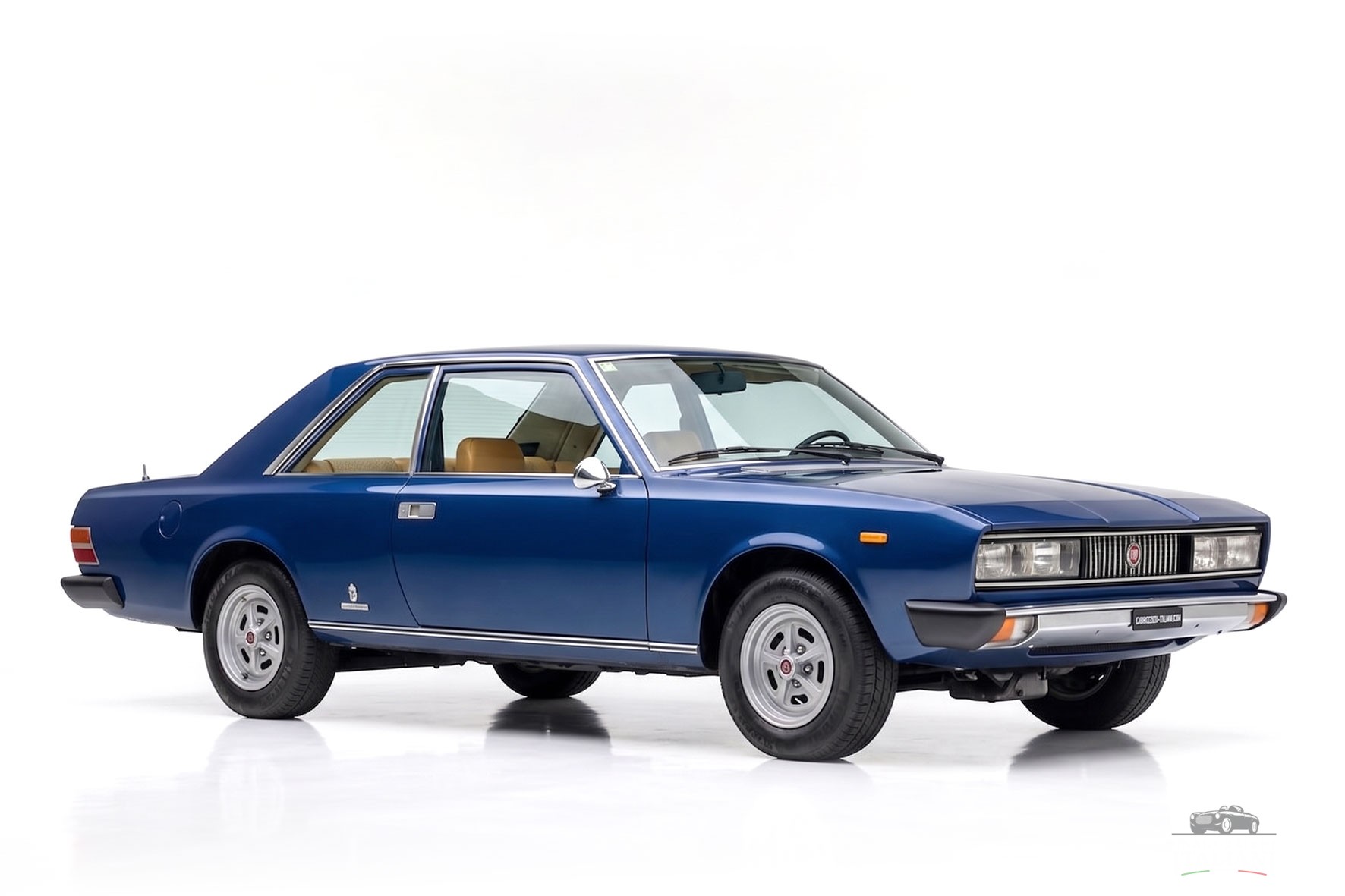
The Fiat 130 Coupé made a striking entrance onto the automotive scene in 1971, boasting a design penned by Paolo Martin during his tenure at Pininfarina. Its aesthetic was bold and distinctive, featuring sharp lines and angles that set it apart from its sedan counterpart. This model marked the inception of a modernist trilogy at Pininfarina, followed by equally visually captivating Italian coupes such as the Ferrari 365 GT4 2+2 and the Lancia Gamma. The same design language found its way onto the Rolls Royce Camargue, showcasing its versatility and impact. Manufactured at Fiat’s Rivalta plant, the body was then sent to Pininfarina for painting, assembly, and finishing, proudly bearing the Pininfarina branding. Despite this, the commercialization of the model remained Fiat’s responsibility. While the Fiat 130 Coupé borrowed most of its mechanics from the sedan, it boasted a slightly larger engine, with a displacement of 3235 cc, enhancing torque and drivability without significantly increasing power output. One significant drawback, however, was its high fuel consumption, which proved to be a challenge despite attempts to address it. Urban cycle figures were notably low, reaching as little as 3 km per liter, even considering its displacement. Moreover, potential buyers often perceived Fiat as a manufacturer of utilitarian vehicles, not luxury cars—a perception that clashed with the Fiat 130 Coupé’s positioning. Despite its technical prowess, the Fiat 130 Coupé struggled to shake off its proletarian brand image. Priced nearly three times higher than the Fiat 132, a luxury sedan in Fiat’s lineup, it faced challenges in garnering significant sales. The onset of the oil crisis in 1973 dealt a severe blow to the model, exacerbating its commercial struggles. While the Fiat 130 Coupé garnered praise for its design, it failed to translate this into sustained market success. Despite accolades such as a design award credited to Pininfarina, the Fiat 130 Coupé failed to sustain Fiat’s interest in producing unique variants. Prototypes like the Opera and the Maremma, conceived in 1974 and 1975 respectively, never saw full-scale production. Paolo Martin’s involvement ceased shortly after the design award in 1971, leaving behind a legacy of design innovation but also the challenge of overcoming the “proletarian” image associated with the Fiat brand. The onset of the 1973 oil crisis further exacerbated the model’s commercial struggles, ultimately leading to its demise in the market. The seats were shaped and designed by Paolo Martin with the collaboration of Giovanni Gottin, a specialist established in Turin. The dashboard was redesigned with sporty round dials, using white needles. The central console was redesigned by Paolo Martin, featuring wooden veneer, a row of switches and soft illumination throughout using state of the art fibre optics. The steering column is adjustable for rake and reach. The driver’s seat has a degree of height adjustment.
02 / TECHNICAL IDENTITY
03 / DESIGN, BODY & SUPPLIERS
Coachbuilder / Design studio
Founded by Battista Pinin Farina in Turin in 1930, Pininfarina became one of the most influential Italian styling and coachbuilding houses, particularly through its work for Ferrari and other international manufacturers.
Explore record ↗Designer
Paolo Martin worked with Giovanni Michelotti before joining Bertone and Pininfarina. At Pininfarina he developed the Ferrari 512 S Modulo and Fiat 130 Coupe, and also worked on the Rolls-Royce Camargue. He later became styling director at Ghia.
Explore record ↗Become a Pro member to see the full details in this section.
Membership is not available yet.
View membership options04 / CHRONOLOGY
05 / PEOPLE, COLLECTIONS & MUSEUMS
07 / CHASSIS REGISTER
08 / GALLERY
09 / PERIOD ARCHIVE
Become a Pro member to see the full details in this section.
Membership is not available yet.
View membership options
THE CONVERSATION
Comments 0