
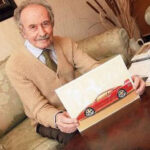
Aldo Brovarone
Aldo Brovarone was an Italian automotive stylist associated with Pininfarina, contributing to the Turin firm's post-war tradition of refined sports cars and experimental design.
Explore record ↗
1976Coachwork by Pininfarina
THE VEHICLE AT A GLANCE
THE PEOPLE BEHIND THE CAR
Aldo Brovarone was an Italian automotive stylist associated with Pininfarina, contributing to the Turin firm's post-war tradition of refined sports cars and experimental design.
Explore record ↗Founded by Battista Pinin Farina in Turin in 1930, Pininfarina became one of the most influential Italian styling and coachbuilding houses, particularly through its work for Ferrari and other international manufacturers.
Explore record ↗01 / THE STORY
The Lancia Gamma Coupé, designed by Aldo Brovarone and built by Pininfarina, was highly praised and is considered by many still relevant even after so much time because of its elegant and classic proportions. The stylistic exercise was better than that of its ancestors, both the Flaminia coupe, more showy and mammoth, and the 2000 coupe, more serious and squat. With the Lancia Gamma Coupé, Lancia finally found the right heir to the Aurelia B20 model. Unveiled at the 1976 Geneva Auto Show, the car was, essentially, a four-seater designed by Pininfarina, with mechanics identical to those of the sedan, except for the wheelbase shortened by 11.5 cm. Compared to the sedan, of course, the styling changed. The driving position was altogether peculiar, and in any case the space was not what one would expect from a coupe; in fact it even seemed excessive. In mechanics, this 3-box Grand Tourer from Turin elicited high praise on its debut. At the wheel, one immediately appreciated the road-holding qualities comparable to today’s cars. Credit was surely due to the combination of front-wheel drive and the low, light boxer engine. Braking, aided by Lancia’s Superduplex circuit, was comparable to that of modern cars and did not regret the absence of ABS. Power delivery and a very flat torque curve induce sporty touring-style driving that is enhanced on mixed-fast and not-too-twisty circuits. Production of the Gamma Coupe first series, built from 1976 to 1980, amounted to 1,978 units with a 2.0 engine and 2,337 units with a 2.5 engine. Similar to the sedan version, the Lancia Gamma Coupé also underwent a slight restyling in 1980. The 2.5-liter engine with Bosch electronic fuel injection was also introduced for the Coupe, replacing the previous one of equal displacement with carburetor. It also became possible to request it with a four-speed automatic transmission. The changes made to the body and interior layout were almost common to those of the Gamma sedan. From the model, the Pininfarina made a four-door sedan called the Gamma Scala in 1980, which was exhibited to critical acclaim at numerous shows. A proposal was also made to replace the standard sedan with this car, but in the end nothing came of it. An example called the Gamma Spider was also obtained, a T-top in which the rear pillars were joined by a center segment to the windshield, making it possible to remove the roof sections above the driver and front passenger, while the rear window was replaced with a roll-up clear plastic one. Another attempt to develop the Gamma Coupe theme in different keys was made with the Gamma Olgiata example, a “shooting brake” similar to the Beta HPE and stylistically equally successful. Of the second-series Gamma Coupé, 1,265 units with the 2.0 engine and 1,209 units with the 2.5 i.e. engine were produced. The overall production total of the Lancia Gamma Coupé (first and second series) was thus 6,789 examples. The Gamma Coupe went out of production in 1984, leaving a gap filled only in 1996 with the advent of the Lancia K coupé. In our Youtube series “Gentleman Garage“, former Pininfarina designer Fabio Filippini explains how the Pininfarina concept car “Cambiano” was inspired by the Lancia Gamma.
02 / TECHNICAL IDENTITY
03 / DESIGN, BODY & SUPPLIERS
Coachbuilder / Design studio
Founded by Battista Pinin Farina in Turin in 1930, Pininfarina became one of the most influential Italian styling and coachbuilding houses, particularly through its work for Ferrari and other international manufacturers.
Explore record ↗Designer
Aldo Brovarone was an Italian automotive stylist associated with Pininfarina, contributing to the Turin firm's post-war tradition of refined sports cars and experimental design.
Explore record ↗Become a Pro member to see the full details in this section.
Membership is not available yet.
View membership options04 / CHRONOLOGY
05 / PEOPLE, COLLECTIONS & MUSEUMS
08 / GALLERY

THE CONVERSATION
Comments 0