
Pininfarina
Founded by Battista Pinin Farina in Turin in 1930, Pininfarina became one of the most influential Italian styling and coachbuilding houses, particularly through its work for Ferrari and other international manufacturers.
Explore record ↗
1985Coachwork by Pininfarina
THE VEHICLE AT A GLANCE
THE PEOPLE BEHIND THE CAR
Founded by Battista Pinin Farina in Turin in 1930, Pininfarina became one of the most influential Italian styling and coachbuilding houses, particularly through its work for Ferrari and other international manufacturers.
Explore record ↗Enrico Fumia is an Italian automotive designer associated with Pininfarina, the Alfa Romeo 164 and 916 GTV/Spider, Ferrari F90 and Lancia.
Explore record ↗01 / THE STORY
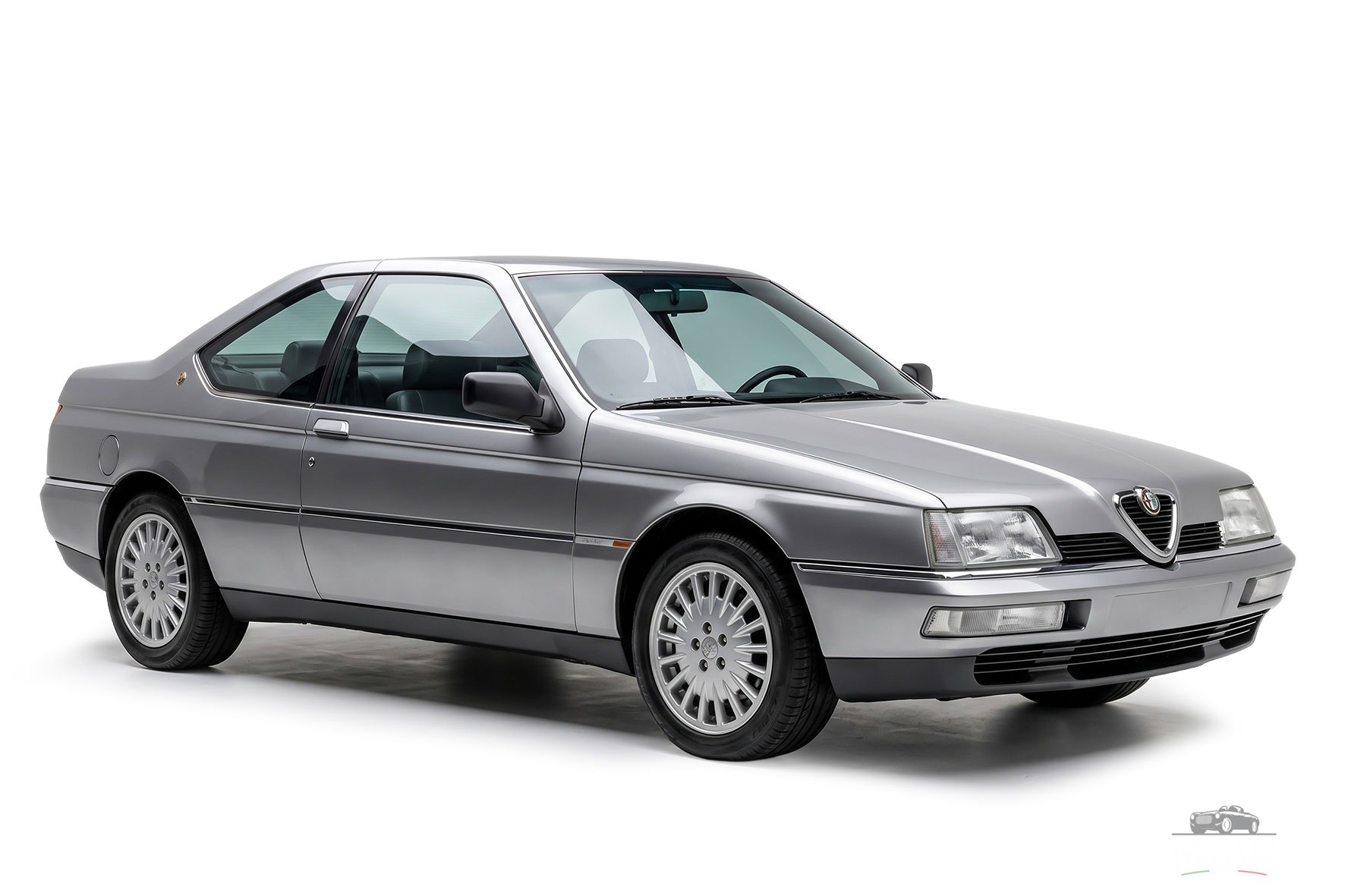
The Alfa Romeo 164 Coupé is a two-door design proposal associated with Pininfarina‘s development of the Alfa Romeo 164, with styling attributed to Enrico Fumia. The proposal is catalogued as a 1985 study and belongs to the period before the production Alfa Romeo 164 saloon made its public debut in 1987. The coupé was not included in the production range, and the available historical documentation does not establish an individual chassis number for this project.
The origins of the 164 programme can be traced to earlier work on Alfa Romeo project 154. Fumia has recalled developing the 154 styling in 1981 and receiving a request in 1982 to reinterpret those ideas for the larger Type Four platform. This architecture was shared in principle with the Fiat Croma, Lancia Thema and Saab 9000, while the production Alfa Romeo acquired its own body styling and distinctive treatment of the front and rear ends.
During the development programme, alternative body configurations were examined alongside the four-door saloon. These included a two-door coupé, a cabriolet study and an estate proposal. The programme’s eventual production outcome was the saloon. The existence of alternative styling projects should therefore be distinguished from approval of a road-going coupé model or a documented manufacturing series.
The coupé’s documented association with Fumia and Pininfarina places it within the broader evolution of Alfa Romeo’s late twentieth-century design language. On the production 164, the characteristic waistline groove, low bonnet, prominent Alfa Romeo shield and shallow transverse rear lighting helped establish a separate visual identity for a car developed on a shared platform. These themes provide historical context for the two-door proposal, but exact coupé dimensions, powertrain specifications, body construction and the mechanical configuration of a completed example remain unverified.
The catalogue’s legacy designation as a concept and its numerical production entry should not by themselves be taken as evidence of a functioning prototype. No independently documented chassis or production register has been established for the coupé in the reconciled project records. The vehicle is therefore treated here as a design project rather than an identified surviving car.
The 164 Coupé should not be confused with the Pininfarina Vivace show cars of 1986, which were associated with designer Diego Ottina and served to introduce Alfa Romeo styling themes to the public. It is also a separate project from the later 164 Super facelift and the GTV and Spider programme. The historical sequence matters because design studies, display vehicles and production models had different authorship, technical status and development objectives.
Further context is provided by the Alfa Romeo–Pininfarina collaboration and the Type Four platform programme.
02 / TECHNICAL IDENTITY
03 / DESIGN, BODY & SUPPLIERS
Coachbuilder / Design studio
Founded by Battista Pinin Farina in Turin in 1930, Pininfarina became one of the most influential Italian styling and coachbuilding houses, particularly through its work for Ferrari and other international manufacturers.
Explore record ↗Attributed designer
Enrico Fumia is an Italian automotive designer associated with Pininfarina, the Alfa Romeo 164 and 916 GTV/Spider, Ferrari F90 and Lancia.
Explore record ↗07 / GALLERY
CONTINUE READING
The story of Pininfarina and Alfa Romeo is one of mutual admiration and a shared passion for innovation in automotive design that spans nearly eighty years. This remarkable partnership, which began in…
Read storyThe Tipo Quattro (Type Four) program was launched in the late 1970s as a joint venture to develop a family of executive-class sedans efficiently. Fiat (including its Lancia and soon-to-be-acquired Alfa Romeo…
Read storyDiscover the fascinating journey of Pininfarina, a name synonymous with luxury automotive design and innovation. From its inception in 1930 to its status as a leader in the industry, this article explores…
Read story

THE CONVERSATION
Comments 0