
Pininfarina
Founded by Battista Pinin Farina in Turin in 1930, Pininfarina became one of the most influential Italian styling and coachbuilding houses, particularly through its work for Ferrari and other international manufacturers.
Explore record ↗
1985Coachwork by Pininfarina
THE VEHICLE AT A GLANCE
THE PEOPLE BEHIND THE CAR
Founded by Battista Pinin Farina in Turin in 1930, Pininfarina became one of the most influential Italian styling and coachbuilding houses, particularly through its work for Ferrari and other international manufacturers.
Explore record ↗Enrico Fumia is an Italian automotive designer associated with Pininfarina, the Alfa Romeo 164 and 916 GTV/Spider, Ferrari F90 and Lancia.
Explore record ↗01 / THE STORY
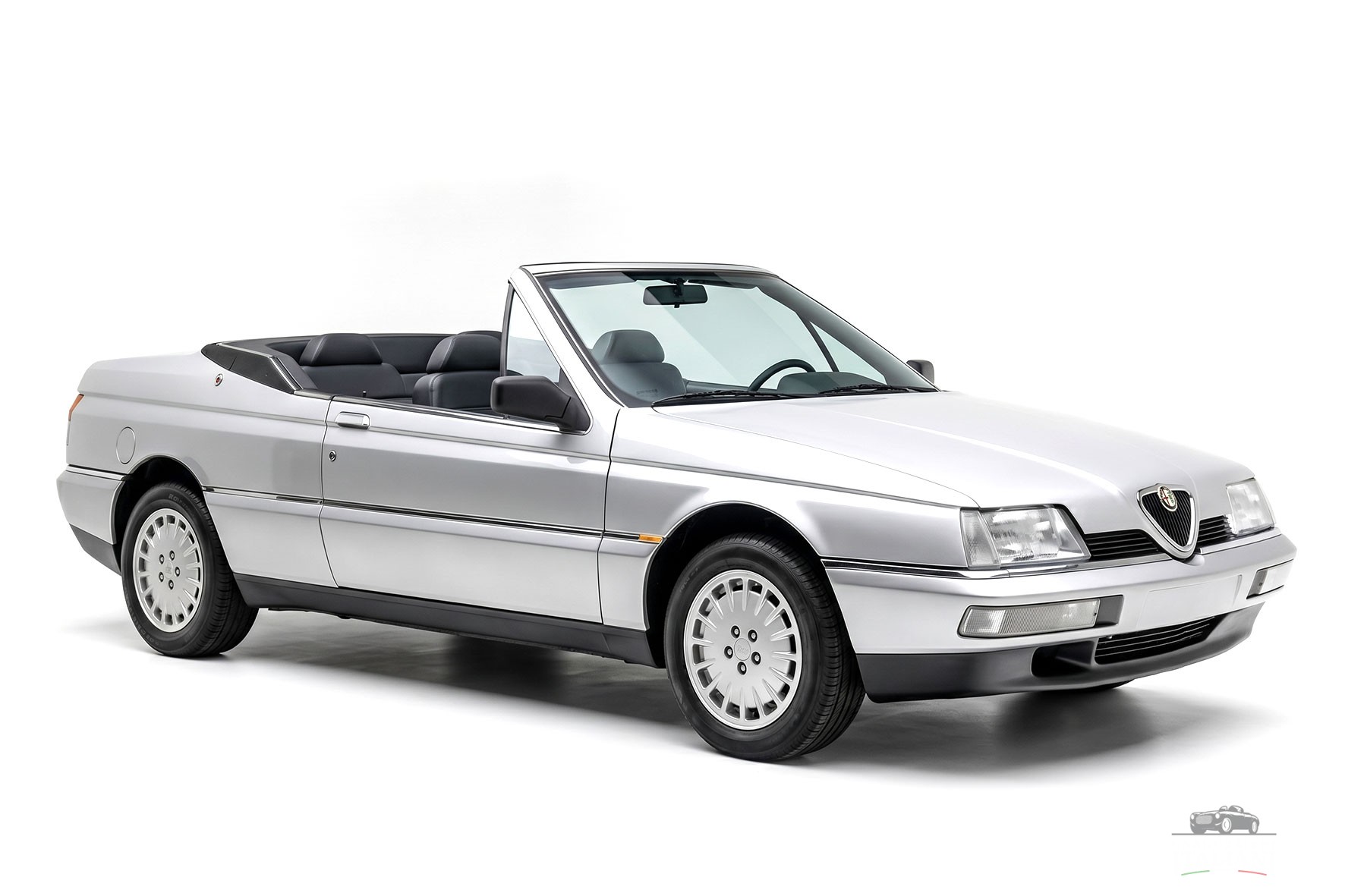
The Alfa Romeo 164 Cabriolet is an open-body design study associated with the 164 programme developed at Pininfarina under Enrico Fumia. The project is catalogued as a 1985 proposal and belongs to the research phase preceding the introduction of the production Alfa Romeo 164 saloon in 1987. It was not adopted as a catalogue model, and its available documentation does not establish a verified production chassis or a series of completed vehicles.
Fumia’s work on the 164 followed an earlier Alfa Romeo project identified as the 154. In a 2012 interview, the designer dated the 154’s initial design to 1981 and explained that, in 1982, Alfa Romeo requested the adaptation of its styling themes to the larger Type Four architecture. That platform was developed for several executive cars, including the Fiat Croma, Lancia Thema and Saab 9000. The subsequent Alfa Romeo 164 retained a distinct Pininfarina exterior treatment rather than sharing the same body panels with its platform relatives.
The proposed cabriolet should be understood against this broader design programme, not as a production derivative of a car already on sale. Contemporary development accounts also describe investigations of a 164 Coupé and an estate-body alternative. Alfa Romeo ultimately selected the four-door saloon for series manufacture; the other proposed body configurations were not included in the production range.
The 164 saloon’s principal styling themes include a sharply defined beltline recess, a low front profile focused around the Alfa Romeo shield, and a broad rear-lamp treatment. These belong to Fumia’s work at Pininfarina and provide the design context for the cabriolet proposal. The available descriptions do not, however, permit a reliable specification of the open car’s roof mechanism, exact dimensions, engine installation or structural construction. Specifications from the later series saloon must not be attributed automatically to this design study.
For the same reason, an image of a design proposal does not independently prove the existence of a functioning, chassis-numbered prototype. The legacy catalogue identifies the concept and gives a production quantity of one, but no primary build record or individual chassis identity has yet been established in the reconciled project documentation. The record is therefore maintained at project level.
The 164 Cabriolet is distinct from the Alfa Romeo Vivace show cars presented in 1986, whose styling was attributed to Diego Ottina and which helped introduce themes of Alfa Romeo’s forthcoming design language. It is also separate from the production 164’s later facelift and from the subsequent Spider and GTV programme. Those related developments form part of the same period of Pininfarina and Alfa Romeo design history, but they should not be treated as proof that the 1985 cabriolet study entered production.
The wider collaboration is documented in the history of Alfa Romeo and Pininfarina and in the account of the Type Four programme.
02 / TECHNICAL IDENTITY
03 / DESIGN, BODY & SUPPLIERS
Coachbuilder / Design studio
Founded by Battista Pinin Farina in Turin in 1930, Pininfarina became one of the most influential Italian styling and coachbuilding houses, particularly through its work for Ferrari and other international manufacturers.
Explore record ↗Attributed designer
Enrico Fumia is an Italian automotive designer associated with Pininfarina, the Alfa Romeo 164 and 916 GTV/Spider, Ferrari F90 and Lancia.
Explore record ↗07 / GALLERY
CONTINUE READING
The story of Pininfarina and Alfa Romeo is one of mutual admiration and a shared passion for innovation in automotive design that spans nearly eighty years. This remarkable partnership, which began in…
Read storyThe Tipo Quattro (Type Four) program was launched in the late 1970s as a joint venture to develop a family of executive-class sedans efficiently. Fiat (including its Lancia and soon-to-be-acquired Alfa Romeo…
Read storyDiscover the fascinating journey of Pininfarina, a name synonymous with luxury automotive design and innovation. From its inception in 1930 to its status as a leader in the industry, this article explores…
Read story

THE CONVERSATION
Comments 0