
How Pietro Camardella designed the Ferrari 456 GT
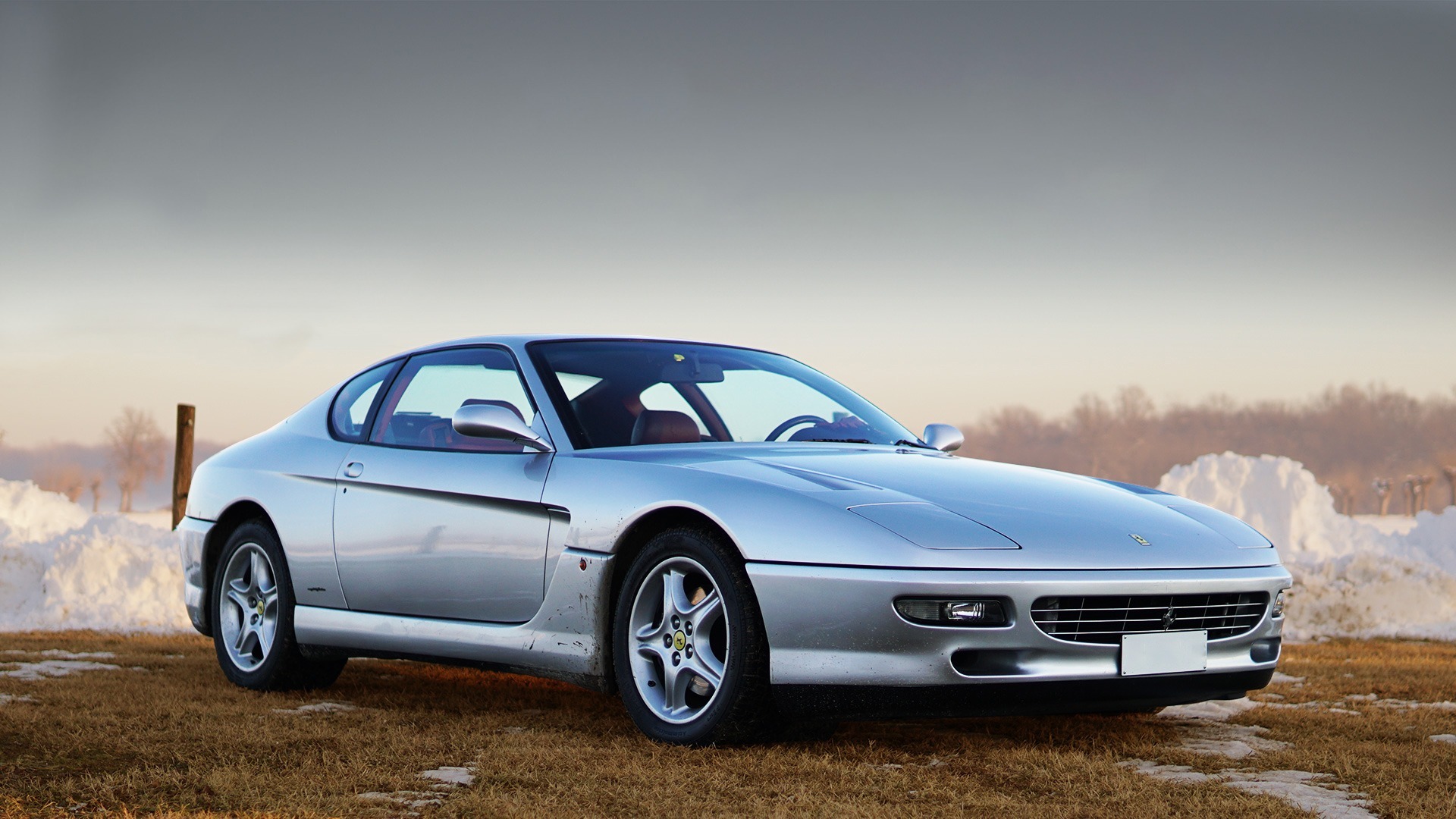
When Ferrari unveiled the 456 GT at Garage Francorchamps in Belgium on 24 September 1992, the car was blue and Pietro Camardella’s drawings stood on easels around it. One decision the finished car shared with those drawings was apparent from across the room. The bonnet looked exceptionally long and the cabin surprisingly small for a coupé with rear seats. That impression had taken years to get right.
In our interview, Camardella recalled that his first assignment at Pininfarina was an early proposal for the 456. By the time the car reached production, the programme had been through two styling rounds, and several details he had drawn had given way to decisions already made in engineering.
The F116 had to be drawn again
Camardella grew up in Salerno and studied architecture in Naples, sending car drawings to northern Italian studios in his spare time. Emanuele Nicosia helped him make contact with Pininfarina. During the selection process, Aldo Brovarone sent him back to revise his drawings until he secured a placement. He joined the styling office in September 1985 and began work on the Ferrari that would eventually become the 456.
Camardella traces that career back to drawings he made before school. Among the subjects he remembers are the horses in Leonardo’s Battle of Anghiari. The cars came later and stayed with him through art school and university. In Salerno, drawing cars could get a picture hung on the wall. It seemed a less realistic way to earn a living. He remembers the doubt he heard at home about whether a designer from Salerno would be needed in Turin. Architecture was the career he was preparing for when he began sending out his portfolios.
An early direction for the F116 programme was well advanced by 1989. The basic arrangement of the engine, cabin and chassis had already shaped what the body could do. Then BMW presented the 850i at the Frankfurt Motor Show.
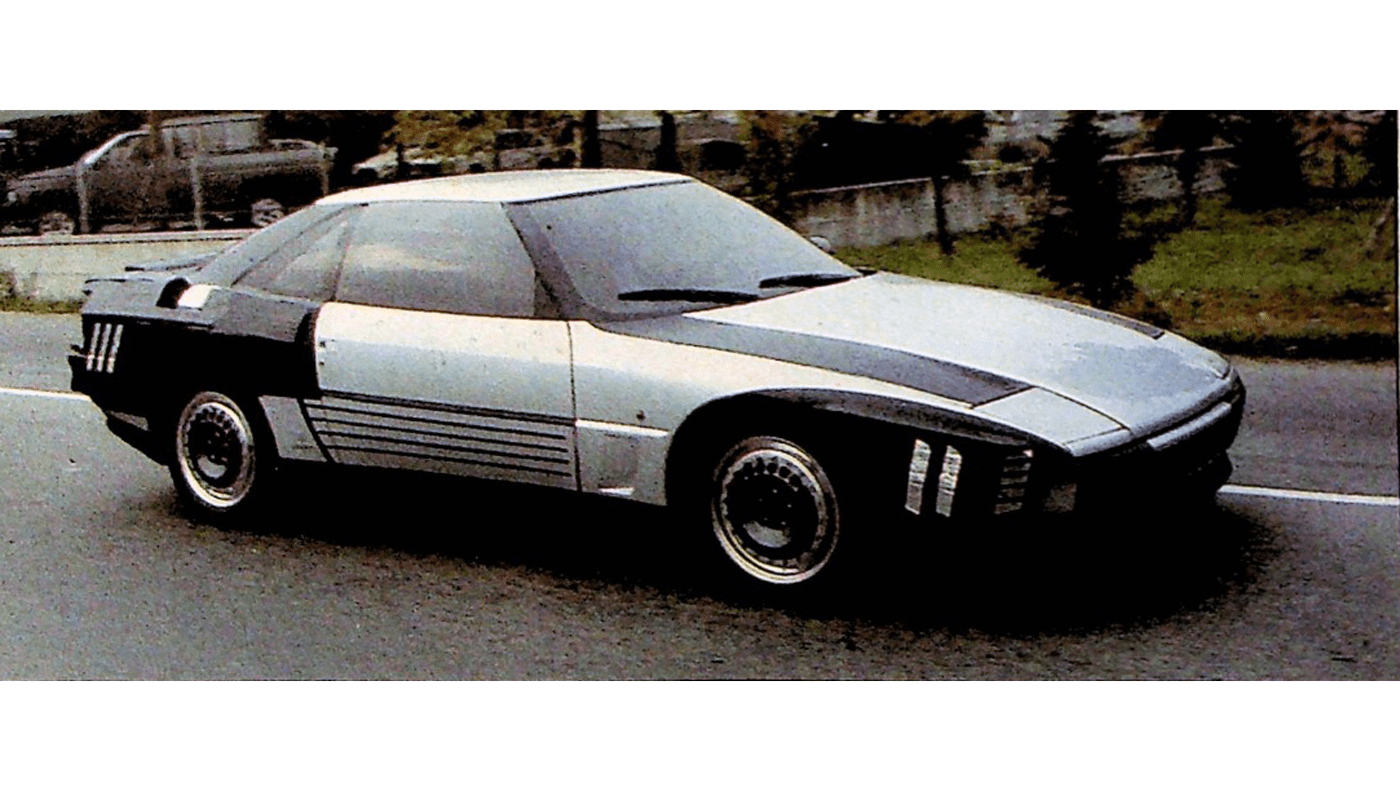
Camardella remembers being struck by how closely the BMW resembled the Ferrari proposal then in development. As he tells it, Ferrari reopened the styling work that autumn. The new proposals had to work around an engineering package already under development.

The return to the same project also gave Camardella a measure of how much he had changed at Pininfarina. He describes the revised proposal as his fourth Ferrari. The initial study had been the work of a newcomer. This time he understood how much of a sketch could survive contact with the people who had to turn it into a production car.
Ferrari chose Camardella’s design in the second internal competition. He describes developing the selected shape at one-fifth scale before engineering took it to full size. In December 1989 Pininfarina commissioned Stola to develop the finished exterior surfaces and build a verification master. The styling model was made at Cambiano under Lorenzo Ramaciotti’s direction.
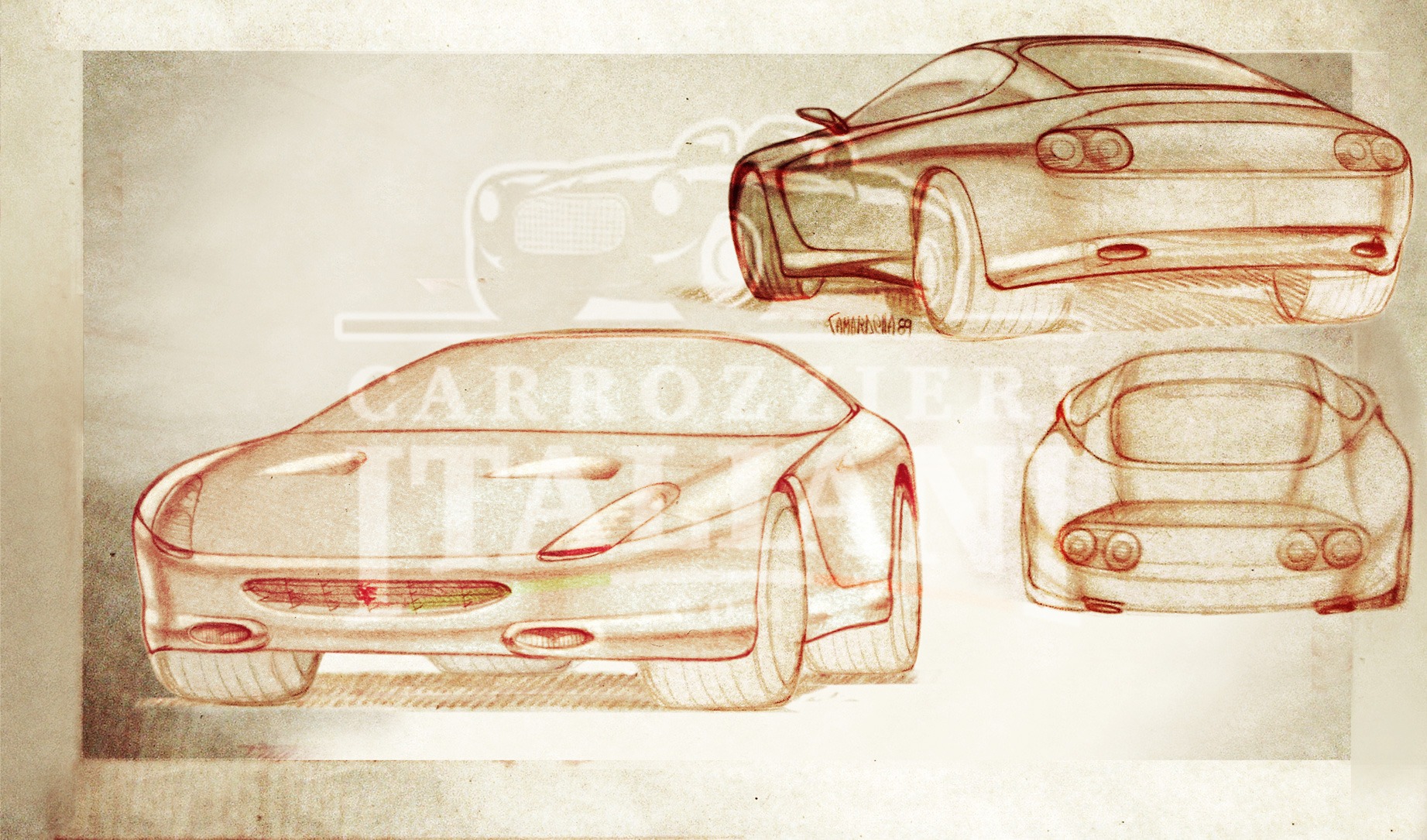
The sketches reproduced here belong to the styling stage. The one-fifth-scale form Camardella describes served another purpose. It set the shape in three dimensions so engineers could carry its surfaces into a full-size model. At Stola, the resulting master let the team check those surfaces against the engineering data. The workshop’s account also places Luca di Montezemolo at a technical presentation during that development, alongside engineers from Ferrari and Pininfarina. The finished exterior took shape through these exchanges after the design had been chosen.
A berlinetta with room for four
Camardella used the architectural term genius loci for what he wanted to recover. On the 456 that meant the proportions he associated with Ferrari’s front-engined berlinettas, especially the Daytona. He drew the windscreen and cabin as far back as the package allowed and tucked the glasshouse inboard of the widest parts of the body. Seen in profile or from above, there was more bonnet and less apparent cabin than the four seats might suggest.
The distinction between the two references shows up in the view from above. The body retains its width around the wheels while the cabin draws inward. As the sides of the glasshouse taper towards the rear, more of the shoulders remains visible. In Camardella’s account, pulling the windscreen back established the impression of a long bonnet. Narrowing the cabin in plan amplified it. The relationship between the two widths mattered as much as the profile of the roof.
The 365 GT 2+2 gave him a different reference. Its roofline changes direction slightly as it runs towards the rear, a detail Camardella used to give the 456 a lighter profile. The brief also called for a car that was easy to drive at speed, with controls that fell readily to hand. Making room for passengers and luggage was part of the design problem from the start.
Camardella says some of the other proposals relied on a more conventional separation of bonnet, cabin and boot. He kept returning to the Daytona because of the way its roof and rear body read together. He could carry that continuity into the 456 while borrowing the subtler change in the roof profile from the 365 GT 2+2. Each earlier car helped with a different part of the problem.
Turning the Mythos around
For the flanks, Camardella drew on a more recent project, the mid-engined Ferrari Mythos. On that concept, a slender front section appeared to slip into the broader body around the engine. For the 456 he reversed the arrangement. The volume over the front-mounted V12 dominates, while the rear body gathers around the cabin. The openings behind the front wheels mark the point where those shapes meet and let heat out of the engine bay.
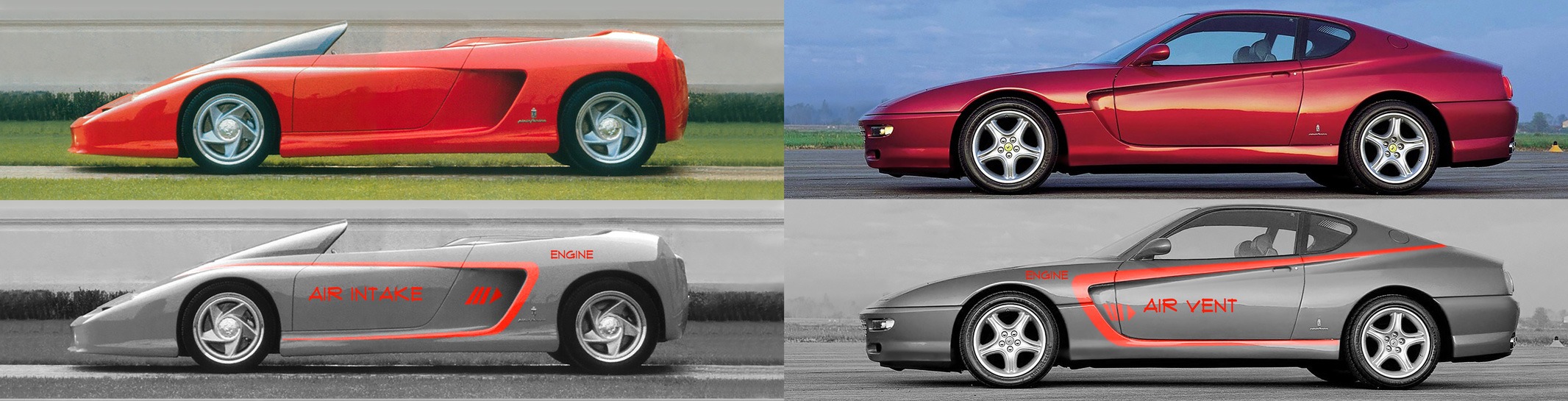
Camardella wanted the flanks to recover something he could see in earlier Ferraris, where the swell over each wheel had followed from the size of the wheels and the relatively low seating position. The 456’s engineering package gave those surfaces a different starting point. He arrived at a related effect by working on the engine bay, cabin and tail as separate masses, then joining them. The surface turns in behind the front wheel and fills out again towards the rear.
The front treatment had its own references. Camardella wanted three separate openings, developing an idea he associated with the F40 and the GTO. He drew fixed headlamps under clear covers, but Ferrari had already invested in the retractable units. Keeping those units meant finding new places for the indicators and position lamps, which changed the shape of the lower nose.
In the interview he describes a single broad grille as an international style he wanted to avoid. He liked the way the older GTO varied its front openings and returned to that idea in the F40. On the 456 the lamp decision had consequences for the rest of the nose. The clear-covered units would have grouped several lighting functions together. The production car needed separate lamps, occupying space Camardella had intended for a different arrangement of openings and fog lights.
The details that changed on the way to production
Camardella wanted the bonnet opening to carry away part of the front wings. He called it a cofango, combining cofano and parafango. The car went forward with a more conventional panel. He remembers Ferrari subsequently adding outlets reminiscent of the Daytona and questions how much their position near the lamps could do for cooling.
Camardella cites the Lamborghini Espada when describing where he wanted the bonnet seam to fall. Placing it down the side would let the upper surface of the nose read as a single piece. Open the bonnet and part of the wing would lift with it. The finished 456 is a useful comparison because the long bonnet survived while the cut that was meant to emphasise its width changed.
His wheel design was another point of debate. Thin spokes made the wheels look lighter, but they also made the hardware behind them more visible. An intermediate design filled part of the gaps. Ferrari dropped that proposal, and a close relative of the open-spoke design reached production first on the 512 TR.

Camardella preferred the proportions of the spokes and open spaces on the eventual 512 TR wheels. In his account, the 456’s production design softened the lines of the spokes. The proposed wheel in the photograph above shows an earlier stage of the discussion, when material was added between them to mask more of the hardware.
At the rear, Camardella grouped the round lights in pairs. He shaped the lenses around the angled tail so that they would read as circles from directly behind. That geometry changed during production development, leaving the lamps looking slightly splayed in rear view. In the interview he calls it the 456’s divergenza di Venere.
The corners of the tail turn away from the viewer in a straight rear view. His plan was to make the lenses elliptical in their own plane to compensate for that angle. Lower down, he welcomed an engineering change that reshaped the underside and introduced an aerodynamic element below the tail. He credits Ferrari’s solution with improving the car’s behaviour at speed. As he tells it, the rear of the 456 contains both a detail that lost some of its precision in production and a change that improved the car.
The blue 456 at Francorchamps
Garage Francorchamps was celebrating its fortieth anniversary. Camardella remembers the drawings arranged in a semicircle at the unveiling, putting the shape Ferrari had selected alongside the studies that led to it. The setting suited a car whose design story was easy to see in a sketch. The long bonnet and the compact roof could be read before anyone knew how the lamps worked or what the V12 could do.
The car shown in Belgium in September 1992 reached a wider public at the Paris Motor Show the following month. Ferrari again had a front-engined V12 2+2 in its range. The 5.5-litre engine and rear-mounted six-speed transaxle gave the coupé a top speed above 300 km/h, with space for rear passengers and fitted luggage.

The original GT was followed by the automatic 456 GTA in 1996. The 456M, introduced in 1998, revised the body and interior while retaining the front-engined 2+2 layout. The family remained in production until 2003. Pininfarina’s later special bodies provide a closer look at how the 456 could change. They altered the roof, doors or rear body while starting from the proportions Camardella had established.
The same design later provided a starting point for Pininfarina’s Venice estate, four-door saloon and open Spider. Each changes what happens behind the front seats, where the original car had worked so hard to disguise its size.
Looking back, Camardella thought about ninety per cent of his idea survived. He called the 456 his capolavoro stradale, the road car he was proudest of. The side view explains his attachment to it. The bonnet carries the weight of the shape, the cabin sits well back, and the sculpture of the flanks holds the two together. That relationship survived every decision about how the car could actually be built.

ABOUT THE AUTHOR
Andreas Scheidl
Italian classic car enthusiast with German roots. Renowned as a respected figure in the classic car community, he serves as a jury member at various international concours d'elegance, including the Classic Gala Schwetzingen and Mantova. As a content creator, Andreas passionately shares his profound knowledge and appreciation for vintage automobiles. His heart beats for cars designed by Giovanni Michelotti, showcasing his discerning taste and dedication to preserving the timeless elegance of automotive history.
More stories by Andreas Scheidl ↗CONTINUE READING
Posts You Might Like
The Fiat 500 Erina and the Zanella Brothers Who Built It
The Zanella brothers turned the Fiat 500 F into a two-seat roadster in Parma. Trace the Erina’s Turin show debut and the mystery of how many were built.
Read story
Blue in Turin, Red-Brown in Germany: The Long Life of Bertone’s Ferrari 166 Inter
One Ferrari chassis, one Bertone cabriolet, and a history divided between the show stands of postwar Italy, German classified advertisements and rival design attributions. A blue Ferrari among the saloon cars The…
Read story
The Pegaso That Missed New York: The Z-102 Thrill
The 1953 Pegaso Z-102 Thrill missed New York, dazzled Turin and survived a remarkable journey. Explore Touring’s design team and chassis 0133.
Read story
Abarth 1500 Biposto: Why Packard Gave It Away
A Letter from Detroit On 10 July 1953, James J. Nance, president of the Packard Motor Car Company, wrote to Richard Austin…
Read story
THE CONVERSATION
Comments 0
Share a memory, a period photograph or a documented detail about this story.