
Zagato
Founded in Milan in 1919 by Ugo Zagato, the coachbuilding house developed lightweight aerodynamic bodies inspired by aircraft construction, creating distinctive racing and grand touring automobiles.
Explore record ↗
1960Coachwork by Zagato
THE VEHICLE AT A GLANCE
THE PEOPLE BEHIND THE CAR
Founded in Milan in 1919 by Ugo Zagato, the coachbuilding house developed lightweight aerodynamic bodies inspired by aircraft construction, creating distinctive racing and grand touring automobiles.
Explore record ↗Ercole Spada (1937–2025) was an Italian automotive designer associated with Zagato, BMW and I.DE.A Institute and co-founder of Spadaconcept.
Explore record ↗01 / THE STORY
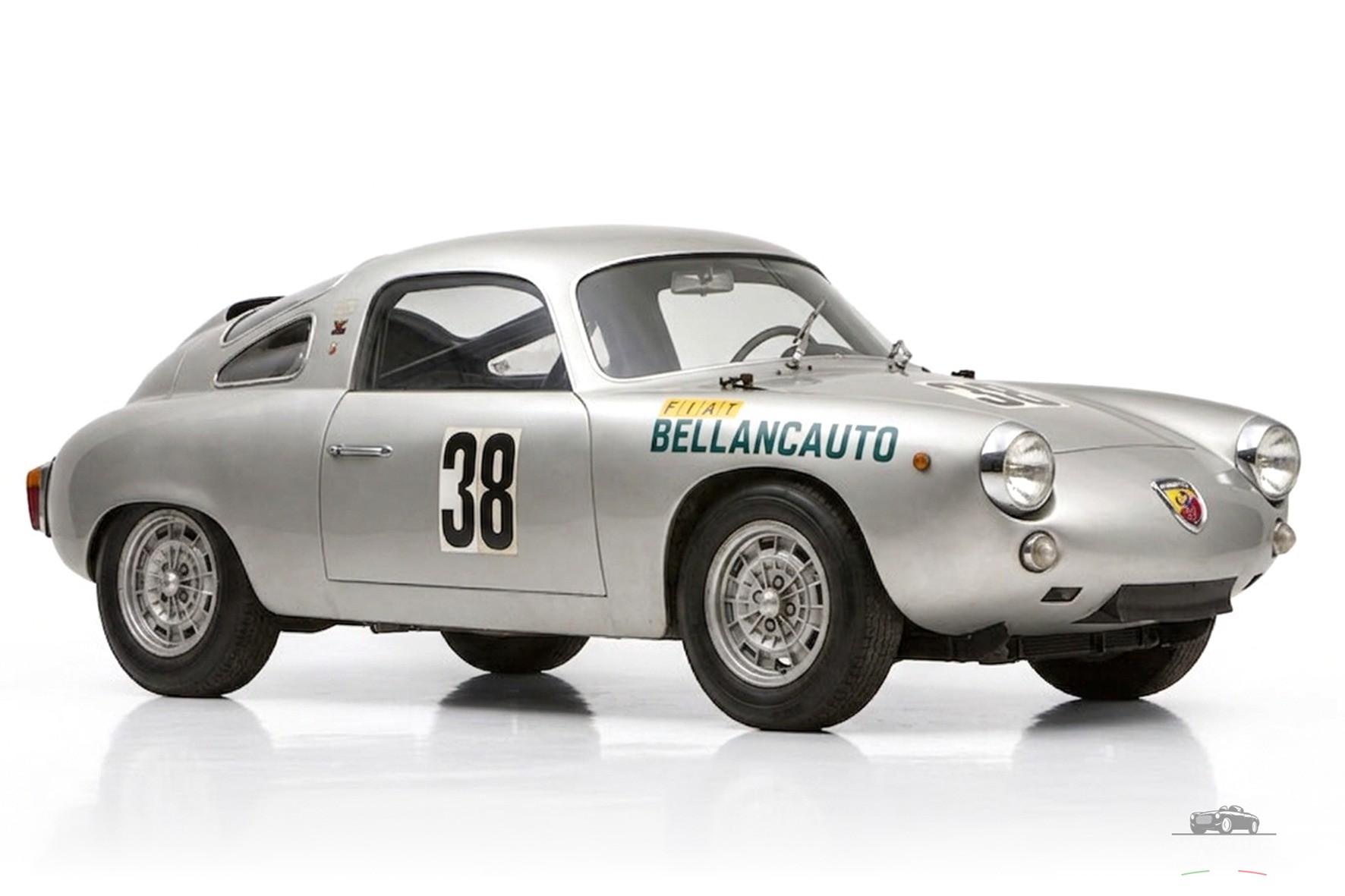
The Abarth 1000 Bialbero Zagato emerged from the collaboration between Carlo Abarth and the Milanese coachbuilder Zagato. Introduced as a racing berlinetta at the 1960 Turin Motor Show, it combined a compact, aerodynamic coupé body with an enlarged version of Abarth’s twin-overhead-camshaft four-cylinder engine. The car belonged to the development line that began with the Fiat 600-derived Abarth competition coupés of the 1950s, including the earlier Abarth 750 GT Zagato.
The mechanical basis was closely related to the rear-engined Fiat 600, although Abarth substantially developed its performance potential. Working with engineer Gioachino Colombo, Abarth introduced a twin-cam cylinder head for a 747 cc engine in 1957. During autumn 1960 the enlarged 982 cc version appeared; it was initially installed in a separate record-breaking single-seater. The Zagato-bodied 1000 Bialbero berlinetta followed in the same year. The record car and the coupé should therefore not be treated as the same vehicle or body design.
With the larger engine, the Zagato coupé required revisions to its packaging and bodywork. Its low roof, rounded front, carefully shaped tail and compact proportions reflected a competition programme in which reduced weight, cooling and aerodynamics mattered alongside power. The car was an evolution of the earlier Abarth-Zagato designs rather than a restyled standard Fiat 600 body. Detailed mechanical specifications vary among surviving cars and later versions, so figures for individual competition chassis must be established separately.
In 1960, the Abarth Zagato 1000 sports and competition car received the Compasso d’Oro for industrial design. The official ADI Design Museum record names Ugo Zagato as designer and Carrozzeria La Zagato as producer. The original jury citation describes the sports and competition automobile as an example of successful semi-industrial design, with styling and mechanical details developed in response to their practical functions. The jury singled out the wheels, restrained cockpit and integration of components as features of the design. This was recognition of the model and its design, not proof that each surviving chassis separately won an award. Further background is given in the contemporary history of Zagato and the Compasso d’Oro.
The Abarth-Zagato collaboration ended in 1961. Abarth continued to revise the 1000 Bialbero, and later bodies were associated with other workshops, including Sibona & Basano from 1963. Stellantis Heritage describes changes to the later cars’ noses, tails and wheel arches, accompanied by wider tyres and different performance specifications. Its stated 104 hp output for a 1963 car therefore cannot be assigned indiscriminately to the original Zagato design. Those long-nose and widened-wing cars should not automatically be described as 1960 Zagato-built coupés. The same distinction matters when interpreting photographs, auction entries and race results: the designation “1000 Bialbero” covers several stages of one programme, while this database entry concerns the early Zagato-bodied design. The wider history of the coachbuilder appears in the Zagato profile.
02 / TECHNICAL IDENTITY
03 / DESIGN, BODY & SUPPLIERS
Coachbuilder / Design studio
Founded in Milan in 1919 by Ugo Zagato, the coachbuilding house developed lightweight aerodynamic bodies inspired by aircraft construction, creating distinctive racing and grand touring automobiles.
Explore record ↗Designer
Ercole Spada (1937–2025) was an Italian automotive designer associated with Zagato, BMW and I.DE.A Institute and co-founder of Spadaconcept.
Explore record ↗04 / CHRONOLOGY
07 / GALLERY
THE CONVERSATION
Comments 0