
Ghia
Founded in Turin in 1916, Carrozzeria Ghia became a major Italian design and coachbuilding house, creating bespoke automobiles, prototypes and international collaborations across the twentieth century.
Explore record ↗
1954Coachwork by Ghia
THE VEHICLE AT A GLANCE
THE PEOPLE BEHIND THE CAR
Founded in Turin in 1916, Carrozzeria Ghia became a major Italian design and coachbuilding house, creating bespoke automobiles, prototypes and international collaborations across the twentieth century.
Explore record ↗Pietro Frua was an Italian automotive designer and coachbuilder who established his own Turin-based company and became known for elegant, individually styled bodies for European manufacturers.
Explore record ↗01 / THE STORY
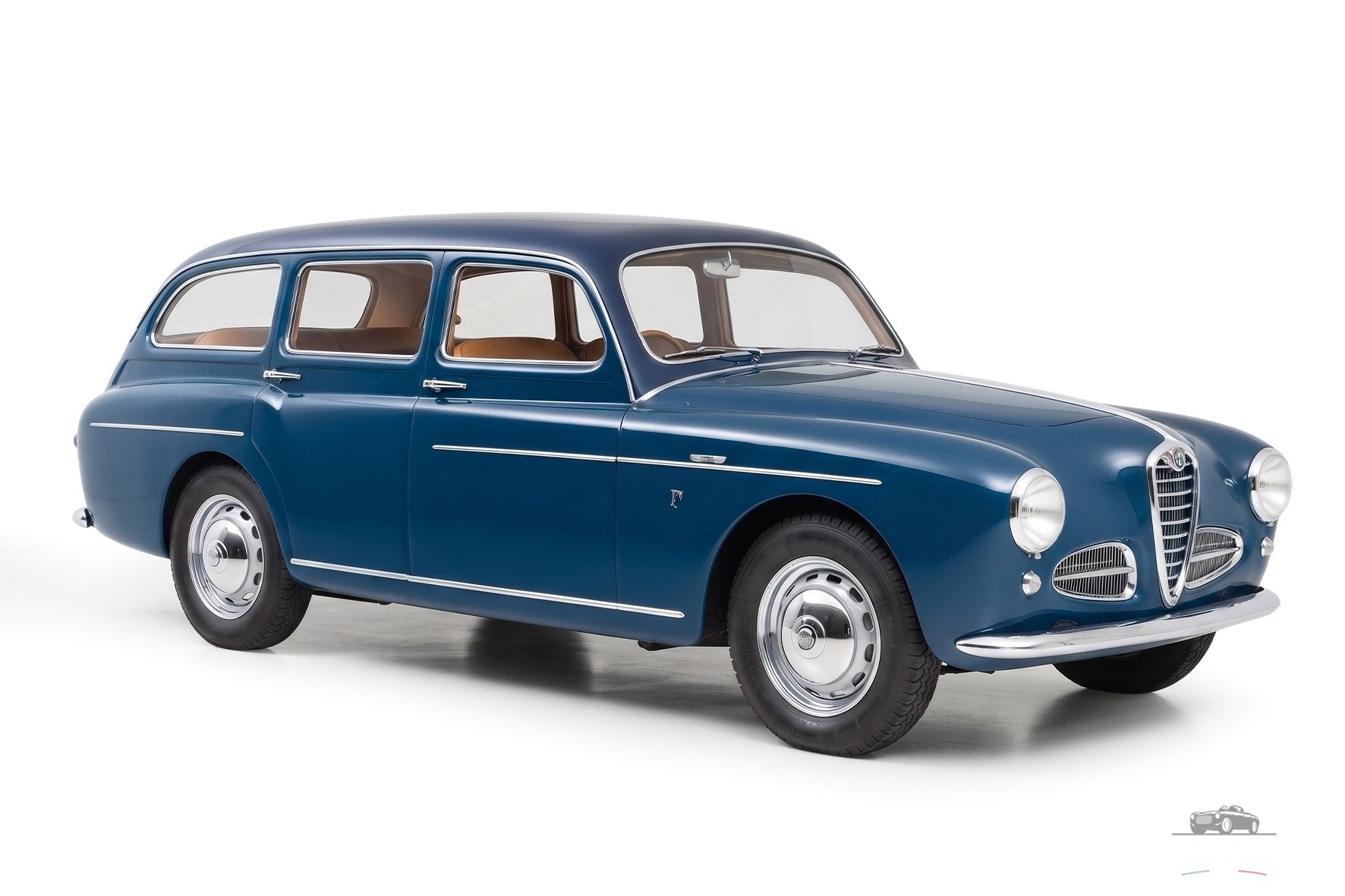
The Alfa Romeo 1900 Giardinetta Ghia was an unusual five-door estate-bodied interpretation of the Alfa Romeo 1900, documented in 1954. Its design is credited to Pietro Frua and associated with Carrozzeria Ghia of Turin. The 1954 car appears under the name Alfa Romeo 1900 Ghia Giardinetta in the Registro Pietro Frua catalogue raisonné. An independent history of Alfa Romeo’s special-bodied 1900 models also identifies Frua as the designer of a five-door body created for Ghia.
The designation Giardinetta described a practical station-wagon configuration rather than the more familiar two-door Italian grand touring coupé. During the post-war period, independent Italian coachbuilders explored this type of body on saloon-car chassis for buyers who wanted luggage-carrying capacity without abandoning a passenger car’s road manners and finish. The history of that wider body style is discussed in the site’s survey of Italian giardiniera and giardinetta designs.
The Giardinetta retained the essential identity of Alfa Romeo’s 1900 while providing a longer enclosed passenger and luggage compartment. Its roof extended over the rear portion of the body, and the five-door arrangement was intended to make the rear space more accessible than in a conventional coupé. The treatment remained relatively restrained, with practical windows and a continuous side profile rather than an experimental low roofline or sharply sculpted tail.
One specialist account describes the car as derived from the longer-wheelbase 1900 and refers to a two-litre Alfa Romeo engine. Because no chassis serial, factory build sheet or individual mechanical record has yet been securely linked to this entry, those details are retained as reported descriptions rather than promoted as exact chassis-specific specifications. The engine, gearbox, wheelbase and production quantity should not be inferred merely from another Alfa Romeo 1900 variant.
The attribution illustrates the overlap between design authorship, commercial presentation and body construction in mid-century Turin. The Registro Pietro Frua lists the Giardinetta among Frua’s 1954 creations, while the model was identified in period and later references with Ghia’s name. These two facts are compatible with Frua having designed coachwork for a vehicle presented through Ghia; they do not, by themselves, establish the location where every body panel was made or the precise contractual arrangement.
Legacy descriptions suggest that surviving photographs show both Frua and Ghia identifiers and connect the project with changes in the firms’ commercial relationships. Those claims remain useful research leads, but badges in photographs cannot alone establish who performed final assembly. The archive therefore distinguishes the documented Frua design attribution from the existing Ghia coachbuilder association, without assigning undocumented production duties to an additional firm.
The catalogue raisonné records the 1954 project, but it does not provide an individual chassis number or a verified total built. The broader dates sometimes given for the car in earlier descriptions should not be treated as a confirmed 1954–1958 production run. No exact auction sale, ownership chain, documented concours award or serial-number sequence has yet been established for this record from the sources checked.
The Giardinetta was a separate programme from Ghia’s sporting Alfa Romeo 1900 coupés, despite sharing an Alfa Romeo mechanical family and a Turin coachbuilder connection. Its historical interest lies in the combination of Frua’s credited design work, Ghia’s association with the finished estate model and the limited surviving documentary record. Further chassis and workshop evidence will be needed to determine individual-car histories and production scope.
02 / TECHNICAL IDENTITY
03 / DESIGN, BODY & SUPPLIERS
Coachbuilder / Design studio
Founded in Turin in 1916, Carrozzeria Ghia became a major Italian design and coachbuilding house, creating bespoke automobiles, prototypes and international collaborations across the twentieth century.
Explore record ↗Designer
Pietro Frua was an Italian automotive designer and coachbuilder who established his own Turin-based company and became known for elegant, individually styled bodies for European manufacturers.
Explore record ↗07 / GALLERY

THE CONVERSATION
Comments 0