
Ghia
Founded in Turin in 1916, Carrozzeria Ghia became a major Italian design and coachbuilding house, creating bespoke automobiles, prototypes and international collaborations across the twentieth century.
Explore record ↗
1948Coachwork by Ghia
THE VEHICLE AT A GLANCE
THE PEOPLE BEHIND THE CAR
Founded in Turin in 1916, Carrozzeria Ghia became a major Italian design and coachbuilding house, creating bespoke automobiles, prototypes and international collaborations across the twentieth century.
Explore record ↗Fedele Bianco was an Italian automotive stylist active in Turin, with documented work at Ghia and Pinin Farina during the 1940s.
Explore record ↗01 / THE STORY
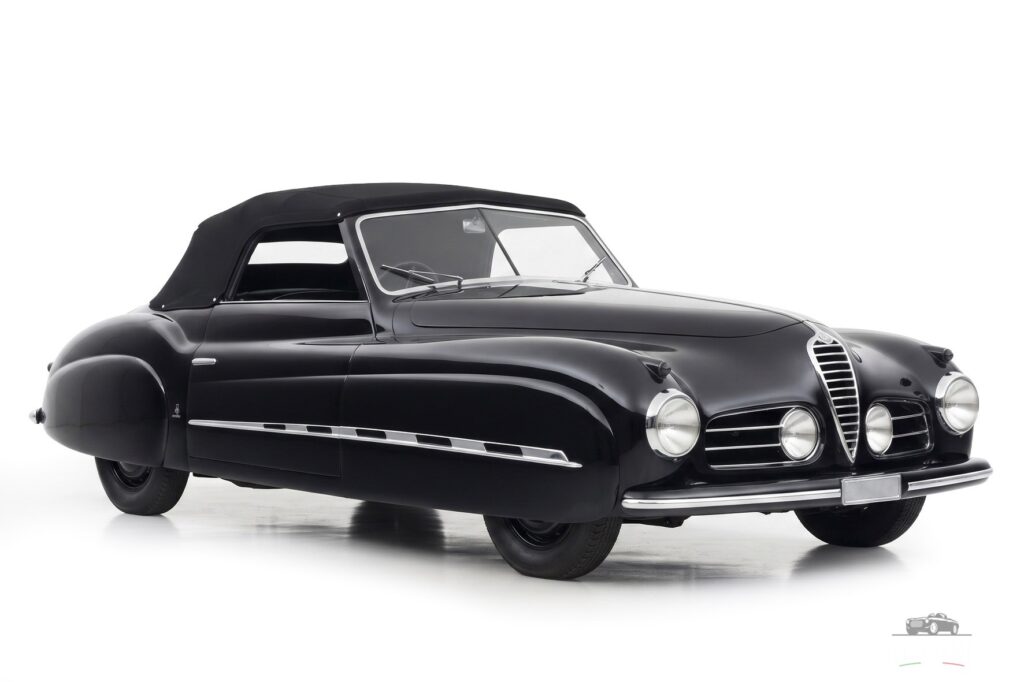
The 1948 Alfa Romeo 6C 2500 SS Cabriolet Ghia, chassis 916.040, is an individually bodied open car commissioned for Prince Alessandro “Dado” Ruspoli. Its coachwork was produced by Carrozzeria Ghia in Turin on Alfa Romeo 6C 2500 mechanical foundations. The cabriolet belongs to the group of special bodies made for the 6C 2500 in the years immediately after the Second World War, but chassis 916.040 identifies a particular vehicle rather than a general body style or a production series.
The commission is linked to Alessandro “Dado” Ruspoli, whose association with the car is recorded in the historical Alfa Romeo material and in the earlier Carrozzieri Italiani catalogue. Ghia adopted an expressive cabriolet treatment rather than a standard Alfa Romeo factory body. The resulting design is usually described as belonging to the flamboyant current of late-1940s Italian coachbuilding. The historical identity and the owner’s commission are supported more securely than details of the car’s complete construction and delivery chronology.
The design attribution requires a distinction between individuals and workshop responsibility. Research recorded in the Alfa Romeo Klöverbladet historical dossier identifies Uberto Capalbi in connection with the design or planning of the Ghia cabriolet. Other accounts mention Fedele Bianco or associate Mario Felice Boano with its styling. Boano’s position in Ghia’s management does not, by itself, establish him as the individual designer. The different attributions should therefore remain qualified pending stronger original workshop documentation.
Chassis 916.040 has been identified in period photographic material relating to the 1948 Turin Motor Show. The appearance provides an important contemporary reference for the car’s configuration and its association with Ghia, although the surviving references do not establish every technical or decorative detail of the exhibited example.
The cabriolet is recorded as having received the Grand Prix d’Honneur at the 1948 Monte-Carlo concours d’élégance. Its historical dossier also records a category distinction at the 1949 Rome concours. These results concern the Ruspoli-associated Ghia car, but the exact Monte-Carlo category, full original entry documentation and Rome class designation require further reconciliation with contemporary results. Neither distinction should be converted into a different award title or assigned to another 6C 2500 chassis.
The Alfa Romeo 6C 2500 family used a double-overhead-camshaft inline six-cylinder engine of 2,443 cc. This model-level specification does not establish the engine serial number, power output or wheelbase of chassis 916.040. The surviving records consulted do not provide a verified individual engine number or an independent Ghia body number. In particular, the chassis designation 916.040 must not be repeated as a body number.
The car’s subsequent ownership and restoration history remain incompletely documented in the materials currently reconciled with this record. Other Alfa Romeo 6C 2500 cabriolets, including examples with similarly dated show appearances, must remain separate unless their individual chassis identifiers match. No auction sale with an independently verified exact-chassis match has been established in the material reviewed for this entry.
02 / TECHNICAL IDENTITY
03 / DESIGN, BODY & SUPPLIERS
Coachbuilder / Design studio
Founded in Turin in 1916, Carrozzeria Ghia became a major Italian design and coachbuilding house, creating bespoke automobiles, prototypes and international collaborations across the twentieth century.
Explore record ↗Attributed designer
Fedele Bianco was an Italian automotive stylist active in Turin, with documented work at Ghia and Pinin Farina during the 1940s.
Explore record ↗04 / CHRONOLOGY
05 / PEOPLE, COLLECTIONS & MUSEUMS
07 / CHASSIS REGISTER
08 / GALLERY
09 / PERIOD ARCHIVE
Become a Pro member to see the full details in this section.
Membership is not available yet.
View membership options
THE CONVERSATION
Comments 0