From aerodynamic prototype to production coupé
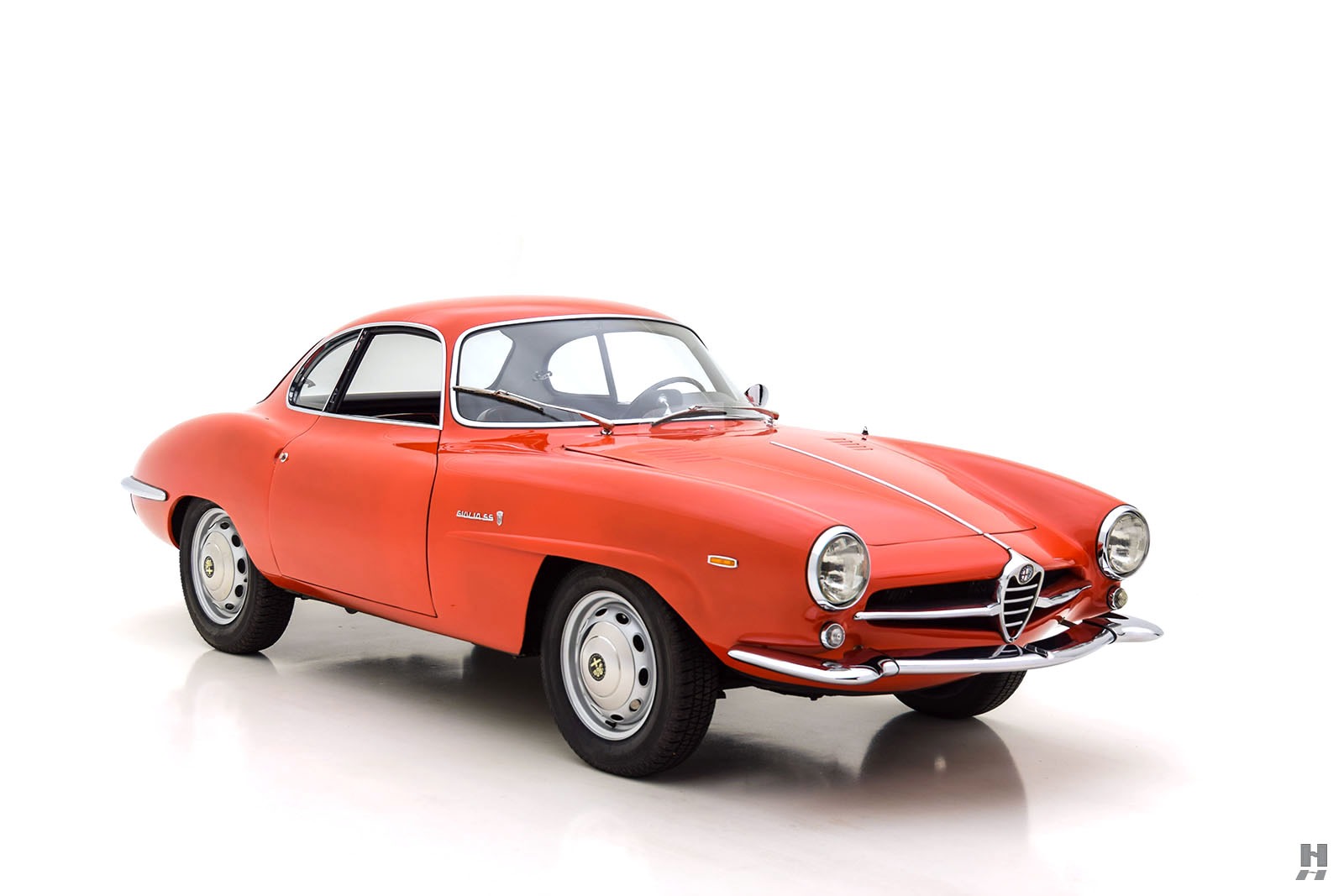
The Alfa Romeo Giulietta Sprint Speciale emerged from the collaboration between Alfa Romeo and Carrozzeria Bertone at a time when Italian designers were exploring the relationship between aerodynamic efficiency and the traditional sports coupé. Franco Scaglione, whose earlier work for Bertone included the experimental Alfa Romeo B.A.T. studies and the Alfa Romeo 2000 Sportiva, developed a particularly low and elongated body for the Giulietta mechanical package. A distinct Giulietta Sprint Speciale prototype was presented at the Turin Motor Show in 1957. That experimental car, with its own construction and history, must not be confused with the production model that followed in 1959.
By the time the Sprint Speciale entered production, its sweeping roof, enclosed rear quarters and carefully shaped nose had been developed into a distinctive two-door berlinetta. The design drew on Bertone’s previous aerodynamic experiments without simply reproducing any one of them. The FIA recorded the Giulietta Sprint Speciale under Group GT homologation number 122 on 17 May 1959. The original project was closely associated with the Giulietta Sprint Veloce mechanical family, but the prototype’s construction details and subsequent competition modifications to individual surviving cars cannot be assumed to describe every production example.
Engineering and production
The Museo Storico Alfa Romeo specifies a front-mounted 1,290 cc twin-cam four-cylinder engine developing 97 metric horsepower at 6,500 rpm, driving the rear wheels through a five-speed manual gearbox. The production body is described as a self-supporting steel structure, with independent front suspension, a live rear axle and hydraulic drum brakes. The museum’s reference dimensions are 2,250 mm for the wheelbase, 4,120 mm in length, 1,660 mm in width and 1,280 mm in height; it also records a weight of 950 kg and a maximum speed of 183 km/h. These are manufacturer model specifications, not measurements of an individually identified chassis.
Alfa Romeo’s museum records 1,252 Giulietta Sprint Speciales. An alternative figure of approximately 1,366 appears in historical registers and auction literature, sometimes with an ambiguous distinction between Giulietta and the later Giulia versions. The museum figure is therefore retained as the preferred count for the Giulietta production model, while the alternative remains documented for further reconciliation. The later Giulia Sprint Speciale was an evolution with a different engine designation and should not be combined indiscriminately with the earlier production total.
Surviving cars and historical documentation
Individual auction catalogues preserve useful evidence for particular cars. RM Sotheby’s documented chassis AR177216, delivered in Bluette to a Lugano dealership in 1961, and AR177344, which subsequently received a different Alfa Romeo engine. Gooding Christie’s recorded chassis AR10120 00657 with engine AR00120 00911 in 2023. Such details illuminate the model’s surviving population but cannot be treated as universal factory specifications. The Giulietta Sprint Speciale also belongs to a wider Alfa Romeo sporting story that includes the separately constructed Giulietta SVZ, whose coachwork and competition development followed a different path. Period brochures, FIA homologation records and factory documentation remain essential to distinguishing the original series from later restorations, modifications and the Giulia successor.


THE CONVERSATION
Comments 0