
Castagna
The Castagna coachbuilding tradition dates to nineteenth-century Milan, when Carlo Castagna took over an established carriage business. Carrozzeria Castagna later became renowned for luxury bespoke automotive bodies.
Explore record ↗
1925Coachwork by Castagna
THE VEHICLE AT A GLANCE
THE PEOPLE BEHIND THE CAR
The Castagna coachbuilding tradition dates to nineteenth-century Milan, when Carlo Castagna took over an established carriage business. Carrozzeria Castagna later became renowned for luxury bespoke automotive bodies.
Explore record ↗01 / THE STORY
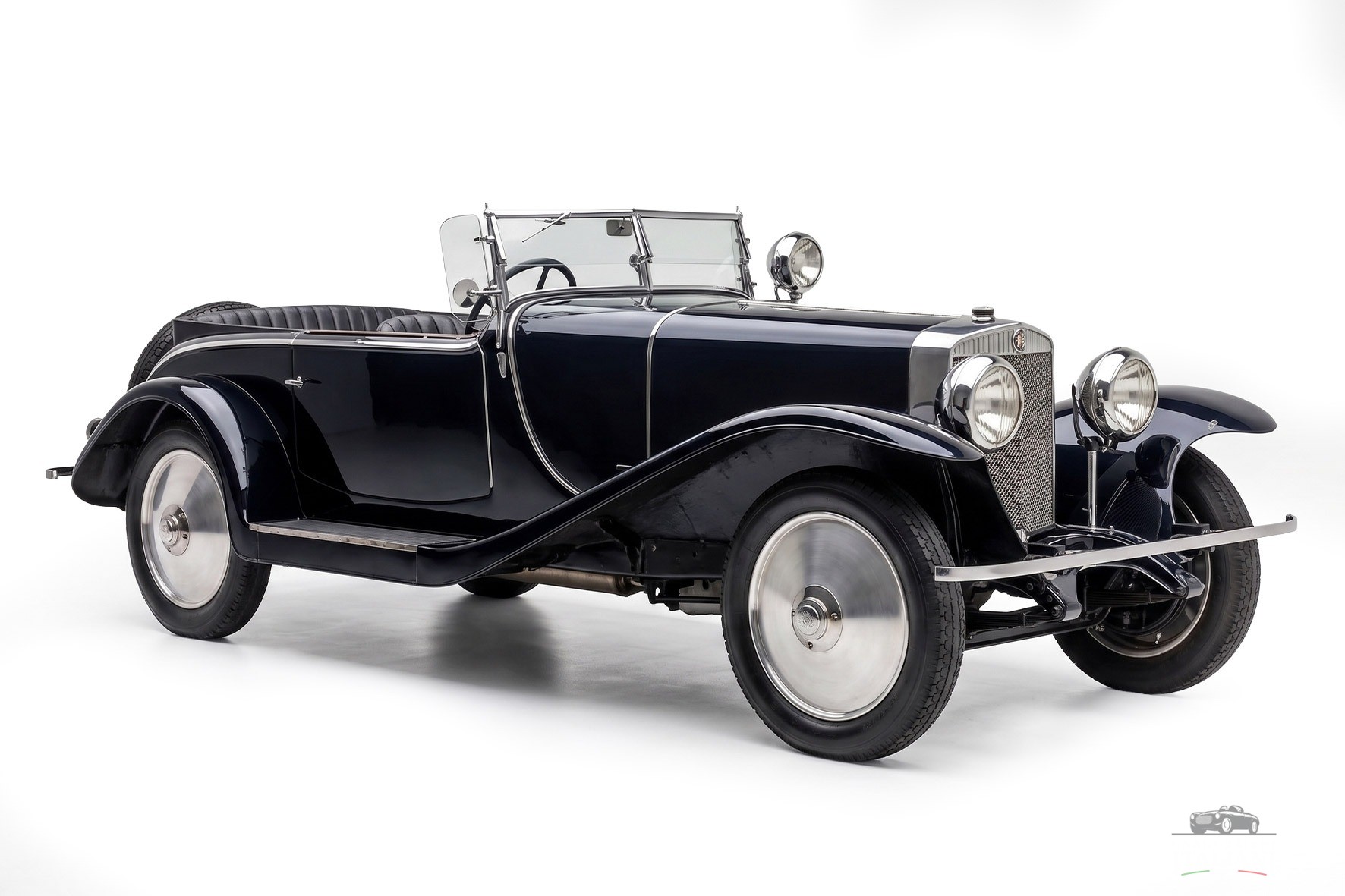
The Alfa Romeo RLSS Castagna was a bespoke, high-performance touring car constructed in 1925 on the RL Super Sport (RLSS) chassis and bodied by Carrozzeria Castagna of Milan. The RLSS represented the most developed and sporting derivative of the RL series, introduced in 1922 and designed under the technical direction of Giuseppe Merosi. The RLSS was characterized by refined mechanical specification and was frequently delivered as a bare chassis to be completed by prominent coachbuilders of the period. The RLSS chassis employed a 2,994 cc inline six-cylinder engine with a single overhead valve layout and aluminum pistons. In its standard configuration, the engine produced approximately 83 CV at 3,600 rpm. The model was fitted with a four-speed manual transmission and rear-wheel drive. Suspension was via semi-elliptical leaf springs, with mechanical drum brakes initially operating only on the rear axle, though later variants included front-wheel braking. Carrozzeria Castagna provided a variety of body styles on the RLSS platform, often tailored to individual customer specifications. The example illustrated featured a two-door open torpedo body with a folding windshield, long flowing fenders, and enclosed disc-type wheel covers. The body was constructed over a wooden frame with aluminum or steel outer panels. Trim and equipment varied according to commission, though instruments and fittings were typically supplied by Italian accessory manufacturers of the period. The RLSS was marketed as a high-performance touring car, distinct from the stripped RLTF and RL Targa Florio competition models. The performance figures, including a top speed approaching 130 km/h, reflected the car’s capabilities on continental roads and mountain passes. Production of the RLSS continued until 1927, with total RL-series output estimated at approximately 2,600 units across all types. The number of RLSS chassis bodied by Castagna is not precisely recorded, though contemporary accounts confirm multiple commissions. Surviving examples are rare, and no comprehensive chassis register exists. The RLSS Castagna exemplifies the Italian approach to high-performance personal transport in the pre-war period, merging advanced engineering with bespoke coachbuilt elegance prior to the consolidation of in-house body design at Alfa Romeo in the early 1930s.
02 / TECHNICAL IDENTITY
03 / DESIGN, BODY & SUPPLIERS
Coachbuilder / Design studio
The Castagna coachbuilding tradition dates to nineteenth-century Milan, when Carlo Castagna took over an established carriage business. Carrozzeria Castagna later became renowned for luxury bespoke automotive bodies.
Explore record ↗07 / GALLERY
THE CONVERSATION
Comments 0