
Ghia
Founded in Turin in 1916, Carrozzeria Ghia became a major Italian design and coachbuilding house, creating bespoke automobiles, prototypes and international collaborations across the twentieth century.
Explore record ↗
1951Coachwork by Ghia
THE VEHICLE AT A GLANCE
THE PEOPLE BEHIND THE CAR
Founded in Turin in 1916, Carrozzeria Ghia became a major Italian design and coachbuilding house, creating bespoke automobiles, prototypes and international collaborations across the twentieth century.
Explore record ↗01 / THE STORY
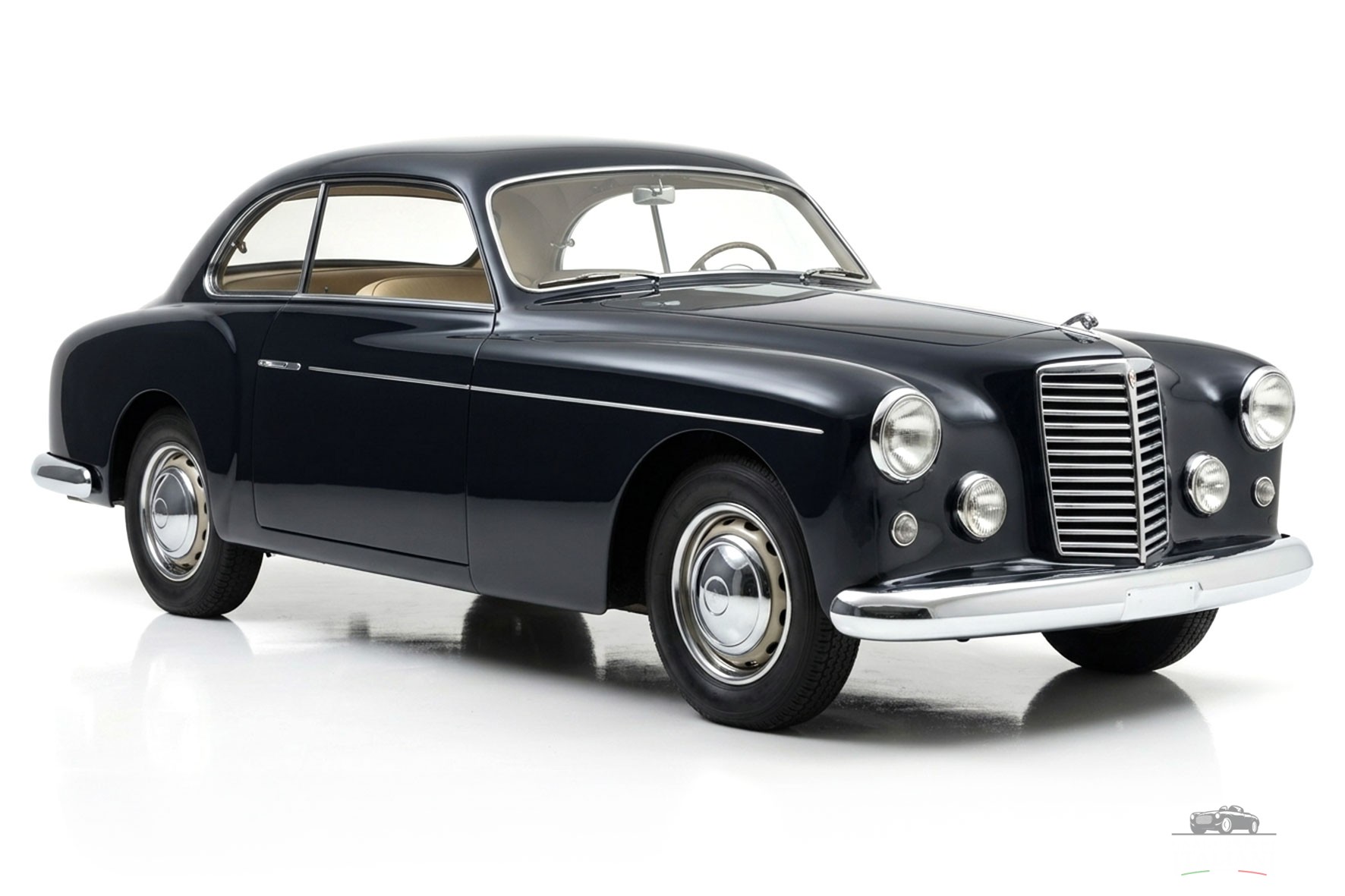
The 1951 Armstrong Siddeley Whitley Coupé by Ghia is a specially bodied two-door car based on British Armstrong Siddeley mechanical components. Carrozzeria Ghia produced the body in Italy during the early 1950s, when several British manufacturers commissioned Italian interpretations of their conventional chassis. The project is identified in historical accounts as an Armstrong Siddeley 18 or Whitley-based coupé. An individual chassis serial and a documented sequence of subsequent owners have not been established.
The standard Armstrong Siddeley Whitley was introduced in early 1950 as a replacement for the Lancaster four-light saloon, retaining the underlying chassis and mechanical family. The manufacturer’s heritage material identifies the 2,309 cc overhead-valve six-cylinder engine introduced for the 18 hp range and the Whitley’s conventional longitudinal front-engine layout. Contemporary Whitley technical literature gives a bore and stroke of 70 by 100 mm and a quoted output of 75 bhp at approximately 4,200 rpm, with a choice of manual synchromesh or preselector transmission.
The production-car specifications provide the engineering context for the Ghia project, but the surviving references do not establish the precise engine number, gearbox installation, wheelbase, suspension revisions or dimensions of the specially bodied coupé. They should not be confused with chassis-specific measurements or original factory documentation for the show car.
The Ghia version departed from Armstrong Siddeley’s normal four-door Whitley body. Its fixed-roof two-door form is recorded as a stylistic prototype, built independently of the regular British body programme. The identity and appearance are associated with Ghia’s early postwar work, although the individual designer has not been established from a contemporary drawing or coachbuilder register.
The original Carrozzieri Italiani record identifies construction in 1951 and an appearance at the 1952 Turin Motor Show. Curbside Classic also places the coupé at the 1952 show. A later illustrated survey in Ruoteclassiche, however, describes a Ghia-bodied Armstrong Siddeley 18 two-door saloon shown at the 1951 Turin Motor Show. These references may concern the same vehicle, but the conflicting exhibition dates cannot be resolved without the period exhibition catalogues or an exact photographic match. Neither year should be treated as conclusively established for an individual chassis.
The project is commonly described as a one-off prototype rather than a production Whitley variant. No original Ghia build sheet, body number or contemporary order register has yet been associated with the surviving catalogue descriptions, and no verified auction result or restoration chronology identifies an individual car. The Whitley saloon’s total production figures and ordinary road-car dimensions must therefore remain separate from this specially bodied vehicle. The Ghia coupé is documented as a distinct body proposal, while its exact serial, exhibition history and later fate remain matters for further archival identification.
02 / TECHNICAL IDENTITY
03 / DESIGN, BODY & SUPPLIERS
Coachbuilder / Design studio
Founded in Turin in 1916, Carrozzeria Ghia became a major Italian design and coachbuilding house, creating bespoke automobiles, prototypes and international collaborations across the twentieth century.
Explore record ↗04 / CHRONOLOGY
07 / GALLERY
THE CONVERSATION
Comments 0