
Ghia
Founded in Turin in 1916, Carrozzeria Ghia became a major Italian design and coachbuilding house, creating bespoke automobiles, prototypes and international collaborations across the twentieth century.
Explore record ↗
1952Coachwork by Ghia
THE VEHICLE AT A GLANCE
THE PEOPLE BEHIND THE CAR
Founded in Turin in 1916, Carrozzeria Ghia became a major Italian design and coachbuilding house, creating bespoke automobiles, prototypes and international collaborations across the twentieth century.
Explore record ↗01 / THE STORY
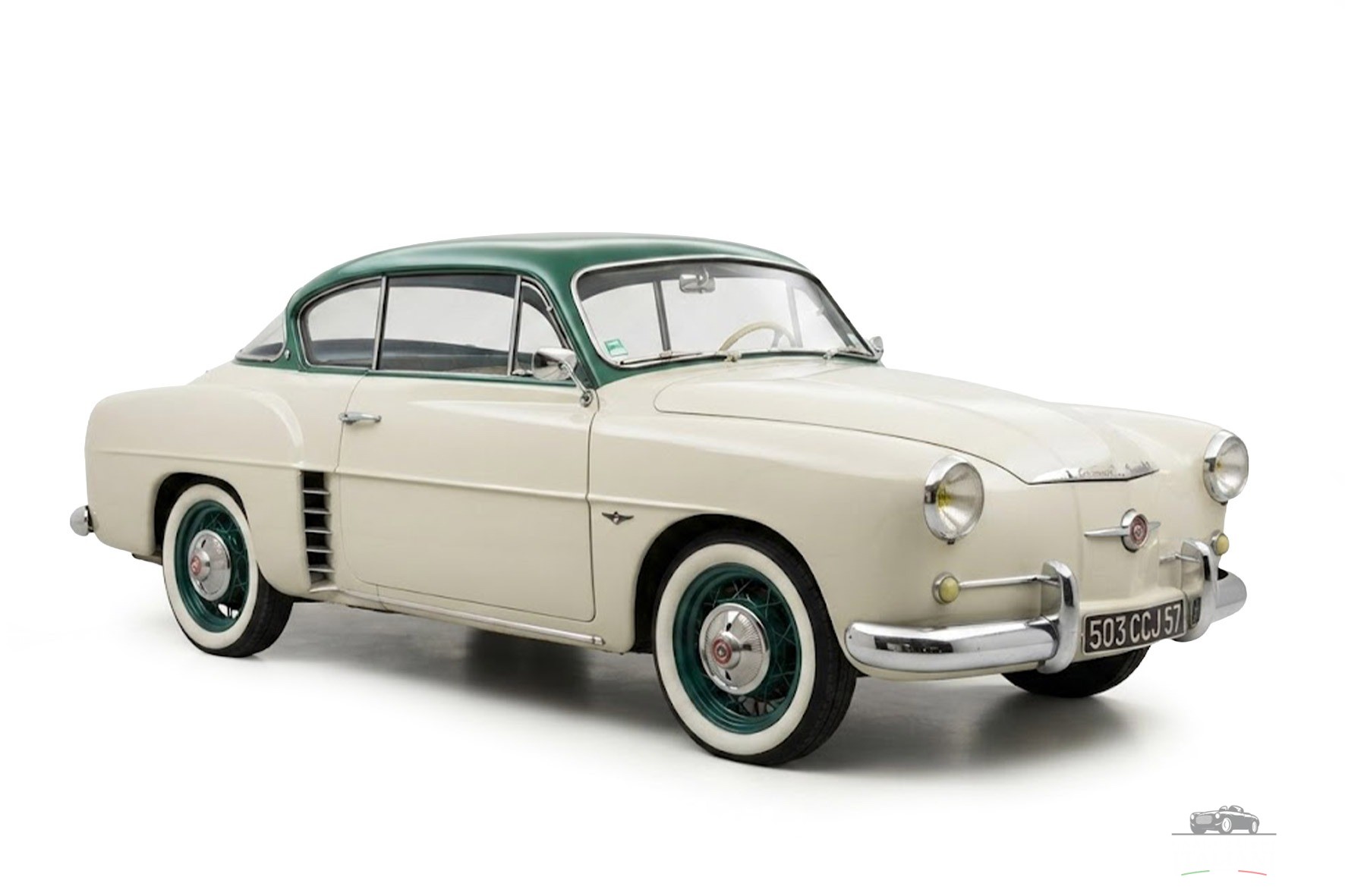
The Autobleu 4CV Coupé was a limited-production French grand touring derivative of the Renault 4CV, developed from 1952 and introduced in prototype form in 1953. The Paris-based Autobleu company, established by Maurice Mestivier and Roger Lepeytre in 1950, initially made intake and exhaust equipment for Renault engines before attempting to develop its own complete car. This record covers the Autobleu coupé programme and its original Italian-designed prototype, not a single identified chassis.
Autobleu commissioned Carrozzeria Ghia in Turin to design a more exclusive coupé using 4CV mechanical components. The project followed contacts in 1952, and the first completed Ghia prototype was delivered in May 1953. Its compact two-door form, rounded roof, broad rear shoulders and prominent cooling-air apertures distinguished it from the standard Renault saloon. Ghia’s role in establishing the design must be separated from the later French construction of production vehicles.
Two Autobleu prototypes were shown at the Paris Motor Show in October 1953. The first originated at Ghia; published histories describe the second as assembled by Figoni using components from Italy. The precise original chassis numbers of the display cars have not been established in the sources checked. The bodies should therefore not be assigned to surviving cars solely on the basis of an early photograph or a similar exterior appearance.
Plans for a small production run encountered difficulties with tooling and body manufacture. Francis Guérin worked on moulding and tooling methods, while French coachbuilders including Pourtout and Figoni were associated with successive phases of production. Henri Chapron subsequently became a principal supplier of bodies and is particularly associated with later examples. A later Chapron-bodied car can share Ghia’s original design without having been physically constructed by Ghia in Turin.
The coupé remained an expensive, specialist derivative rather than a Renault factory model. Its numbers are conventionally estimated at around eighty, but the figure is not treated here as a verified chassis-by-chassis production total. Contemporary variants, including later convertible work, must be distinguished from the original Ghia prototype and the subsequent coupé production.
The Autobleu retained the basic rear-engined Renault 4CV layout, including a water-cooled inline-four and a compact rear transaxle. Early examples used the 747 cc Renault engine. Autobleu’s experience with inlet and exhaust equipment informed modifications described in period and later technical accounts, including improved induction components. Exact carburettor arrangements, power output and gearing may differ among individual cars and should be established from each surviving vehicle rather than assumed from a general model description.
The exterior’s larger side air intakes, relatively low roof and restrained brightwork were intended to give the modest 4CV platform the appearance of a specialist coupé. Surviving examples show differences in body details, paint and equipment. A separately documented 1955 Chapron-bodied car, for example, was offered with a Ferlec electromagnetic clutch; this does not establish that the system was standard across the Autobleu series.
Autobleu’s coupé is distinct from the later Renault 4CV Ghia SAPCAR special, an unrelated 1950s coachbuilding programme on similar Renault mechanical foundations. It must also be separated from Autobleu’s other prototype and competition projects, whose records can carry different chassis numbers and body suppliers.
Individual Autobleu coupés have been documented in later dealer catalogues, but those descriptions cannot be generalized into a single ownership history or market price for the entire production family. No specific auction amount or owner is assigned here without an exact vehicle match. The original Ghia contribution remains the creation of the prototype design that French coachbuilders adapted for limited production.
02 / TECHNICAL IDENTITY
03 / DESIGN, BODY & SUPPLIERS
Coachbuilder / Design studio
Founded in Turin in 1916, Carrozzeria Ghia became a major Italian design and coachbuilding house, creating bespoke automobiles, prototypes and international collaborations across the twentieth century.
Explore record ↗07 / GALLERY
THE CONVERSATION
Comments 0