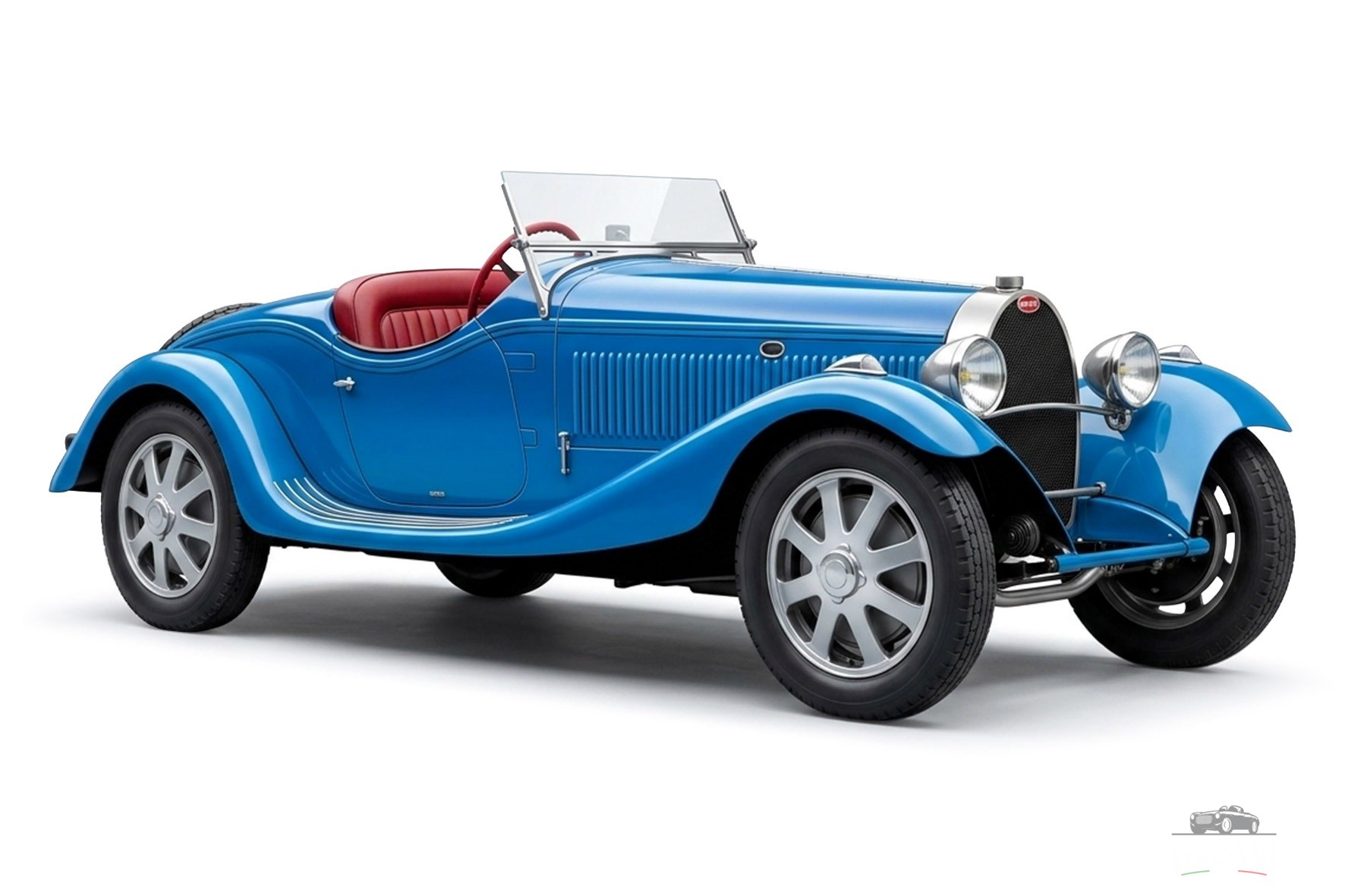

Zagato
Founded in Milan in 1919 by Ugo Zagato, the coachbuilding house developed lightweight aerodynamic bodies inspired by aircraft construction, creating distinctive racing and grand touring automobiles.
Explore record ↗
1928Coachwork by Zagato
THE VEHICLE AT A GLANCE
THE PEOPLE BEHIND THE CAR
Founded in Milan in 1919 by Ugo Zagato, the coachbuilding house developed lightweight aerodynamic bodies inspired by aircraft construction, creating distinctive racing and grand touring automobiles.
Explore record ↗01 / THE STORY
The Bugatti Type 43 Spider Zagato was an open coachbuilt version of the Type 43 associated with chassis 43198. On 28 March 1928 the chassis was delivered through Agenzia Generale in Turin on behalf of Alberto Musy. Contemporary planning connected the car with the 1928 Mille Miglia, although an actual start, competition number and finishing result have not been established for this specific chassis. Zagato’s historical catalogue identifies the 1928 project as the Type 43 Corsa Zagato.
The Type 43 was based on a supercharged straight-eight sports chassis related mechanically to the Type 35B, with a 2,262 cc engine and four-speed manual transmission in standard specification. These are model characteristics; the individual engine number and measured dimensions of chassis 43198 have not been established. Zagato supplied distinctive open roadster coachwork rather than the standard Grand Sport body offered by Bugatti.
By 1950 the car was associated with Hans Tolle of Düsseldorf and still carried its Zagato body. A photograph taken in Italy in 1952 records registration BR 851-456. Its later history includes Swedish ownership connected with Giess Pluim and Torsten Arrgård. During restoration, the Zagato coachwork was removed and chassis 43198 was fitted with a replacement Grand Sport-style body.
The removed Zagato body followed a separate history. It passed through Uwe Hucke and was subsequently associated with a spare Type 34 frame and mechanical components including a Type 44 engine. This later assembly entered the collection of Joseph Németh in Hungary in 2005. In May 2012 Andreas Arrgård confirmed that chassis 43198 survived separately from the transferred Zagato body, and described the replacement coachwork fitted during his grandfather’s restoration.
02 / TECHNICAL IDENTITY
Become a Pro member to see the full details in this section.
Membership is not available yet.
View membership options03 / DESIGN, BODY & SUPPLIERS
Coachbuilder / Design studio
Founded in Milan in 1919 by Ugo Zagato, the coachbuilding house developed lightweight aerodynamic bodies inspired by aircraft construction, creating distinctive racing and grand touring automobiles.
Explore record ↗06 / CHASSIS REGISTER
07 / GALLERY
THE CONVERSATION
Comments 0