
Pininfarina
Founded by Battista Pinin Farina in Turin in 1930, Pininfarina became one of the most influential Italian styling and coachbuilding houses, particularly through its work for Ferrari and other international manufacturers.
Explore record ↗
1973Coachwork by Pininfarina
THE VEHICLE AT A GLANCE
THE PEOPLE BEHIND THE CAR
Founded by Battista Pinin Farina in Turin in 1930, Pininfarina became one of the most influential Italian styling and coachbuilding houses, particularly through its work for Ferrari and other international manufacturers.
Explore record ↗01 / THE STORY
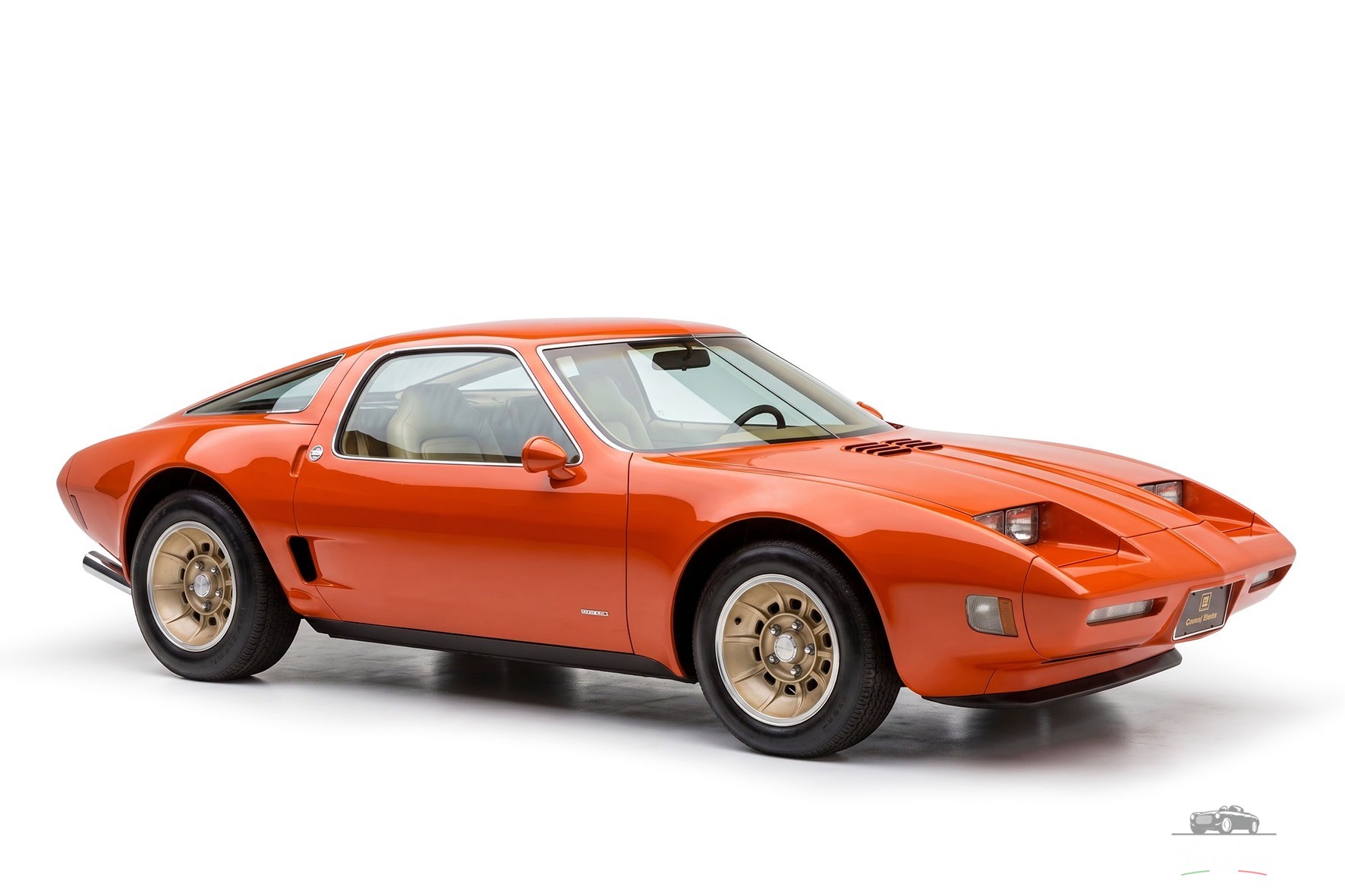
The Chevrolet XP-897 GT was an experimental mid-engine sports-car prototype developed by General Motors in the early 1970s within the framework of its rotary-engine research program. The internal designation XP-897 GT identified a project intended to study alternative powertrain layouts and advanced packaging solutions at a time when GM was evaluating non-piston engines for future production vehicles. The prototype was constructed in 1973 by Pininfarina in Italy, working under contract to General Motors. The car made its debut at the 1973 Frankfurt show, where it captured attention for its distinctive design and cutting-edge technology. The mechanical basis was a modified Porsche 914/6 chassis, shortened and reinforced to accept a transverse mid-mounted power unit. Suspension geometry was adapted accordingly, with revised mounting points and track widths to suit the new proportions. Steering, braking, and basic chassis architecture remained consistent with contemporary European sports-car practice. Power was supplied by a GM-developed two-rotor Wankel engine, part of the broader rotary program that also included experimental Chevrolet and Pontiac sedans. The engine was positioned ahead of the transaxle, allowing a compact drivetrain layout and a low center of gravity. Cooling, exhaust routing, and ancillary systems were engineered specifically for the prototype. Output figures were secondary to packaging, thermal behavior, and drivability evaluation. The body design, executed by Pininfarina, bore no direct resemblance to production Corvettes. It featured a low nose, sharply defined wheel arches, a steeply raked windshield, and a compact greenhouse. Surface treatment emphasized clean geometry rather than ornamentation. The car was configured as a two-seat coupe, with a short rear overhang and integrated engine ventilation at the flanks and rear deck. The styling aligned with early-1970s European mid-engine prototypes rather than American production sports cars. Although often described in later literature as a “mid-engine Corvette,” the XP-897 GT was never officially presented as such by General Motors. The project remained a research exercise and was discontinued when GM terminated its rotary-engine program due to emissions regulations, fuel-consumption concerns, and durability issues. After completion, the prototype remained in Europe. The rotary engine and transmission were removed prior to storage. The XP-897 GT survived the dismantling of many related experimental vehicles and was later preserved, becoming a documented example of GM’s mid-engine and rotary-powertrain research during the early 1970s.
02 / TECHNICAL IDENTITY
03 / DESIGN, BODY & SUPPLIERS
Coachbuilder / Design studio
Founded by Battista Pinin Farina in Turin in 1930, Pininfarina became one of the most influential Italian styling and coachbuilding houses, particularly through its work for Ferrari and other international manufacturers.
Explore record ↗Become a Pro member to see the full details in this section.
Membership is not available yet.
View membership options04 / CHRONOLOGY
07 / GALLERY
THE CONVERSATION
Comments 0