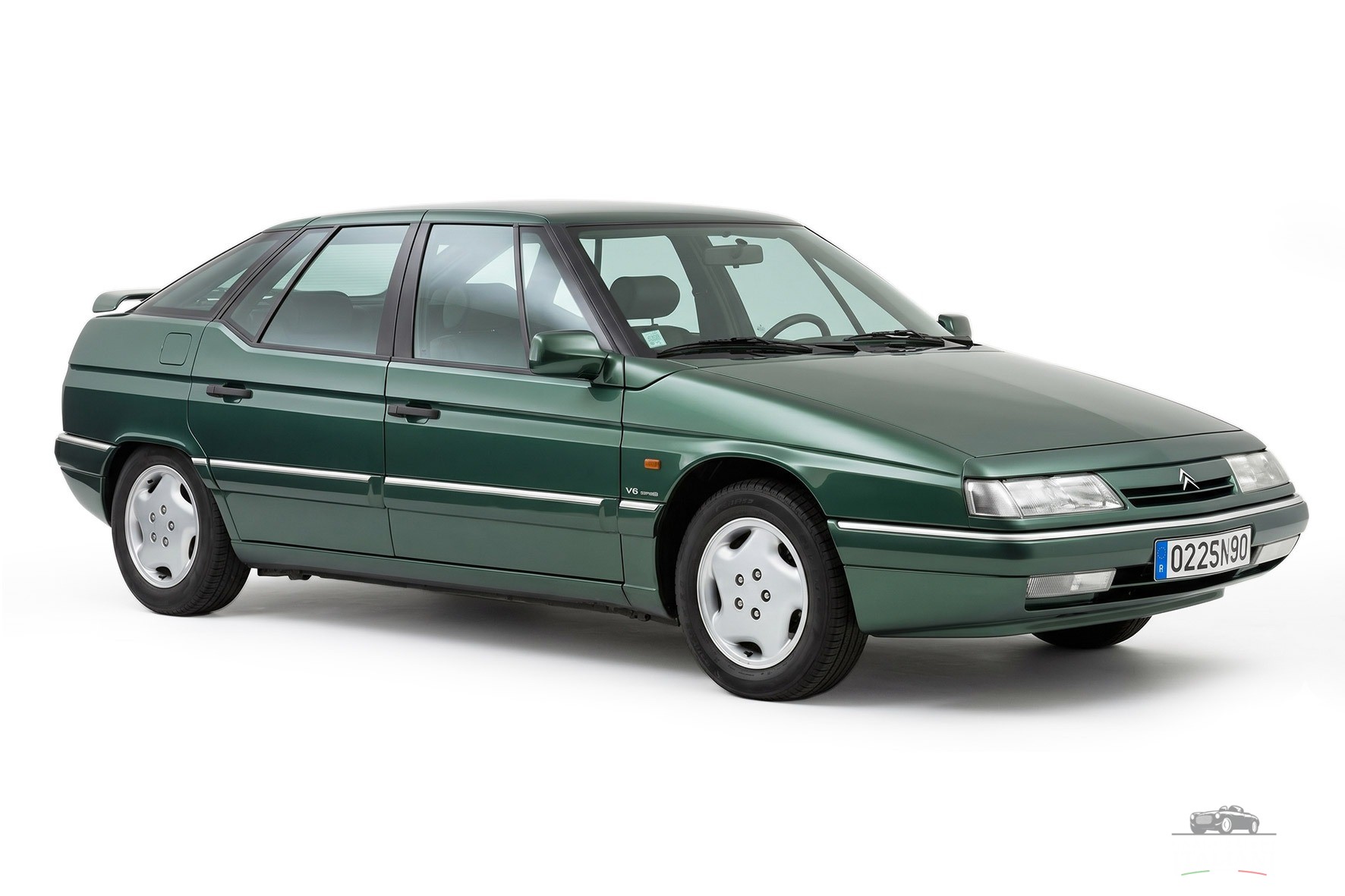
The Citroën XM, unveiled on 23 May 1989, renewed the French manufacturer’s flagship range after the CX. The exterior design was developed by Bertone, while Citroën was responsible for the production car and its manufacture at Rennes-La-Janais. Its long, sharply drawn nose, low bonnet, angular five-door silhouette and expansive glasshouse established a distinct visual identity. The XM followed the earlier Citroën BX in a wider sequence of Citroën styling programmes involving the Italian studio, but the two cars belonged to different model families. Following its May introduction, the XM was presented at the Frankfurt International Motor Show in September 1989.
The XM combined this exterior design with one of Citroën’s most significant technical developments of the period: Hydractive suspension. The system brought electronic control to the company’s hydropneumatic suspension tradition, adapting ride characteristics in response to driving conditions. Another distinctive feature was the separate rear glass partition, popularly called the thirteenth window, which divided the passenger compartment from the luggage space when the tailgate was opened. Both innovations were central to the model’s identity as a large, technologically ambitious touring car.
The first-generation XM, designated Y3, was built from May 1989 to July 1994. The revised Y4 followed from August 1994 until June 2000, while the XM Break estate joined the range in November 1991. The five-door hatchback had a wheelbase of approximately 2,850 mm, with period specifications giving a length of 4,709 mm and width of 1,793 mm; dimensions and equipment must nevertheless be interpreted by version. The range included several four-cylinder petrol and diesel engines as well as V6 petrol models, including a later 3.0-litre 24-valve V6 rated at 200 PS. These figures describe particular versions and must not be assigned indiscriminately to every XM.
The XM received the European Car of the Year 1990 award. Citroën’s retrospective also credits the model with fourteen national and international distinctions, although the individual awards require separate event-by-event reconciliation. An account published by the Automobile Club d’Italia attributes early Bertone XM drawings to Marc Deschamps; without the underlying signed drawings, this remains an attributed contribution rather than proof that he individually authored every element of the production design. Bertone’s role was that of design studio, not manufacturer of the XM’s production bodies. Later collaborations on the Citroën ZX and Citroën Xantia continued the relationship, without implying a shared chassis or a direct derivative relationship.


THE CONVERSATION
Comments 0