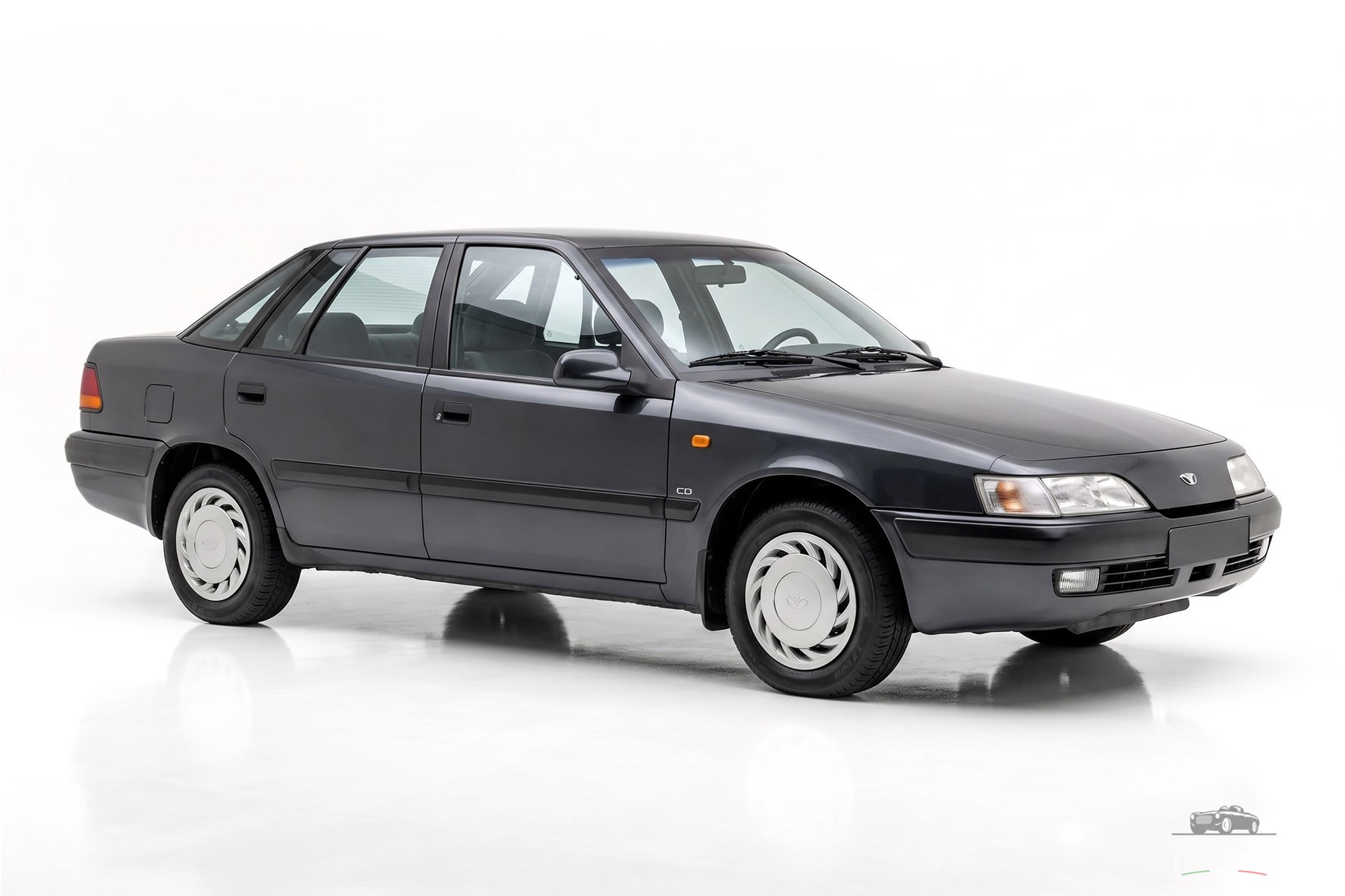
The Daewoo Espero entered production in 1990 as a four-door saloon whose exterior styling was developed by the Italian design house Bertone. For Daewoo, it represented an attempt to establish a more independent visual identity beyond the General Motors-derived models with which the South Korean manufacturer had previously built its business. Bertone’s role was in styling: the production Espero was manufactured by Daewoo, rather than being a series-built Bertone coachbody.
Design and its Citroën connection
The Espero combined a low nose, steeply inclined windscreen, generous glazed area and high, almost horizontal tail in an unusually smooth three-box composition. Its visual language was close to the work Bertone was undertaking for Citroën in the same period. A specialist historical account describes the Espero’s body as descending from a Bertone proposal rejected during development of a successor to the Citroën BX, while another proposal became associated with the later Citroën Xantia. The precise design-transfer agreement, however, has not been established from original contractual records. Similarity of styling does not imply common engineering, tooling or a shared chassis, and no individual designer can yet be credited with certainty on the evidence examined.
Engineering and international production
Underneath the Italian styling, the Espero used a front-wheel-drive mechanical architecture related to General Motors’ J-platform and the Opel Ascona C, known in Britain as the earlier Vauxhall Cavalier. The production range included transverse four-cylinder petrol engines of approximately 1.5, 1.8 and 2.0 litres, with specifications varying by market and model year. Published model dimensions include a 2,620 mm wheelbase, 4,615 mm length and 1,718 mm width. These are general model specifications, not evidence for any particular surviving chassis.
Daewoo introduced the Espero in its domestic market in 1990. In Britain, where the marque arrived in 1995, its fixed-price retail strategy combined extensive equipment with servicing and warranty provisions. A contemporary road test in The Independent recorded a 2.0-litre CDXi with 1,998 cc, 105 bhp at 5,000 rpm and a UK price of £12,195. Those figures belong to the tested British-market version and should not be assigned to every Espero. Production and assembly extended beyond South Korea, including Daewoo-FSO operations in Warsaw during 1996–1999. The Daewoo Leganza succeeded the Espero in the British range in 1997, closing a distinct chapter in Daewoo’s collaboration with Italian styling studios.


THE CONVERSATION
Comments 0