
Pininfarina
Founded by Battista Pinin Farina in Turin in 1930, Pininfarina became one of the most influential Italian styling and coachbuilding houses, particularly through its work for Ferrari and other international manufacturers.
Explore record ↗
1964Coachwork by Pininfarina
THE VEHICLE AT A GLANCE
THE PEOPLE BEHIND THE CAR
Founded by Battista Pinin Farina in Turin in 1930, Pininfarina became one of the most influential Italian styling and coachbuilding houses, particularly through its work for Ferrari and other international manufacturers.
Explore record ↗01 / THE STORY
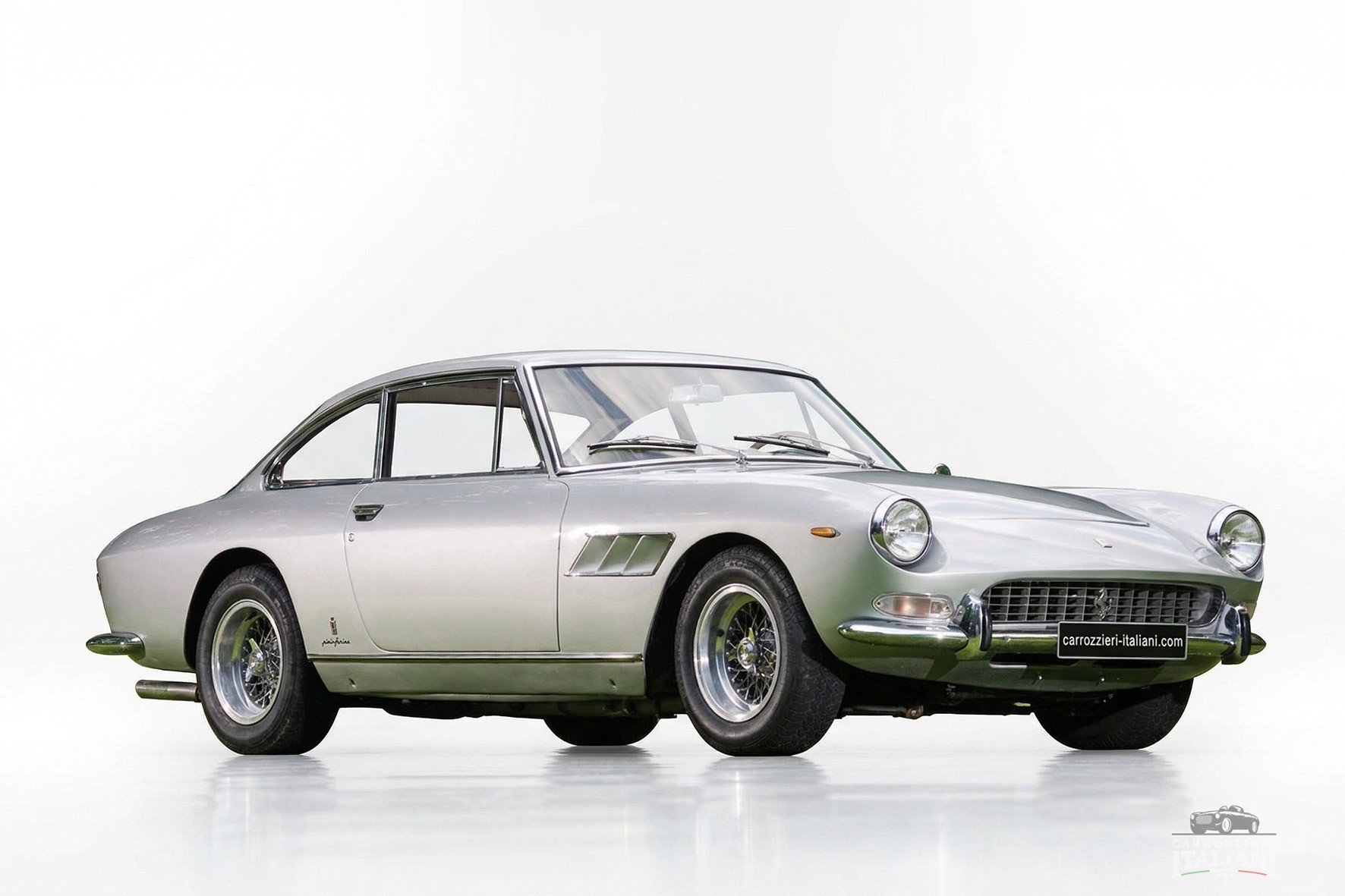
The Ferrari 330 GT 2+2 Second Series, introduced in 1965, marked a deliberate and necessary revision of Ferrari’s four-seat grand tourer following mixed reception of the first series. While the original version—unveiled in early 1964—offered technical progress over the outgoing 250 GTE and 330 America, its styling, particularly the quad headlamp treatment by Pininfarina, divided opinion. The Second Series resolved this with a more conventional dual headlamp layout, giving the front fascia a balanced and more traditionally Ferrari appearance. Mechanically, the updates were substantial. The Series II gained a five-speed gearbox, replacing the earlier four-speed with overdrive, and a revised rear suspension geometry. Inside, refinements in finish and ergonomics reflected Ferrari’s growing emphasis on comfort for clients seeking both long-distance capability and brand prestige. Other improvements included optional air conditioning and power steering—features that aligned with Ferrari’s increasing focus on the American market. Production of the Second Series totaled 474 examples, built between 1965 and 1967. These cars were built on the same 2650 mm wheelbase as the first series, using the same 4.0-liter Colombo V12 engine, rated at 300 hp. Despite the engine’s carryover, drivability and usability improved significantly. Notably, Ferrari began transitioning from bespoke hand-built interiors to more standardized practices during this period, and the 330 GT 2+2 reflects that change. The 330 GT 2+2 was shown at several international venues, including the Brussels and Paris Motor Shows, and certain chassis featured in competition or ceremonial roles. A well-known example served as the pace car at the 1966 24 Hours of Le Mans. Some cars were commissioned with bespoke coachwork or specifications, such as the one-off Shooting Brake by Vignale (chassis 07963), displayed at the 1967 Turin Auto Salon. New, the 330 GT 2+2 retailed for around $13,000 in the U.S., placing it above Jaguar and Aston Martin, but beneath the more exotic Ferrari 275 GTB. While it was never a competition car, its success lay in broadening Ferrari’s appeal to a growing market of affluent clients seeking style, speed, and space. For collectors, the Series II represents a turning point where Ferrari began integrating performance with real-world usability—an ethos that would define the marque’s future GT cars.
02 / TECHNICAL IDENTITY
03 / DESIGN, BODY & SUPPLIERS
Coachbuilder / Design studio
Founded by Battista Pinin Farina in Turin in 1930, Pininfarina became one of the most influential Italian styling and coachbuilding houses, particularly through its work for Ferrari and other international manufacturers.
Explore record ↗04 / CHRONOLOGY
07 / GALLERY
THE CONVERSATION
Comments 0