
Pininfarina
Founded by Battista Pinin Farina in Turin in 1930, Pininfarina became one of the most influential Italian styling and coachbuilding houses, particularly through its work for Ferrari and other international manufacturers.
Explore record ↗
1988Coachwork by Pininfarina
THE VEHICLE AT A GLANCE
THE PEOPLE BEHIND THE CAR
Founded by Battista Pinin Farina in Turin in 1930, Pininfarina became one of the most influential Italian styling and coachbuilding houses, particularly through its work for Ferrari and other international manufacturers.
Explore record ↗Enrico Fumia is an Italian automotive designer associated with Pininfarina, the Alfa Romeo 164 and 916 GTV/Spider, Ferrari F90 and Lancia.
Explore record ↗01 / THE STORY
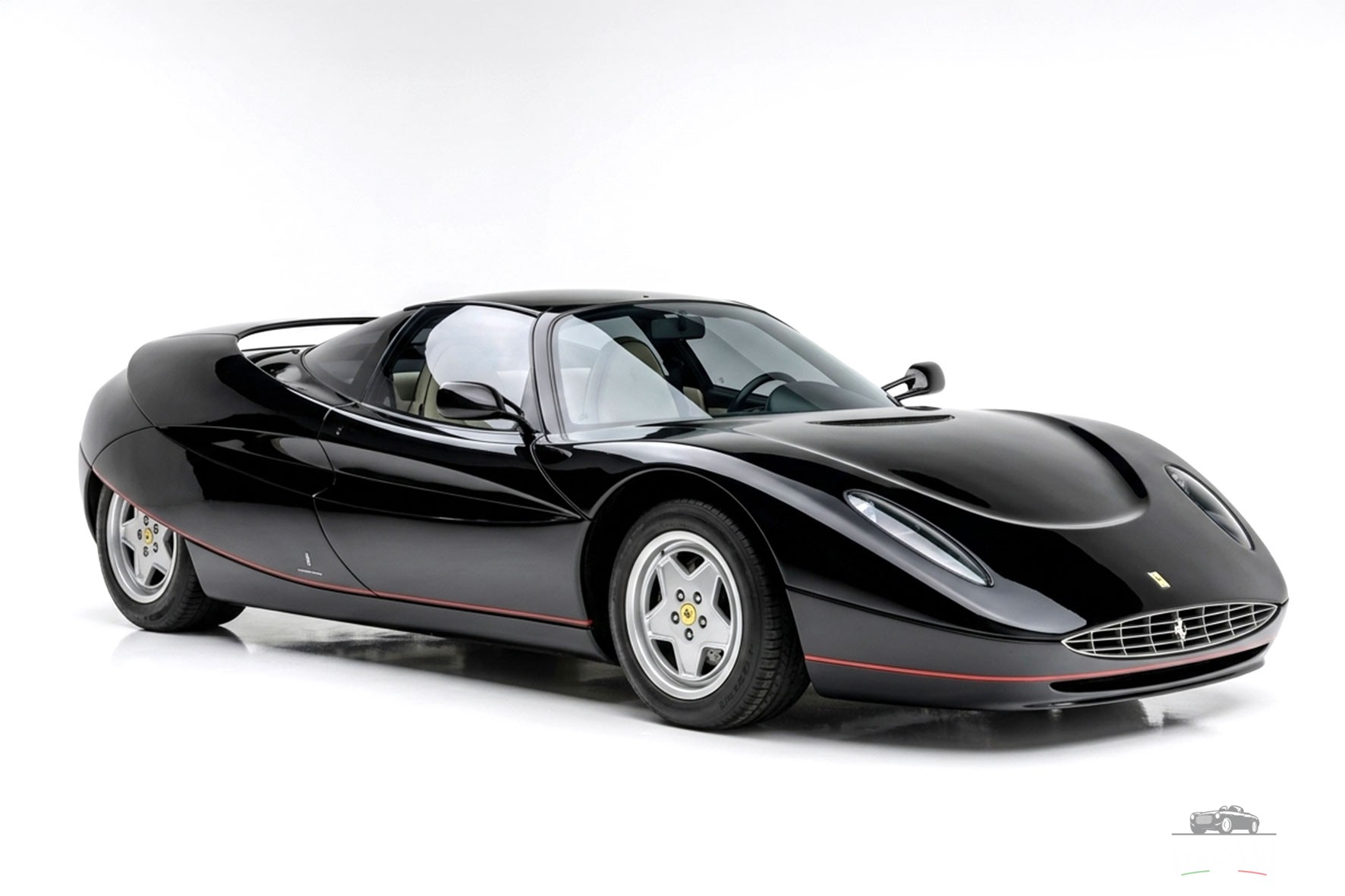
The Ferrari F90 was a bespoke prototype designed and built by Pininfarina in 1988 on the mechanical base of the Ferrari Testarossa. The project was executed under the direction of Enrico Fumia, with production limited to six units commissioned by the Royal Family of Brunei. The model was kept confidential for nearly two decades and was first officially documented in the 2005 Ferrari Yearbook. The chassis and drivetrain originated from the Testarossa, retaining the longitudinal rear-mounted 4,942 cc flat-twelve engine producing approximately 390 hp at 6,300 rpm. Power was transmitted to the rear wheels through a five-speed manual gearbox. The tubular steel structure and independent suspension with unequal-length wishbones, coil springs, and telescopic dampers were carried over with minor adaptations. Braking was by ventilated discs on all four wheels. Dimensions were similar to the Testarossa donor, with an overall length of approximately 4,480 mm, width of 2,000 mm, and height of 1,135 mm. Kerb weight was estimated at 1,500 kg. Performance values were comparable, with a top speed around 290 km/h and 0–100 km/h acceleration in approximately 5.2 seconds. The body was entirely redesigned by Pininfarina using the “four-side look” design concept, characterized by the repetition of an elliptical leitmotif across the front, sides, and rear of the vehicle. The exterior incorporated a targa-style sliding roof panel that overlapped the rear window, flush glazing, and concealed headlamps. The overall form emphasized aerodynamic flow through clean surfacing and integrated air channels. The F90’s structure was composed of hand-formed aluminum panels over the modified Testarossa frame. The cabin followed a two-seat grand touring layout with bespoke materials and instrumentation. Cooling radiators were repositioned from the Testarossa’s side pods to a frontal configuration beneath the nose. Six examples of the Ferrari F90 were completed by Pininfarina for Brunei in 1988, each differing slightly in detailing and finish.
02 / TECHNICAL IDENTITY
Become a Pro member to see the full details in this section.
Membership is not available yet.
View membership options03 / DESIGN, BODY & SUPPLIERS
Coachbuilder / Design studio
Founded by Battista Pinin Farina in Turin in 1930, Pininfarina became one of the most influential Italian styling and coachbuilding houses, particularly through its work for Ferrari and other international manufacturers.
Explore record ↗Designer
Enrico Fumia is an Italian automotive designer associated with Pininfarina, the Alfa Romeo 164 and 916 GTV/Spider, Ferrari F90 and Lancia.
Explore record ↗Become a Pro member to see the full details in this section.
Membership is not available yet.
View membership options05 / PEOPLE, COLLECTIONS & MUSEUMS
07 / CHASSIS REGISTER
08 / GALLERY
THE CONVERSATION
Comments 0