
Pininfarina
Founded by Battista Pinin Farina in Turin in 1930, Pininfarina became one of the most influential Italian styling and coachbuilding houses, particularly through its work for Ferrari and other international manufacturers.
Explore record ↗
1970Coachwork by Pininfarina
THE VEHICLE AT A GLANCE
THE PEOPLE BEHIND THE CAR
Founded by Battista Pinin Farina in Turin in 1930, Pininfarina became one of the most influential Italian styling and coachbuilding houses, particularly through its work for Ferrari and other international manufacturers.
Explore record ↗Paolo Martin worked with Giovanni Michelotti before joining Bertone and Pininfarina. At Pininfarina he developed the Ferrari 512 S Modulo and Fiat 130 Coupe, and also worked on the Rolls-Royce Camargue. He later became styling director at Ghia.
Explore record ↗01 / THE STORY
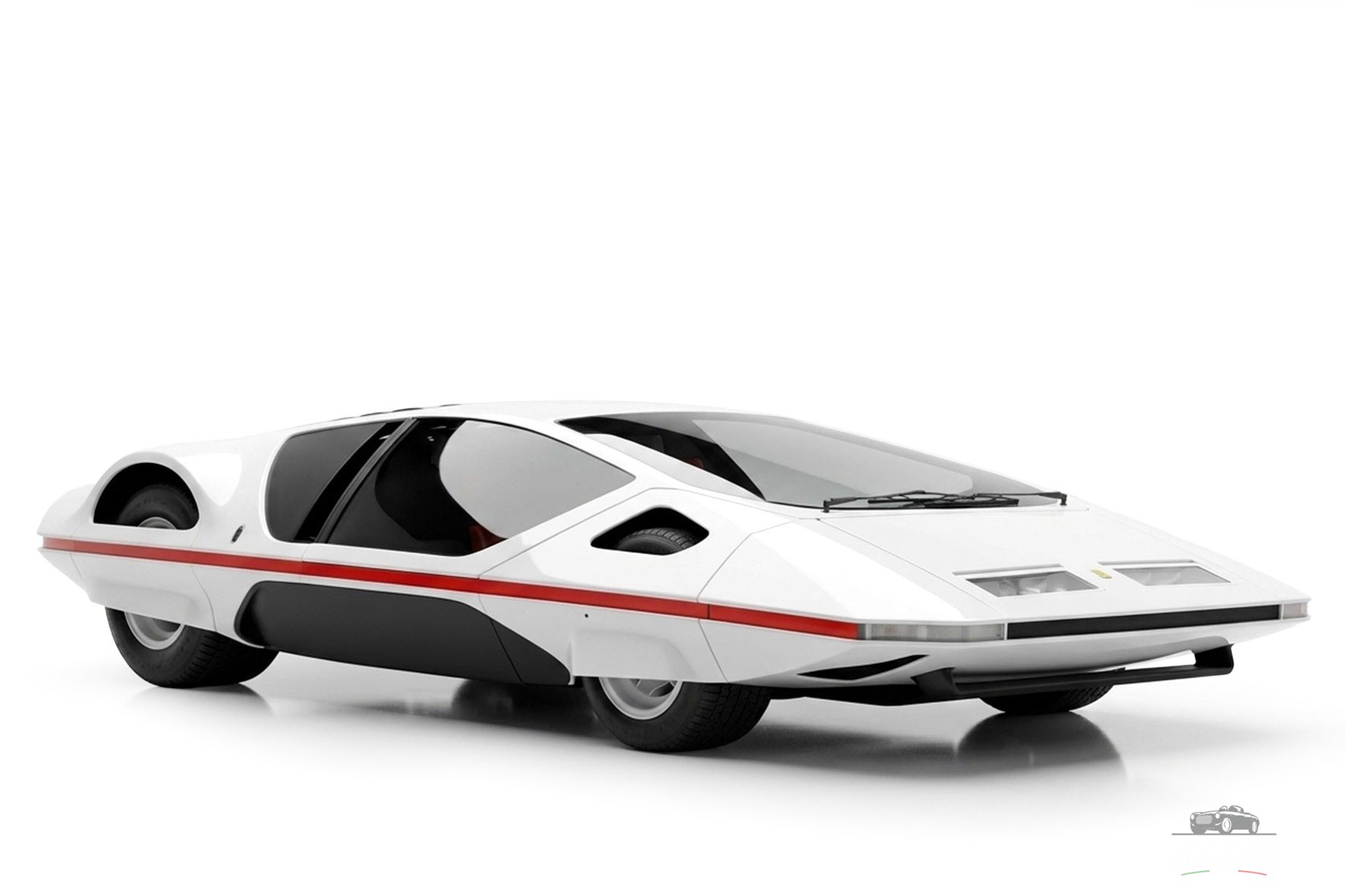
The Ferrari Modulo originally started out as a Ferrari 512S and was converted to 612 Can Am spec. After testing, the engine and transmission were removed and the chassis was stripped down and given to Pininfarina to build a show car. The show car debuted at the 1970 Geneva Motor Show and was originally painted black, but was later repainted in the white. The Modulo was well received by critics and has won 22 awards for its design. The Ferrari Modulo was designed in 1967, based on the Ferrari 512 S, by Paolo Martin, designer at Pininfarina, and is recognized as one of the most famous dream cars of all time. The car was presented by Pininfarina at the 1970 Geneva Motor Show, and then remained on display from April to September of that year in the Italian Pavilion at the 1970 Expo in Osaka. Since then, the “Modulo” has been in constant demand at various shows on every continent, receiving dozens of awards, including Automobile Quarterly’s prestigious Award for Design Excellence in 1971. The Ferrari Modulo is an unusually shaped vehicle with graphically mirrored solutions considered too futuristic for the time; specifically, it does not have doors but the entire windshield and the front part of the roof and windows are manually moved forward to allow entry. This system is derived from research into access in cars of limited height (less than a meter in this case); this system, also used on Bertone’s coeval Strato’s Zero prototype, the precursor to the Lancia Stratos, was taken up after forty years, in an automated version, on the 2005 Maserati Birdcage 75th concept. Also noteworthy are the distinctly futuristic interior, in which all controls are arranged on a special sphere equipped with buttons facing the driver and positioned to his left; this arrangement was possible because of the car’s considerable width, although the driver and passenger find themselves very close to each other. The gearshift lever, on the other hand, is positioned on axis with the dashboard. The Ferrari Modulo was unveiled at the Geneva motor show in 1970 with a metallic black color scheme and was hailed as the star of the show, although the maquette was later repainted with the original color, a pearl light blue. For the boldness of its solutions, it won more than twenty-two international awards for design and concept. Long stored at the Centro Stile Pininfarina in Cambiano, Italy, the “Modulo” was sold in September 2014 to classic car collector James Glickenhaus, a U.S. entrepreneur and film producer who owns Scuderia Cameron Glickenhaus (SCG), a small car manufacturer that builds racing cars, made in Turin by Manifattura Automobili Torino (MAT). After the purchase, the new owner entrusted the “Modulo” to MAT technicians in order to study and implement the transformation of the maquette into a running prototype.
02 / TECHNICAL IDENTITY
03 / DESIGN, BODY & SUPPLIERS
Coachbuilder / Design studio
Founded by Battista Pinin Farina in Turin in 1930, Pininfarina became one of the most influential Italian styling and coachbuilding houses, particularly through its work for Ferrari and other international manufacturers.
Explore record ↗Designer
Paolo Martin worked with Giovanni Michelotti before joining Bertone and Pininfarina. At Pininfarina he developed the Ferrari 512 S Modulo and Fiat 130 Coupe, and also worked on the Rolls-Royce Camargue. He later became styling director at Ghia.
Explore record ↗04 / CHRONOLOGY
05 / PEOPLE, COLLECTIONS & MUSEUMS
06 / MARKET & PRICE HISTORY
Become a Pro member to explore the full price and sale history.
Membership is not available yet.
View membership optionsMarket observations describe documented transactions, estimates or offers. They are not themselves a current valuation of the vehicle.
07 / CHASSIS REGISTER
08 / GALLERY
THE CONVERSATION
Comments 0