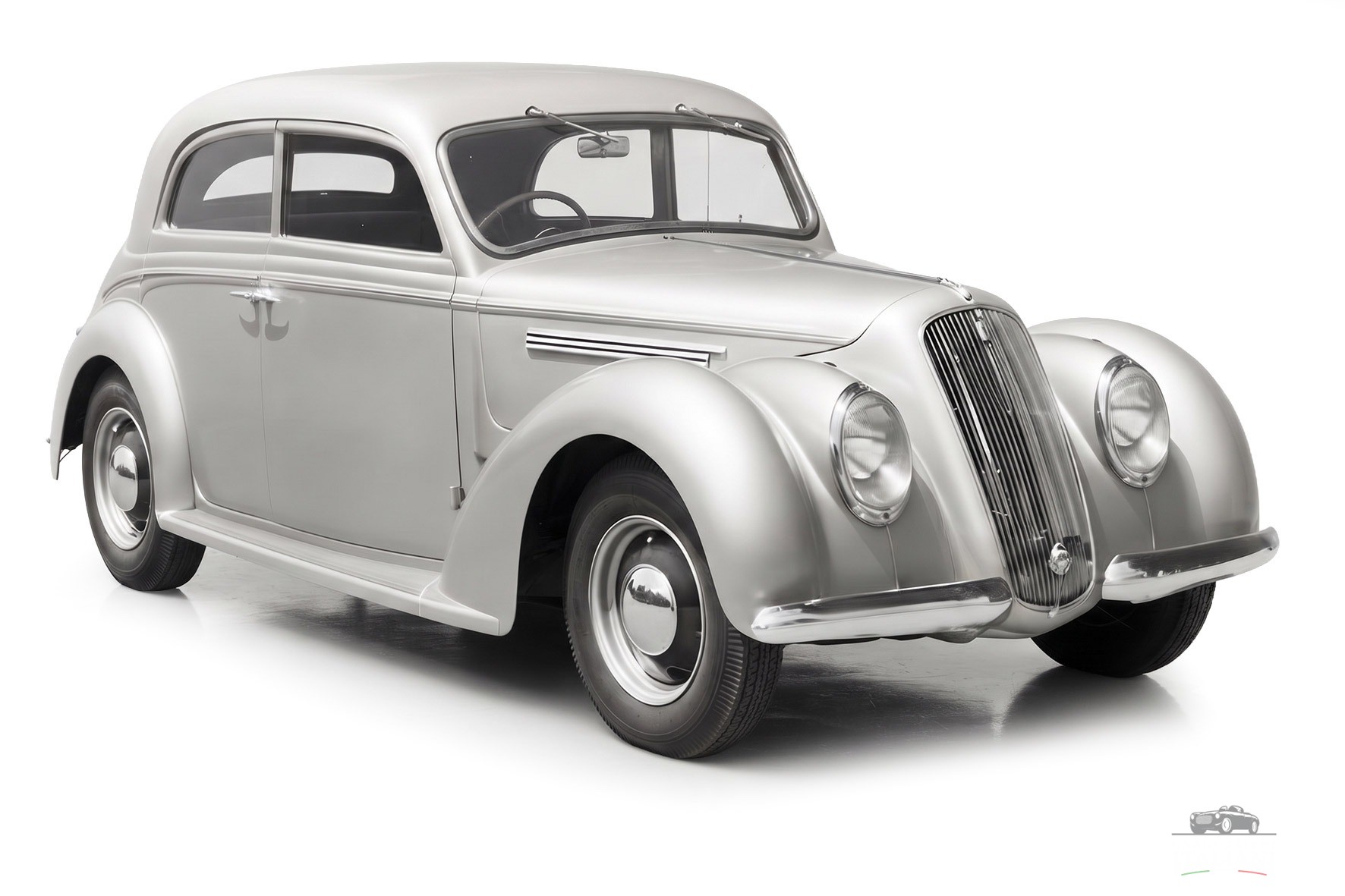
The Fiat 1500 Berlina Bertone catalogued as a 1937 creation belongs to the Turin coachbuilder’s experiments with aerodynamic saloon bodies during the second half of the 1930s. The Fiat 1500, introduced in 1935, provided a modern six-cylinder chassis that attracted several Italian coachbuilders. A photographic survey published by the Swedish magazine Klassiker in 2012 explicitly identifies a Fiat 1500 saloon bodied by Bertone in 1937. This independent caption supports the historical presence of a Bertone saloon of that date, although the photograph has not yet been matched conclusively to an original chassis number or to every image attached to the present archive record.
From the Aerodinamica to the later saloons
Bertone had already explored the Fiat 1500’s streamlined architecture with the 1935 Aerodinamica. Specialist historical accounts also document several aerodynamic Bertone saloons in 1936, represented in the archive by a separate 1936 Berlina entry. The original descriptions of the 1936 and 1937 records contain overlapping language and details. It is therefore necessary to distinguish their catalogue identities from any claim that they represent demonstrably different chassis, body commissions or surviving cars. A comparison of dated coachbuilder photographs and period exhibition catalogues remains essential.
The earlier description of the 1937 car emphasizes headlights blended into the wings and a more upright radiator grille. These features remain useful visual clues, but their precise application to this body requires further documentation. In particular, integrated front lighting was already characteristic of the production Fiat 1500; it cannot alone establish an innovation unique to Bertone. The standard Fiat 1500 employed a 1,493 cc overhead-valve inline-six engine, a four-speed manual gearbox and rear-wheel drive. Those specifications describe the underlying Fiat model, not a mechanically verified individual Bertone chassis. Its engine number, wheelbase configuration, original registration and subsequent ownership are presently unknown.
Exhibition history and authorship
The inherited record associates the Berlina with the 1937 Milan Motor Show and a Turin concours of the same year, including a reported class award. The Milan exhibition itself is documented in the Museo Nazionale dell’Automobile’s history of Italian motor shows, but that establishes the event rather than this particular car’s participation. The surviving Carrozzieri Italiani event index identifies a different Bertone Fiat 1500, the Vittoria, among the Milan participants. Similarly, a later history of Bertone discusses a 1937 Fiat 1500 Cabriolet receiving a Turin distinction in 1938; that account cannot substantiate the Berlina’s separate 1937 award. The inherited event and prize links should consequently be retained as historical claims awaiting verification against contemporary entry lists and classifications.
Mario Revelli di Beaumont contributed to the design history of the production Fiat 1500, but no reviewed document establishes his authorship of this specific Bertone saloon. Nor does Giovanni Bertone’s direction of the coachbuilding firm by itself establish that he personally drew its body. For now, Bertone’s responsibility for the coachwork and the 1937 photographic identification are better supported than the individual stylist, exact production quantity, concours result or chassis provenance. The car remains an important subject for research into the changing relationship between factory streamlining and independent Italian coachbuilding before the war.


THE CONVERSATION
Comments 0