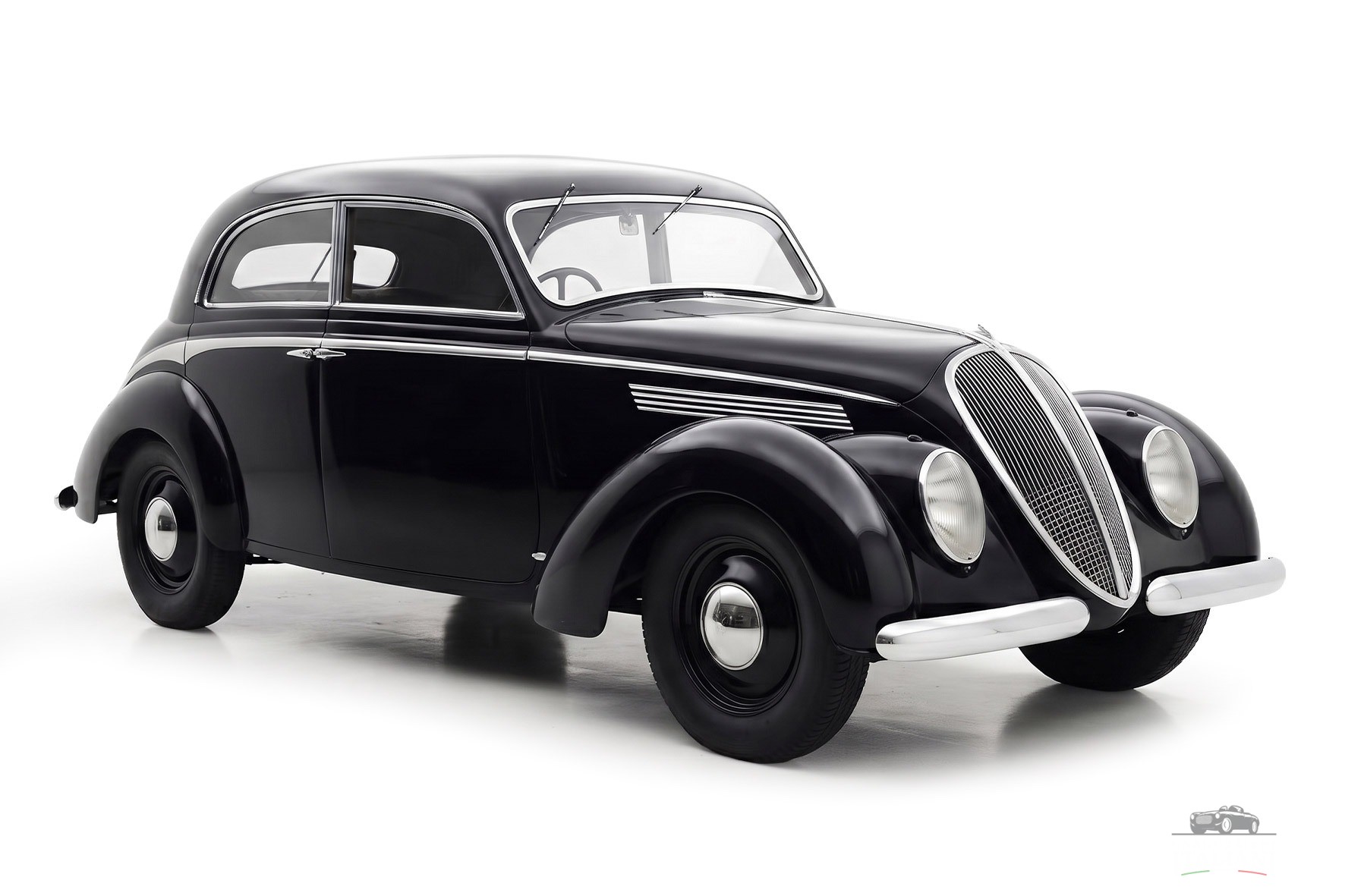
The Fiat 1500 Berlina Bertone belongs to the series of streamlined saloons developed by Carrozzeria Bertone during the first years of Fiat’s six-cylinder 1500. Introduced in 1935, the production Fiat 1500 offered a notably modern starting point for independent coachbuilders, with its tapered bonnet, integrated front lighting and attention to aerodynamic form. Bertone was among the first firms to reinterpret the new chassis. The Museo Nicolis records that in 1936 the Turin coachbuilder presented several Fiat 1500 berlinas whose lines placed even greater emphasis on streamlining than those of the standard car.
Bertone’s pre-war aerodynamic saloons
The 1936 Berlina should be considered within a developing family of coachbuilt Fiat 1500s rather than automatically identified with a single surviving car. Specialist literature illustrates an earlier Bertone 1500 Aerodinamica of 1935, while the archive also contains a Fiat 1500 Berlina Bertone dated 1937. The original descriptions of the 1936 and 1937 entries overlap, so their precise relationship and the number of separate bodies require comparison with dated photographs and original coachbuilder records. Neither the existence of several Bertone saloons nor their appearance in historical literature establishes an exact production total.
The earlier Carrozzieri Italiani description of this 1936 entry mentions headlamps integrated into the front wings and a more upright radiator grille. Those details are useful research leads, but they have not yet been tied securely to an identified 1936 Bertone chassis. Headlamps blended into the wings were also part of the standard Fiat 1500’s aerodynamic design, and later Fiat 1500 versions adopted different grille treatments. It would therefore be misleading to treat these features as independently confirmed evidence of a unique Bertone body without examining the relevant period images.
Mechanical context and attribution
The underlying Fiat 1500 family employed a 1,493 cc inline-six engine, a four-speed manual transmission and rear-wheel drive. These figures describe the production platform, not the verified specification of a particular Bertone-built car. No original chassis or engine number, registration plate, individual owner, or period competition entry has yet been established for the 1936 Berlina. The precise coachwork materials, dimensions, production quantity and survival history likewise remain open.
Mario Revelli di Beaumont is named in the original listing’s excerpt and search metadata, but the available evidence does not establish him as the individual stylist of this 1936 body. The Museo Nicolis associates Revelli with a different, later Bertone Fiat 1500 C coupé, built on a 1941 chassis around the end of the war; that attribution cannot be transferred to the pre-war Berlina. The historical importance of the 1936 entry lies in Bertone’s documented experimentation with the Fiat 1500 platform during the transition toward more integrated and aerodynamic coachwork. A definitive identification of the body and its authorship awaits stronger contemporary documentation.


THE CONVERSATION
Comments 0