
Boneschi
Carrozzeria Boneschi developed from a Lombard coachbuilding business into a specialist producer of individual automobile bodies, commercial conversions and distinctive post-war projects.
Explore record ↗
1964Coachwork by Boneschi
THE VEHICLE AT A GLANCE
THE PEOPLE BEHIND THE CAR
Carrozzeria Boneschi developed from a Lombard coachbuilding business into a specialist producer of individual automobile bodies, commercial conversions and distinctive post-war projects.
Explore record ↗01 / THE STORY
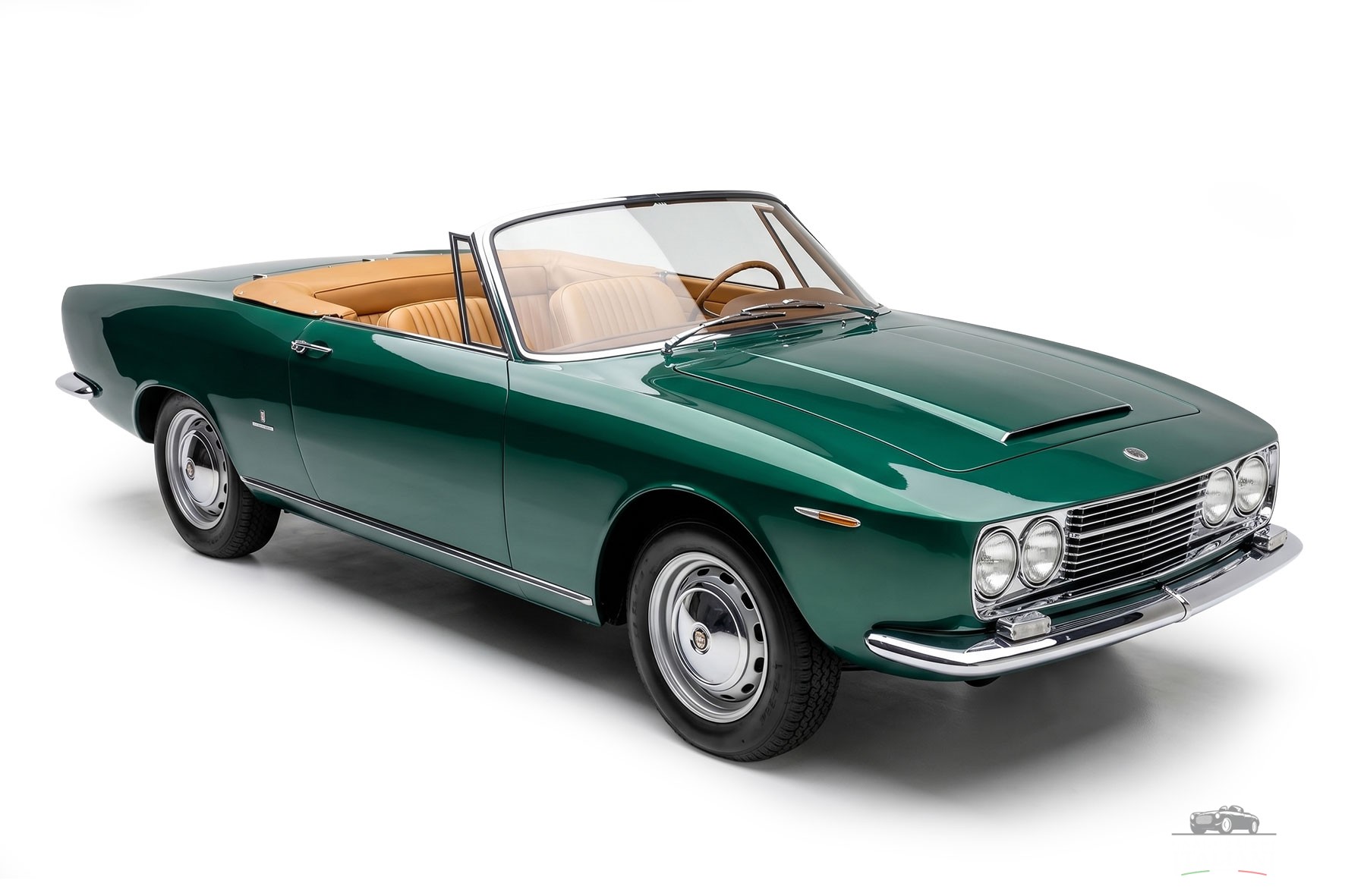
The Fiat 2300 S Cabriolet by Carrozzeria Boneschi is a prototype constructed in the early 1960s, based on the mechanical platform of the Fiat 2300 S Coupé. It adopts the “Linea Tesa” design language, developed under the direction of industrial designer Rodolfo Bonetto. The Linea Tesa approach is defined by strict geometric lines, flat surfaces, and an absence of ornamental detailing, in contrast to the curved forms typical of Italian automotive styling in the preceding decade. The prototype uses the standard 2300 S mechanicals, including a 2.3-liter inline-six engine developed with input from Abarth, coupled to a manual transmission. The chassis and drivetrain remain unchanged from the production coupé, but the bodywork was completely reconfigured by Boneschi. The front features a horizontal grille integrated with dual headlamps, a flat bonnet, and a straight beltline extending from the front to the rear quarter. The rear is similarly angular, with minimal surface curvature and integrated rear lights positioned flush with the bodywork. The interior of the vehicle is finished in white upholstery, with simplified door panels and dashboard design. Chrome elements are limited and used only to frame key structural lines such as the windshield and upper body edge. The vehicle lacks additional equipment beyond basic instrumentation and switchgear. The Fiat 2300 S Cabriolet by Boneschi was not intended for series production and remained a one-off design study. It was presented to evaluate the viability of angular design principles applied to an open-top grand touring vehicle. While it did not progress beyond the prototype stage, the car is representative of Boneschi’s design direction in the period and is one of the few surviving examples of Linea Tesa applied to a Fiat model. Its construction reflects a broader experimental phase in Italian coachbuilding during the early 1960s.
02 / TECHNICAL IDENTITY
03 / DESIGN, BODY & SUPPLIERS
Coachbuilder / Design studio
Carrozzeria Boneschi developed from a Lombard coachbuilding business into a specialist producer of individual automobile bodies, commercial conversions and distinctive post-war projects.
Explore record ↗Designer
04 / CHRONOLOGY
07 / GALLERY
THE CONVERSATION
Comments 0