
Zagato
Founded in Milan in 1919 by Ugo Zagato, the coachbuilding house developed lightweight aerodynamic bodies inspired by aircraft construction, creating distinctive racing and grand touring automobiles.
Explore record ↗
1960Coachwork by Zagato
THE VEHICLE AT A GLANCE
THE PEOPLE BEHIND THE CAR
Founded in Milan in 1919 by Ugo Zagato, the coachbuilding house developed lightweight aerodynamic bodies inspired by aircraft construction, creating distinctive racing and grand touring automobiles.
Explore record ↗01 / THE STORY
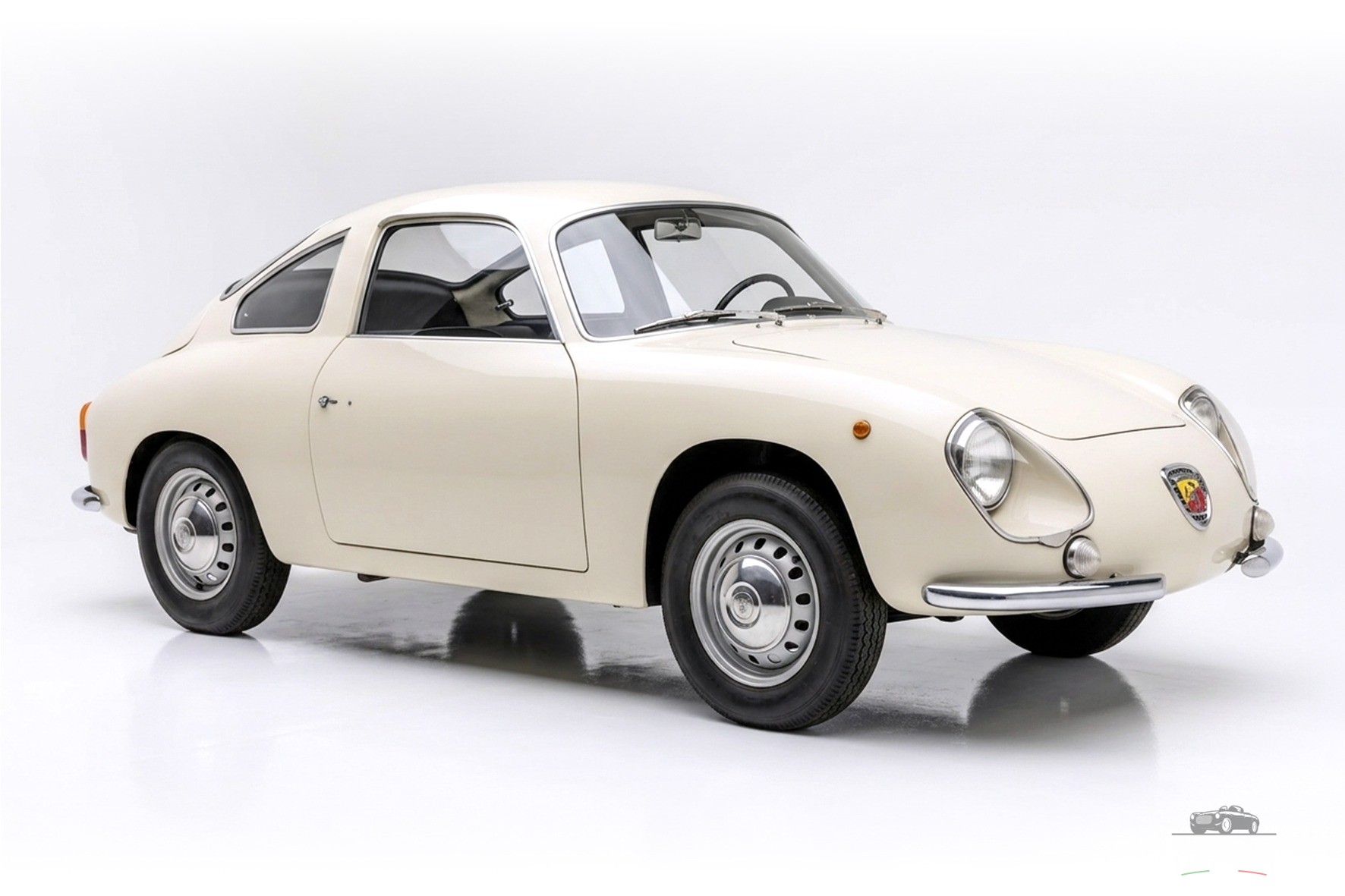
The Abarth 850 Coupé Stradale Zagato, introduced in 1960, is a limited-production sports vehicle developed through a collaboration between Abarth & C. of Turin and Carrozzeria Zagato. Constructed on the Fiat 850 mechanical base, the model represents an early example of Abarth’s efforts to produce lightweight, performance-oriented variants using compact platforms. The vehicle employed an 847 cc inline-four, overhead valve, naturally aspirated engine, producing approximately 52 brake horsepower at 6,000 revolutions per minute and 83 Newton-meters of torque at 3,000 rpm. Power was delivered to the rear wheels via a four-speed manual transmission. The model utilized rear-wheel drive and a suspension system consistent with the donor Fiat 850, optimized for improved handling characteristics. The vehicle’s kerb weight was approximately 570 kilograms, enabling a top speed near 165 kilometers per hour. Bodywork was executed by Carrozzeria Zagato using lightweight materials, notably aluminium panels fashioned into an aerodynamic two-door coupé configuration. The design emphasized low drag and minimal frontal area, employing smooth, flowing lines and reduced external ornamentation. Zagato’s influence is evident in the vehicle’s streamlined silhouette and compact proportions. The coachbuilt body was mounted upon a modified Fiat chassis, adapted to accommodate enhanced suspension and braking components. Production volumes were low, with no comprehensive records indicating the total number of units constructed. Surviving chassis numbers are few, with examples distributed among private collectors and motorsport historians. Documentation of ownership history is limited and typically confined to private registries or specialized auctions. The vehicle was primarily intended for competition use and for motorsport enthusiasts seeking a high-performance compact coupé. It may have been associated with racing teams active in regional or national events during the early 1960s. No direct evidence links the model to specific motorsport campaigns or factory-supported entries. The Abarth 850 Coupé Stradale Zagato occupies a niche within the Italian postwar automotive landscape as a compact, coachbuilt sports car, illustrating the practice of combining small-displacement mechanical platforms with bespoke aerodynamic bodies to achieve enhanced performance and exclusivity.
02 / TECHNICAL IDENTITY
03 / DESIGN, BODY & SUPPLIERS
Coachbuilder / Design studio
Founded in Milan in 1919 by Ugo Zagato, the coachbuilding house developed lightweight aerodynamic bodies inspired by aircraft construction, creating distinctive racing and grand touring automobiles.
Explore record ↗07 / GALLERY
THE CONVERSATION
Comments 0