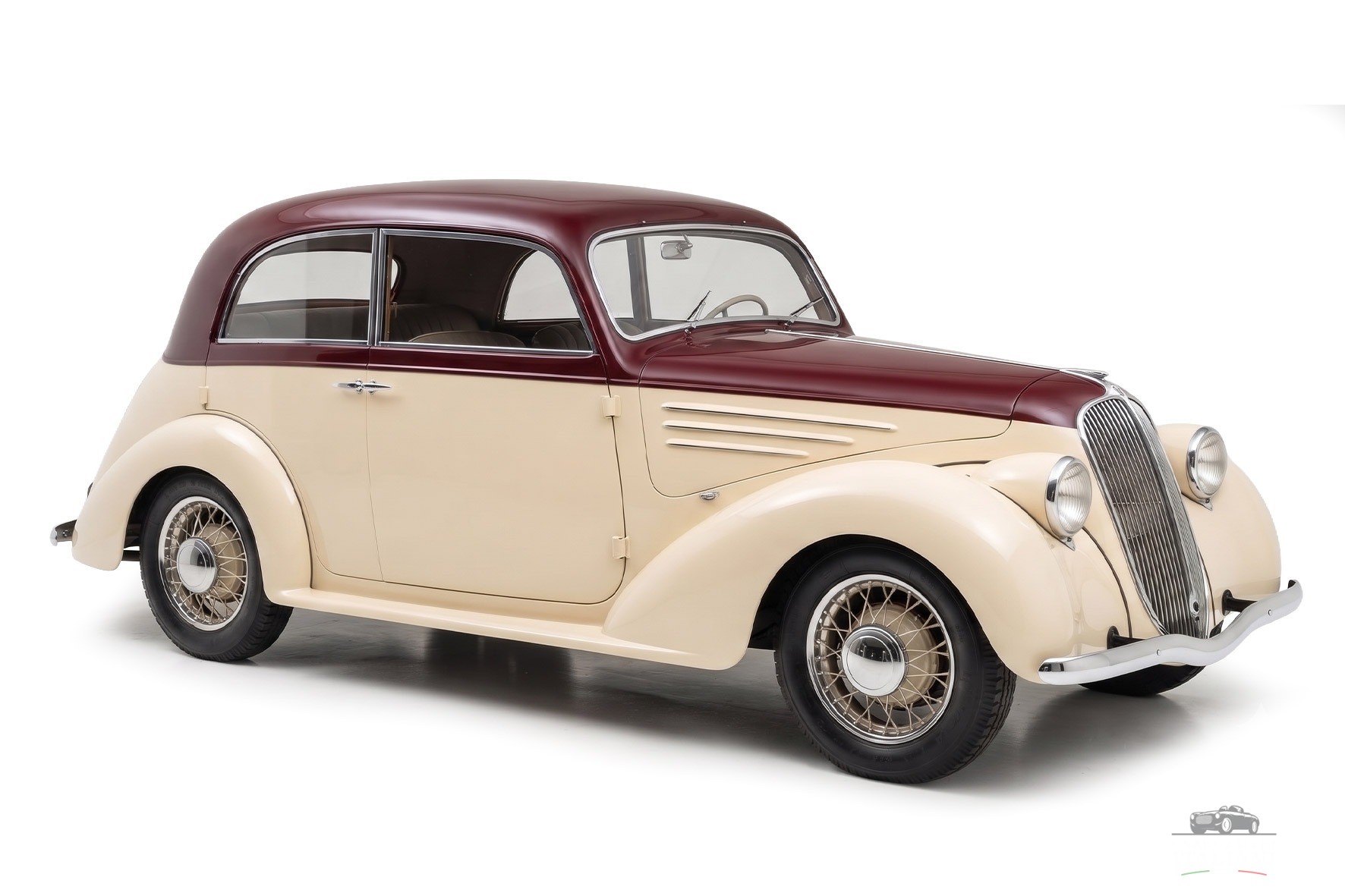
Among the special-bodied Fiat 508 Balilla models of the 1930s, Bertone’s 1936 508 Balilla Variant has a distinct entry in the surviving coachbuilder chronology. A historical model list reproduced by the Greek motoring magazine 4Troxoi in January 2008, with links to Bertone’s former website, records a “508 Balilla Variant” for 1936 and separately lists a Fiat 508 Balilla Variant for 1934. This is useful evidence for the project’s place in the Bertone programme, but it does not identify an individual chassis, the precise body configuration, the number built or a named stylist.
Identification and the Balilla family
The earlier catalogue record called this car the “Fiat 508 Balilla Berlina Z”. That wording remains part of its archival history and its original web address is preserved, but the suffix “Z” is not substantiated by the accessible Bertone-derived chronology. The exact saloon body classification also requires period evidence. For that reason, the neutral designation Fiat 508 Balilla Variant Bertone is preferable until a factory photograph, drawing or contemporary description resolves the identification.
The Fiat 508 Balilla had been introduced in 1932, and its family was revised in 1934 with updated styling and a four-speed transmission. Bertone was among the independent Italian coachbuilders that used the Fiat 508 as the basis for special bodies. This mechanical and commercial background should not be mistaken for a specification of the 1936 Bertone variant itself: its individual engine, gearbox, chassis number, suspension and dimensions have not been established. The earlier description’s claims about exhibitions, production and surviving examples likewise remain unverified for this particular project.
Related Bertone projects
Within Bertone’s pre-war Fiat work, the 1936 entry can be considered alongside the Fiat 508 Balilla della Signora of 1934 and the Fiat 508 Balilla Berlina Bertone dated 1935. The later Fiat 508C Cabriolet Bertone of 1938 belongs to the subsequent 508C generation. These are related coachbuilding projects, not evidence of a shared individual chassis. Establishing the 1936 variant’s original appearance, designer, provenance and possible exhibition history remains an open archival task.


THE CONVERSATION
Comments 0