
Ghia
Founded in Turin in 1916, Carrozzeria Ghia became a major Italian design and coachbuilding house, creating bespoke automobiles, prototypes and international collaborations across the twentieth century.
Explore record ↗
1977Coachwork by Ghia
THE VEHICLE AT A GLANCE
THE PEOPLE BEHIND THE CAR
Founded in Turin in 1916, Carrozzeria Ghia became a major Italian design and coachbuilding house, creating bespoke automobiles, prototypes and international collaborations across the twentieth century.
Explore record ↗Paul Breuer is a Belgian designer who joined OSI in Turin in 1966 and subsequently worked at Fiat and Ford's Ghia studio. At Open Design he collaborated on projects for Mitsubishi, Saab, SEAT and De Tomaso. Becoming independent in 1985, he expanded into boats, trains, caravans and industrial vehicles.
Explore record ↗01 / THE STORY
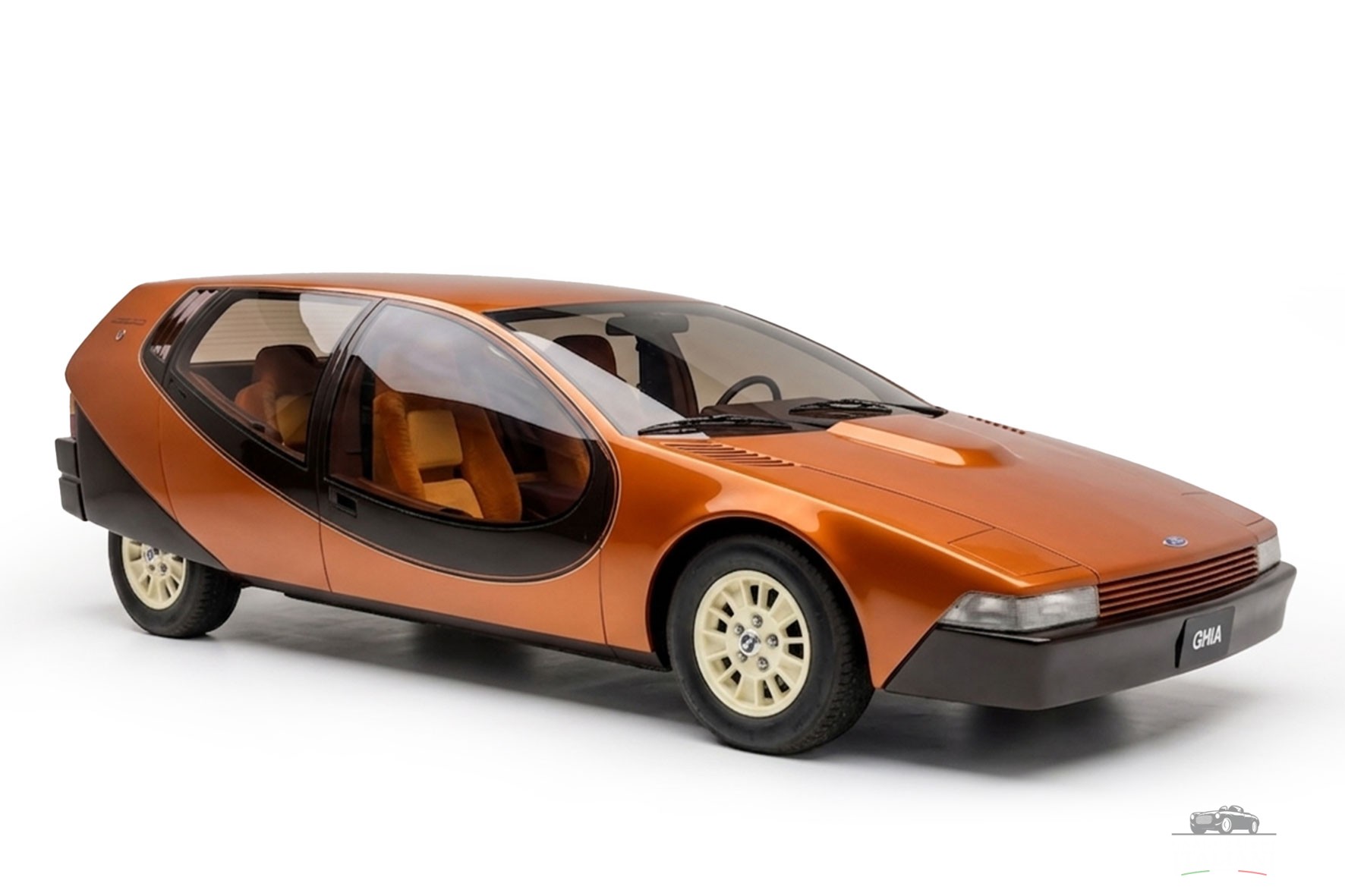
The Ford Megastar I, designed by Paul Breuer in 1977 for Carrozzeria Ghia under Filippo Sapino’s direction, is a striking wedge-shaped sedan. Created to explore innovative design language for a new generation of more aerodynamic and fuel-efficient sedans, the Megastar made its debut at the 1977 Geneva Motor Show. Ford displayed the Megastar I also at the 1978 Chicago, which was fitted with a 3-litre V6. Featuring a pronounced two-volume wedge silhouette, the Megastar boasted expansive side windows, bold graphics, and a truncated rear end reminiscent of a “Shooting Brake.” Beneath its unconventional exterior lay the chassis of a Ford Granada, powered by a 3.0-liter V6 engine. The Megastar shared several design elements typical of the era, including hood-mounted air intakes, a slim horizontal grille, pop-up headlights, and thin rectangular running lights. Its most distinctive feature was the extensive use of glass in the side profile, with large, curving panels extending across the front and rear doors, covering approximately 80% of the car’s sides. A notable design element was the stylish band running parallel from the front edge of the roof to the threshold level, which harmonized with the car’s profile and visually lightened its impact. This design choice subtly echoed the graphic treatment of the 1971 NSU RO80 concept by Pininfarina. Inside, the Megastar featured padded leather finishes, futuristic analog indicators with bright orange needles, a large automatic gear lever, and orange velvet seat surfaces. Despite its innovative design, the Megastar elicited mixed reactions and remained a prototype. The automotive design landscape was shifting towards softer, rounded lines, exemplified by the debut of the Porsche 928 during the same period, signaling a departure from the bold, angular aesthetics of the Megastar. A second model called Megastar II was released one year after.
02 / TECHNICAL IDENTITY
03 / DESIGN, BODY & SUPPLIERS
Coachbuilder / Design studio
Founded in Turin in 1916, Carrozzeria Ghia became a major Italian design and coachbuilding house, creating bespoke automobiles, prototypes and international collaborations across the twentieth century.
Explore record ↗Designer
Paul Breuer is a Belgian designer who joined OSI in Turin in 1966 and subsequently worked at Fiat and Ford's Ghia studio. At Open Design he collaborated on projects for Mitsubishi, Saab, SEAT and De Tomaso. Becoming independent in 1985, he expanded into boats, trains, caravans and industrial vehicles.
Explore record ↗04 / CHRONOLOGY
07 / GALLERY
08 / PERIOD ARCHIVE
Become a Pro member to see the full details in this section.
Membership is not available yet.
View membership options
THE CONVERSATION
Comments 0