
Ghia
Founded in Turin in 1916, Carrozzeria Ghia became a major Italian design and coachbuilding house, creating bespoke automobiles, prototypes and international collaborations across the twentieth century.
Explore record ↗
1980Coachwork by Ghia
THE VEHICLE AT A GLANCE
THE PEOPLE BEHIND THE CAR
Founded in Turin in 1916, Carrozzeria Ghia became a major Italian design and coachbuilding house, creating bespoke automobiles, prototypes and international collaborations across the twentieth century.
Explore record ↗01 / THE STORY
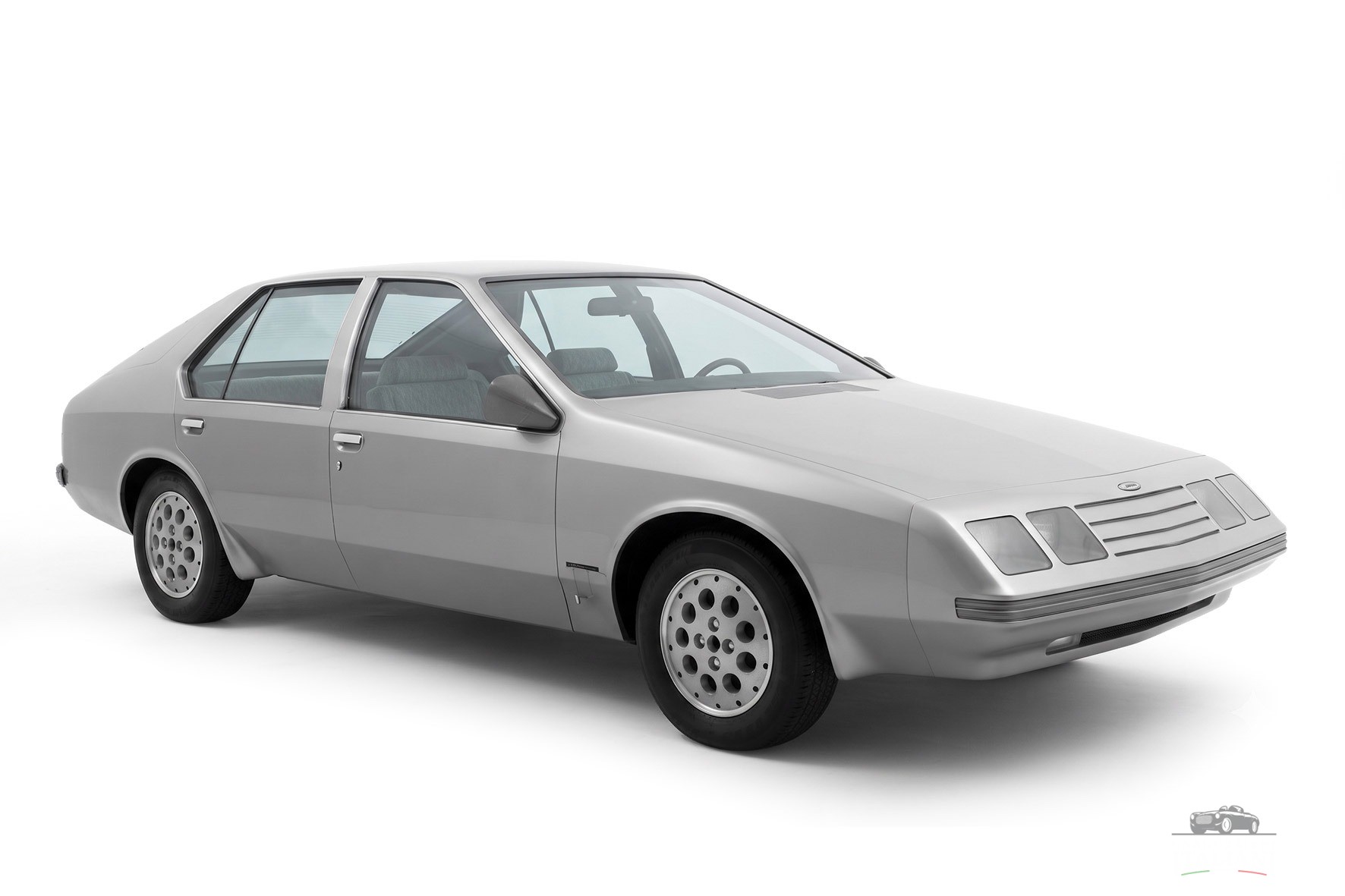
The Ford Probe II is a concept automobile developed by Ford Motor Company in collaboration with Carrozzeria Ghia. It was unveiled in 1980 as part of the Ford Probe series, a succession of design studies initiated during the late 1970s to investigate aerodynamic efficiency, fuel economy, and forward-looking vehicular form. These concepts emerged in response to shifting economic conditions and regulatory developments influenced by the energy crises of the preceding decade. The Probe II built upon the design and theoretical framework established by the 1979 Probe I. While retaining a low-profile, wedge-shaped silhouette, the Probe II introduced further aerodynamic refinements. The bodywork featured flush-mounted glass, concealed headlamps, covered rear wheels, and an uninterrupted beltline, all of which served to reduce aerodynamic drag. These design decisions were driven by the pursuit of a minimal drag coefficient, aligning with Ford’s goal to develop more fuel-efficient vehicle architectures. The vehicle’s proportions emphasized compactness and streamlined volume, with a sharply raked windscreen and tapered rear treatment. The absence of traditional ornamentation, coupled with the presence of large, integrated bumper fascias, illustrated a departure from prevailing automotive styling practices of the late 1970s. The cabin layout followed a driver-oriented philosophy, with advanced instrumentation and control interfaces. Digital gauges and capacitive touch inputs were incorporated into a unified dashboard console, prefiguring future trends in electronic vehicle interfaces. The seating and interior ergonomics were designed to accommodate four occupants within a tightly packaged, aerodynamically optimized space. Mechanically, the Probe II utilized a front-engine, front-wheel-drive layout. Although the concept’s powertrain was not intended for production validation, it reflected the shift toward compact, transversely mounted engines that were gaining prominence during the era due to their packaging efficiency and fuel economy. The Ford Probe II did not proceed to production in its conceptual form, but it exerted a measurable influence on subsequent Ford models, particularly the Ford Sierra and Ford Taurus. Its significance lies in its articulation of a new design paradigm that prioritized aerodynamic performance, integrated form, and energy-conscious engineering, anticipating the stylistic and technical evolution of mainstream automobiles throughout the 1980s and beyond.
02 / TECHNICAL IDENTITY
03 / DESIGN, BODY & SUPPLIERS
Coachbuilder / Design studio
Founded in Turin in 1916, Carrozzeria Ghia became a major Italian design and coachbuilding house, creating bespoke automobiles, prototypes and international collaborations across the twentieth century.
Explore record ↗07 / GALLERY
THE CONVERSATION
Comments 0