
Ghia
Founded in Turin in 1916, Carrozzeria Ghia became a major Italian design and coachbuilding house, creating bespoke automobiles, prototypes and international collaborations across the twentieth century.
Explore record ↗
1981Coachwork by Ghia
THE VEHICLE AT A GLANCE
THE PEOPLE BEHIND THE CAR
Founded in Turin in 1916, Carrozzeria Ghia became a major Italian design and coachbuilding house, creating bespoke automobiles, prototypes and international collaborations across the twentieth century.
Explore record ↗Patrick Le Quément is a French automobile designer who led Renault design and redefined the brand visual identity.
Explore record ↗01 / THE STORY
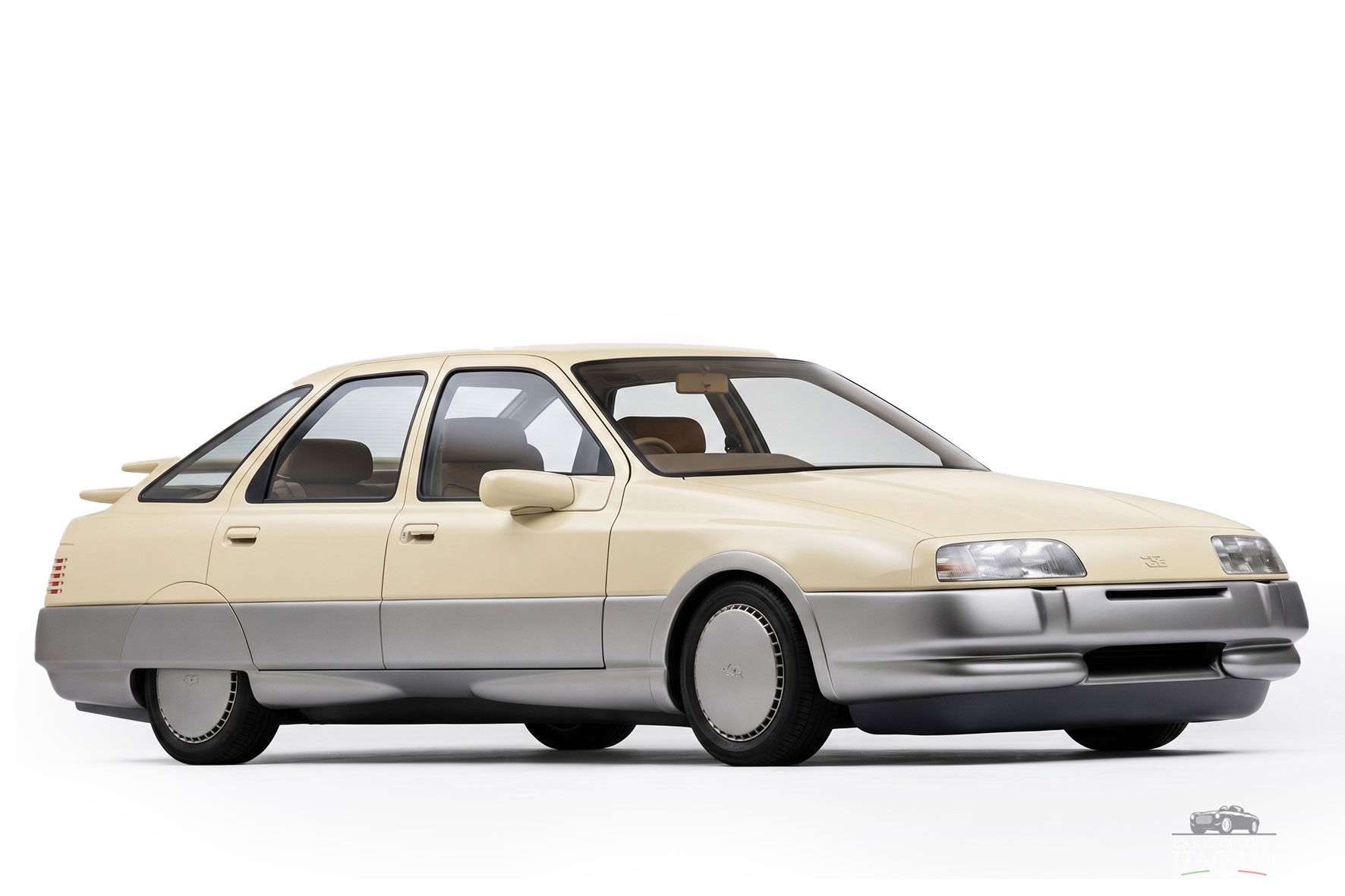
The Ford Probe III is an aerodynamic research vehicle produced by Ford in cooperation with Ghia and presented in 1981. It formed part of Ford’s multi-stage “Probe” program, which examined the practical application of low-drag body design for potential use in future mass-produced vehicles. The Probe III followed the earlier Probe I and Probe II concepts and preceded the more experimental Probe IV and Probe V models. Only one fully functional example of the Probe III is known to have been constructed, serving exclusively as a development prototype. The vehicle was built on a chassis closely related to the early engineering work that informed the subsequent Ford Sierra program. It employed a front-engine, rear-wheel-drive layout and was equipped with a 2.0-liter inline-four petrol engine, a common Ford powerplant at the time, chosen not for performance evaluation but to provide a representative mechanical baseline for aerodynamic and efficiency testing. Although the exact engine specification varied during its testing life, it remained within the standard Ford Pinto/Sierra four-cylinder family. The primary purpose of the Probe III was the reduction of aerodynamic drag. Wind-tunnel development produced a reported drag coefficient of approximately 0.25, significantly lower than contemporary production vehicles. Achieving this figure involved the use of a sloped windshield, flush glazing, integrated bumpers, partially enclosed rear wheels, and a tapered tail section consistent with aerodynamic theory of the period. Bodywork was constructed primarily from lightweight steel and composite materials, with emphasis on surface continuity and reduced panel interruption. The vehicle’s interior included experimental arrangements intended to assess future ergonomic approaches, such as digital instrumentation and simplified control groupings positioned within easy reach of the driver. These features were not intended for direct production but to test alternative interior layouts for later feasibility studies. The sole known Probe III prototype has been retained within Ford’s internal collection and has appeared periodically in archival exhibitions. Its design studies contributed directly to the aerodynamic form of the Ford Sierra (1982) and informed subsequent development of large hatchback and executive models within the company’s European lineup.
02 / TECHNICAL IDENTITY
03 / DESIGN, BODY & SUPPLIERS
Coachbuilder / Design studio
Founded in Turin in 1916, Carrozzeria Ghia became a major Italian design and coachbuilding house, creating bespoke automobiles, prototypes and international collaborations across the twentieth century.
Explore record ↗Attributed designer
Patrick Le Quément is a French automobile designer who led Renault design and redefined the brand visual identity.
Explore record ↗04 / CHRONOLOGY
07 / GALLERY
THE CONVERSATION
Comments 0