
Ghia
Founded in Turin in 1916, Carrozzeria Ghia became a major Italian design and coachbuilding house, creating bespoke automobiles, prototypes and international collaborations across the twentieth century.
Explore record ↗
1959Coachwork by Ghia
THE VEHICLE AT A GLANCE
THE PEOPLE BEHIND THE CAR
Founded in Turin in 1916, Carrozzeria Ghia became a major Italian design and coachbuilding house, creating bespoke automobiles, prototypes and international collaborations across the twentieth century.
Explore record ↗Sergio Sartorelli was an Italian automotive designer and engineer associated with Ghia, OSI and Fiat Centro Stile, contributing to Italian car styling from the 1950s onward.
Explore record ↗01 / THE STORY
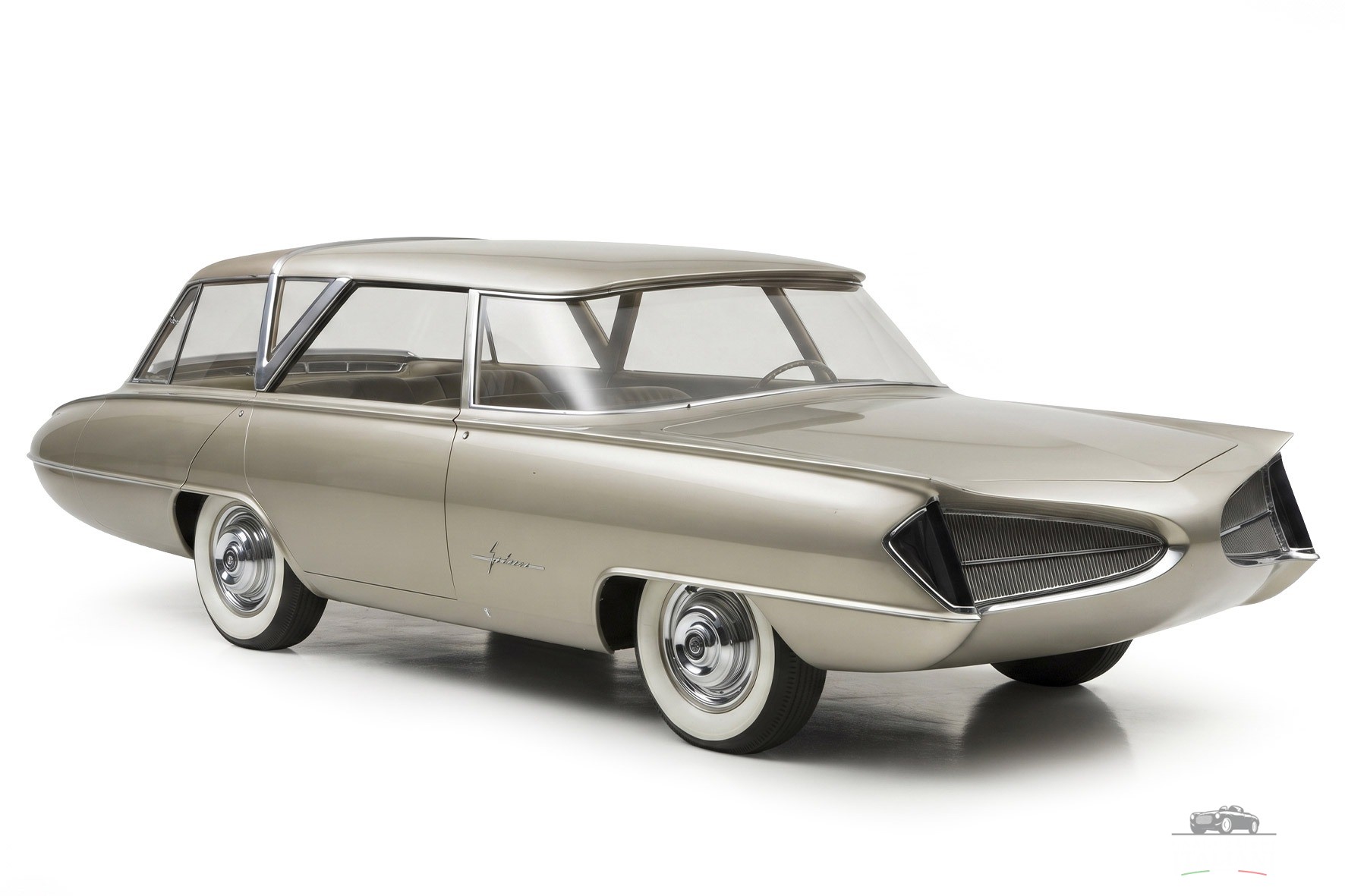
The Ghia Selene I stands out as an audacious and forward-thinking concept car that embodied innovative design trends of the late 1950s. Designed by Sergio Sartorelli, one of Ghia‘s most talented stylists, the Selene I made its debut at the 1959 Turin Motor Show, where it captivated audiences with its unconventional cab-forward layout and futuristic features. The Selene I shared notable similarities with the Renault Project 900 concept, particularly in its radical design philosophy. Both vehicles embraced a cab-forward configuration, which positioned the passenger compartment far forward on the chassis, allowing for a spacious rear area intended for the engine. This unique design made the Selene I appear as if its front and rear ends had been reversed, an effect that further emphasized its groundbreaking approach to automotive styling. The Selene I was designed as a luxurious “people carrier,” capable of seating six passengers. Two occupants sat in the front, while the rear compartment featured four seats facing each other. This lounge-like layout, complete with a strikingly modern interior, was conceived to enhance comfort and promote interaction among passengers. Remarkably, the Selene I was purely a design study, as no engine was ever fitted to the car, underscoring its purpose as an exploration of form and space rather than a functional prototype. Sartorelli’s bold concept left a lasting impression on the automotive design world, influencing future trends in people-focused vehicle architecture. In 1962, Ghia introduced the Selene II, a follow-up design created in collaboration with Tom Tjaarda. This iteration retained the spirit of innovation, featuring a central driving seat with airplane-style controls, a bar-equipped lounge area, and the ability to drive the car from either side thanks to dual steering and instrument setups. Unfortunately, the fate of the Ghia Selene I remains unknown, and it’s unclear whether the concept survived beyond its initial public appearances. Nevertheless, the Selene I remains a testament to Sartorelli’s talent and Ghia’s willingness to push the boundaries of automotive design during a time of exciting experimentation.
02 / TECHNICAL IDENTITY
03 / DESIGN, BODY & SUPPLIERS
Coachbuilder / Design studio
Founded in Turin in 1916, Carrozzeria Ghia became a major Italian design and coachbuilding house, creating bespoke automobiles, prototypes and international collaborations across the twentieth century.
Explore record ↗Attributed designer
Sergio Sartorelli was an Italian automotive designer and engineer associated with Ghia, OSI and Fiat Centro Stile, contributing to Italian car styling from the 1950s onward.
Explore record ↗04 / CHRONOLOGY
07 / GALLERY
THE CONVERSATION
Comments 0